
Opinions
12:28, 01-Jun-2018
Opinion: Is this the end of the Western alliance?
 ["china"]
Share







Copied
Editor’s Note: Liu Mingli is the deputy director of the Institute of European Studies at China Institute of Contemporary International Relations. The article reflects the author’s opinion, and not necessarily the views of CGTN.
On May 31, the last day of temporary tariff exemptions granted by the US, the US government announced its implementation of tariffs on steel and aluminium imported from the EU, Canada and Mexico starting on June 1.
The EU has been a close ally of the US for decades and has made it clear that it should be entitled to permanent exemptions. Following the unexpected announcement, the EU has expressed its disappointment and anger.
The EU trade commissioner Malmstrom said it was a “bad day for world trade.” Juncker, president of the European Commission, declared that the EU would go ahead with plans to impose its own duties on US products.

European Commissioner Cecilia Malmstrom holds a news conference in Brussels, Belgium, March 7, 2018. /Reuters Photo
European Commissioner Cecilia Malmstrom holds a news conference in Brussels, Belgium, March 7, 2018. /Reuters Photo
The tariff issue shows the deep differences between EU-US relations.
First of all, the two sides have different perceptions on bilateral trade. The European Union and the United States are the largest trading partners in the world. Data from the European Commission shows that the trade volume in goods was 532 billion euros in 2017, when the EU exported 375.8 billion euros and imported 256.2 billion euros worth of goods.
According to Donald Trump’s America First philosophy, the US’s trade deficit with the EU, which was 119.7 billion euros last year, makes the EU a major target of high tariffs. The Europeans insist that the EU is not the origin of overcapacity in the steel and aluminium sectors, and that the tariffs cannot be justified on the grounds of national security. Germany, in particular, believes that they sell more goods to the US because their companies are more competitive.
But whether or not the European’s complaints are reasonable, Trump’s administration is not willing to grant the EU the exemption it seeks.
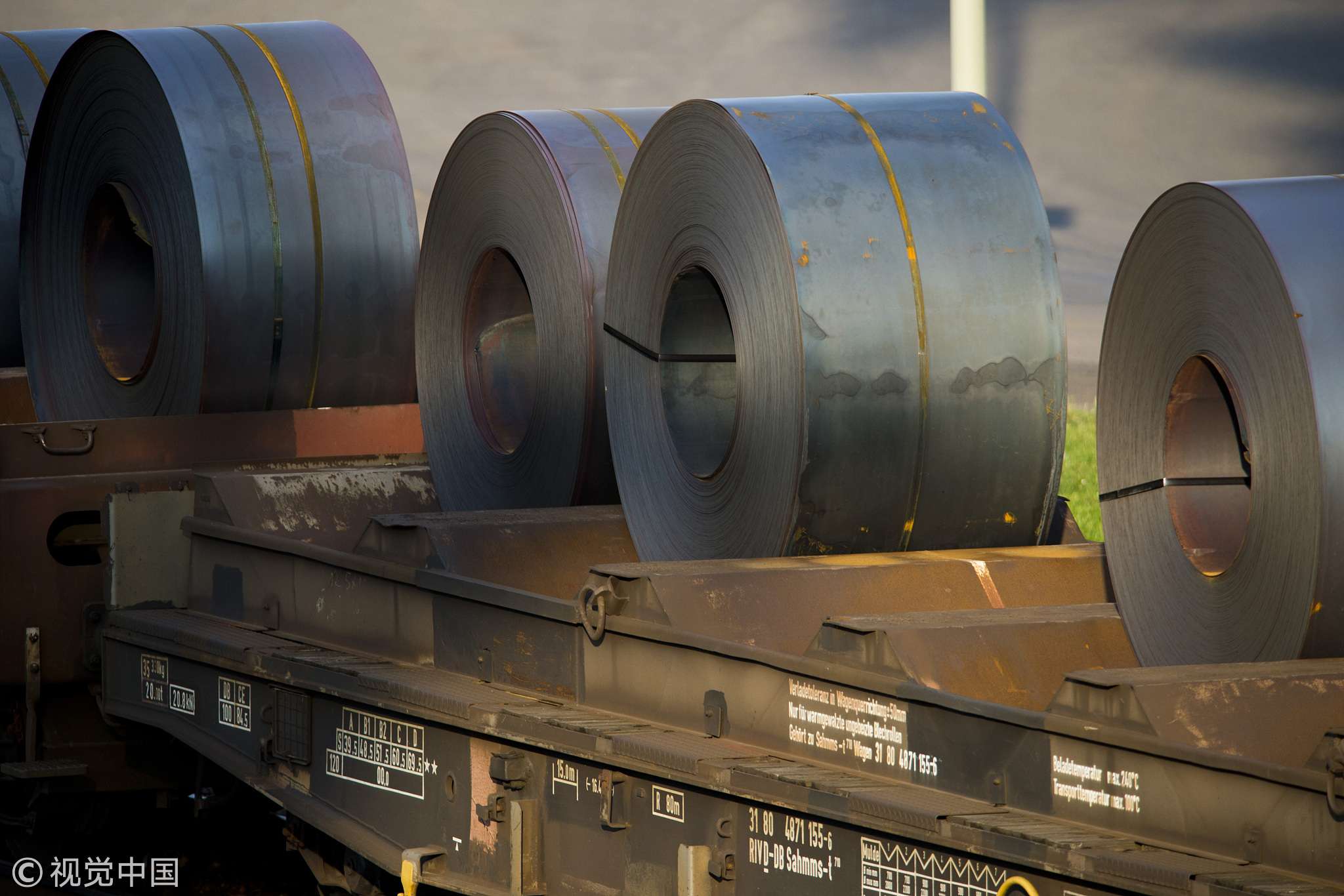
Rail cars loaded with rolled up steel on the site of ThyssenKrupp Schwelgern steel plant on May 30, 2018 in Duisburg, Germany. /VCG Photo
Rail cars loaded with rolled up steel on the site of ThyssenKrupp Schwelgern steel plant on May 30, 2018 in Duisburg, Germany. /VCG Photo
Secondly, trade issues are combined with security ones in transatlantic relations. Security cooperation is a very important part in bilateral relations and differences have been rising since President Trump took office. For example, Trump has been putting pressure on European countries to meet the NATO spending target of 2% of their GDP, which is a tough challenge for European governments who have been taking austerity measures for years after the debt crisis.
The Iran nuclear agreement signed in 2015 is another example, which has been supported by Europe but abandoned by the US. According to President Trump’s previous negotiation tactics, the exemption of tariffs could be a leverage for security issues.
Currently, European countries don't make major concessions for military expenditure or Iran nuclear issues. This could be a reason for why the EU has not been granted with an exemption.
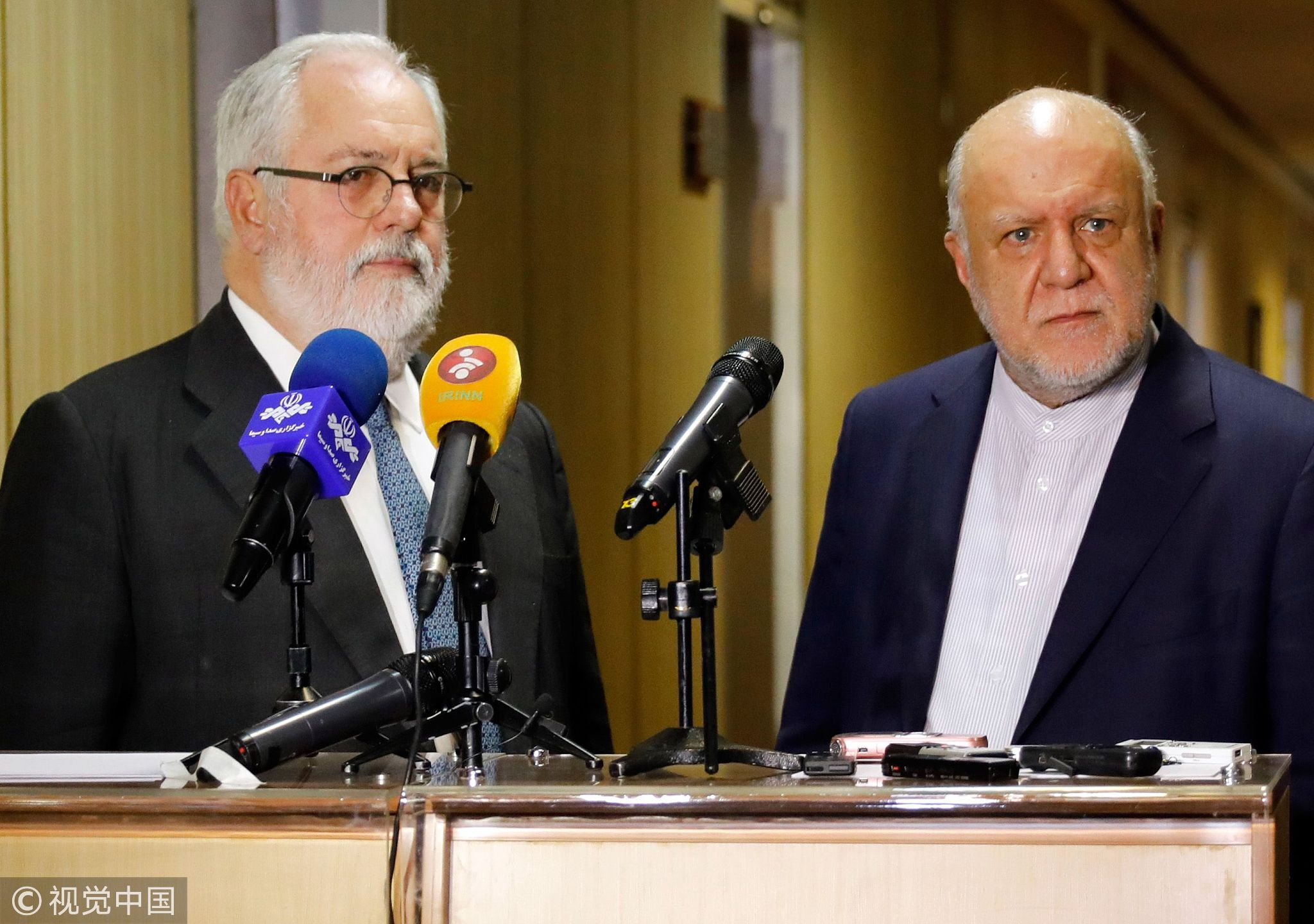
Iranian Oil Minister Bijan Namdar Zanganeh (R) and Miguel Arias Canete, European Union Energy Commissioner, speak to the press after meeting in the capital Tehran, May 19, 2018. /VCG Photo
Iranian Oil Minister Bijan Namdar Zanganeh (R) and Miguel Arias Canete, European Union Energy Commissioner, speak to the press after meeting in the capital Tehran, May 19, 2018. /VCG Photo
Thirdly, it is becoming increasingly difficult to bridge the differences between the "American First" concept and multilateralism. Europeans believe that multilateral institutions which were created after World War Two like the UN, IMF and WTO, brought peace, stability and prosperity to the world.
Multilateral cooperation is still Europe’s preferred approach in dealing with international issues. If the EU was to make principal concessions on tariff issues, it would mean that the EU recognizes Trump’s America First policy and diverges from multilateralism.
To some extent, this signals that the EU has to abandon its values, which is one of the reasons why the EU does not want to negotiate with the US. Rather than acting upon threats, it would rather try to handle the tariff issue within the WTO framework.
In general, transatlantic relations are entering a new era. During the Cold War, Europe followed the US’s lead to secure military protection and stable relations. After the Cold War, Europe sought equality with the US, and ultimately more differences arose between the two sides.
For the time being, the US isn't interested in cooperating with Europe under its America First philosophy, which could spell trouble for the EU's future.