
Culture
08:42, 28-May-2018
'Solo' sputters in takeoff both domestically and internationally
 ["china"]
Share







Copied
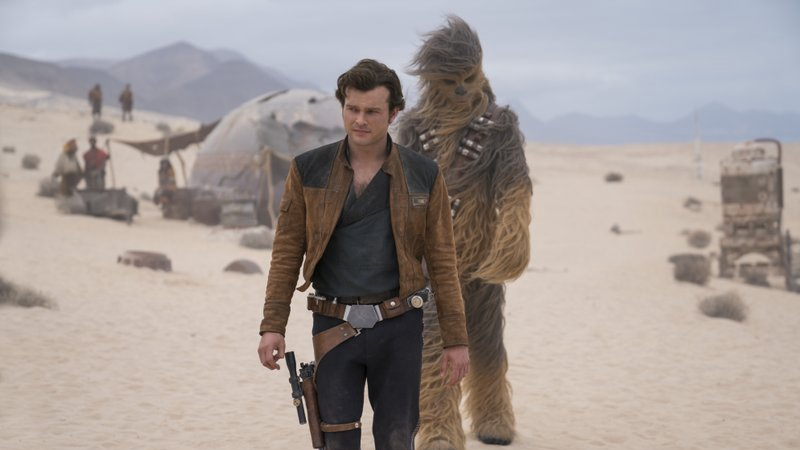
In the largest disturbance yet in Disney’s otherwise lucrative reign over “Star Wars,” the Han Solo spinoff “Solo: A Star Wars Story” opened well below expectations with a franchise-low 83.3 million US dollars in ticket sales over the three-day weekend in North American theaters.
Disney estimated Sunday that “Solo” will gross 101 million US dollars over the four-day Memorial Day weekend, a figure below even the opening weekends of the much-derided “Star Wars” prequels. Last week, forecasts ran as high as 150 million US dollars for the four-day haul of “Solo”.
Overseas ticket sales were even worse. “Solo,” starring Alden Ehrenreich in the role made iconic by Harrison Ford, grossed 65 million US dollars internationally in its opening weekend, including a paltry 10.1 million US dollars in China after it opened here on May 25. However, the Chinese box office take-in did not come as a surprise considering the lack of traction the series has been able to muster over the most recent entries.

The Chinese poster for “Solo: A Star Wars Story” /Photo via Mtime
The Chinese poster for “Solo: A Star Wars Story” /Photo via Mtime
“Of course we would have hoped for this to be a bit bigger,” said Dave Hollis, Disney’s distribution chief. “We’re encouraged by the response that people have had to the film. It got a good CinemaScore (A-minus). The exits are very encouraging.”
The film is also the best opening weekend for veteran director Ron Howard. "Didn't meet projections but mount to a new personal best." Howard wrote on his Twitter.
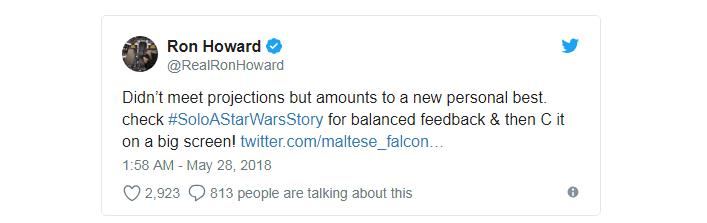
Twitter
“Solo” came in with a Millennium Falcon’s worth of baggage following the mid-production firing of directors Phil Lord and Christopher Miller, who were replaced by Ron Howard. With the rejiggered production, the budget soared well past 250 million US dollars.
But the cause of the spinoff’s disappointing performance may have had as much to do with “Star Wars” fatigue (“The Last Jedi” exited theaters just last month) and the stiffer competition of a summer holiday weekend. While no major releases dared to open against “Solo,” Fox’s “Deadpool 2" moved its release date up a week ahead of “Solo.”
The gambit may have hurt both releases. After debuting with 125 million US dollars last weekend, the R-rated Ryan Reynolds sequel dropped 66 percent to second place with 42.7 million US dollars and an estimated 53.5 million dollars four-day haul.
“Solo” notched the biggest Memorial Day weekend opening in several years, but it also came on the heels of a pair of summer-sized blockbusters – “Deadpool 2" and Disney’s own “Avengers: Infinity War” – making for an unusually crowded May. “Infinity War” added 16.5 million US dollars in its fifth weekend to bring its domestic total to 621.7 million US dollars and its global sales to 1.9 billion US dollars – both among the highest of all time.
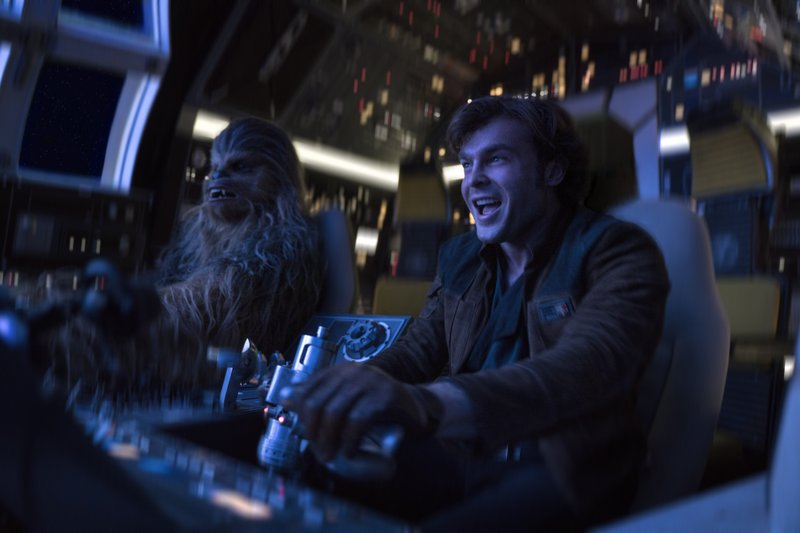
In this image released by Lucasfilm, Alden Ehrenreich, right, and Joonas Suotamo appear in a scene from “Solo: A Star Wars Story.” /Jonathan Olley/Lucasfilm via AP
In this image released by Lucasfilm, Alden Ehrenreich, right, and Joonas Suotamo appear in a scene from “Solo: A Star Wars Story.” /Jonathan Olley/Lucasfilm via AP
“It is a business that is built on momentum but also one where people probably are only able to get to theaters a certain number of weeks in a row,” said Hollis.
But there were also questions beyond the effect the calendar had on “Solo.” While reviews were generally positive (71 percent “fresh” on Rotten Tomatoes), there was little about “Solo” that made the movie a must-see event.
Fans were skeptical of Ehrenreich and uncertain about the dismissal of Lord and Miller (the popular filmmaking duo behind “21 Jump Street” and “The Lego Movie”). Unlike any “Star Wars” release before, “Solo” was deemed skippable.
While the original “Star Wars” films helped define the summer moviegoing experience, Disney released their previous three “Star Wars” films in December. What most hurt “Solo” was the “fatigue factor” of a May “Star Wars” film following a December one, said Paul Dergarabedian, senior media analyst for comScore.
“It’s the compressed timeframe between the two ‘Star Wars’ films and the highly competitive nature of this marketplace. It is summer, after all,” said Dergarabedian. “The good news is that the next film isn’t until December 2019. That’s plenty of breathing space. I think part of the allure of the ‘Star Wars’ brand in the past has been the long wait.”
That time might also be valuable for Lucasfilm and Disney to find a way to counter the diminishing returns of its multi-billion-dollar franchise. To help propel “Solo” internationally, Disney brought the film to Cannes Film Festival, flooding the French film festival’s red carpet with Storm Troopers.
“The Last Jedi” also flopped in China (it was pulled out from theaters after a week), and Rian Johnson’s movie – even though it grossed 1.3 billion US dollars worldwide – showed relatively weak legs at the box office, while proving divisive among “Star Wars” die-hards.
The magic around a “Star Wars” film may be fading. To right the ship on Episode 9, Lucasfilm has turned to an old friend: “The Force Awakens” director J.J. Abrams. He, too, is replacing a fired director after Colin Trevorrow departed last fall.
(With input from AP)