
Politics
23:17, 15-Aug-2018
Andrew Brunson, the pastor behind US-Turkey tensions
Updated
22:56, 18-Aug-2018
 ["china"]
Share






Copied
Not long ago, the relationship between US President Donald Trump and Turkey's Recep Tayyip Erdogan was flourishing. In June, the former congratulated the latter for being re-elected as the country's top leader. But shortly after that, things began heading south.
In just two months, the relationship between the two NATO allies soured, hitting their lowest levels in years.
Last Friday, Trump announced the doubling of tariffs on Turkey's aluminum and steel, causing the already struggling lira to further depreciate.
Read more:
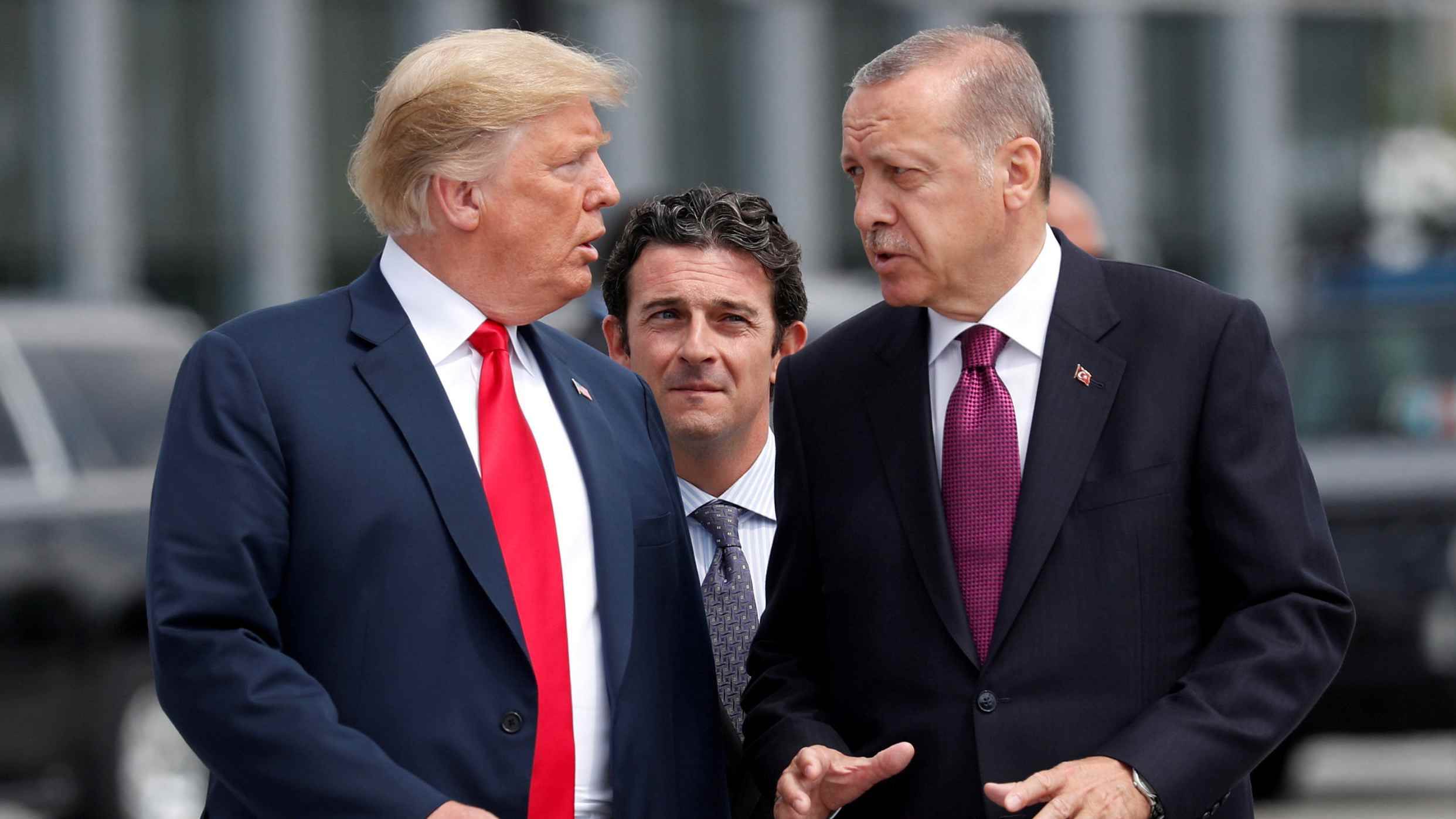
US President Donald Trump (L) and Turkish President Recep Tayyip Erdogan talk at the start of the NATO summit in Brussels, Belgium, July 11, 2018. /VCG Photo
US President Donald Trump (L) and Turkish President Recep Tayyip Erdogan talk at the start of the NATO summit in Brussels, Belgium, July 11, 2018. /VCG Photo
"You act on one side as a strategic partner, but on the other, you fire bullets into the foot of your strategic partner," Erdogan said during a conference in the Turkish capital Ankara.
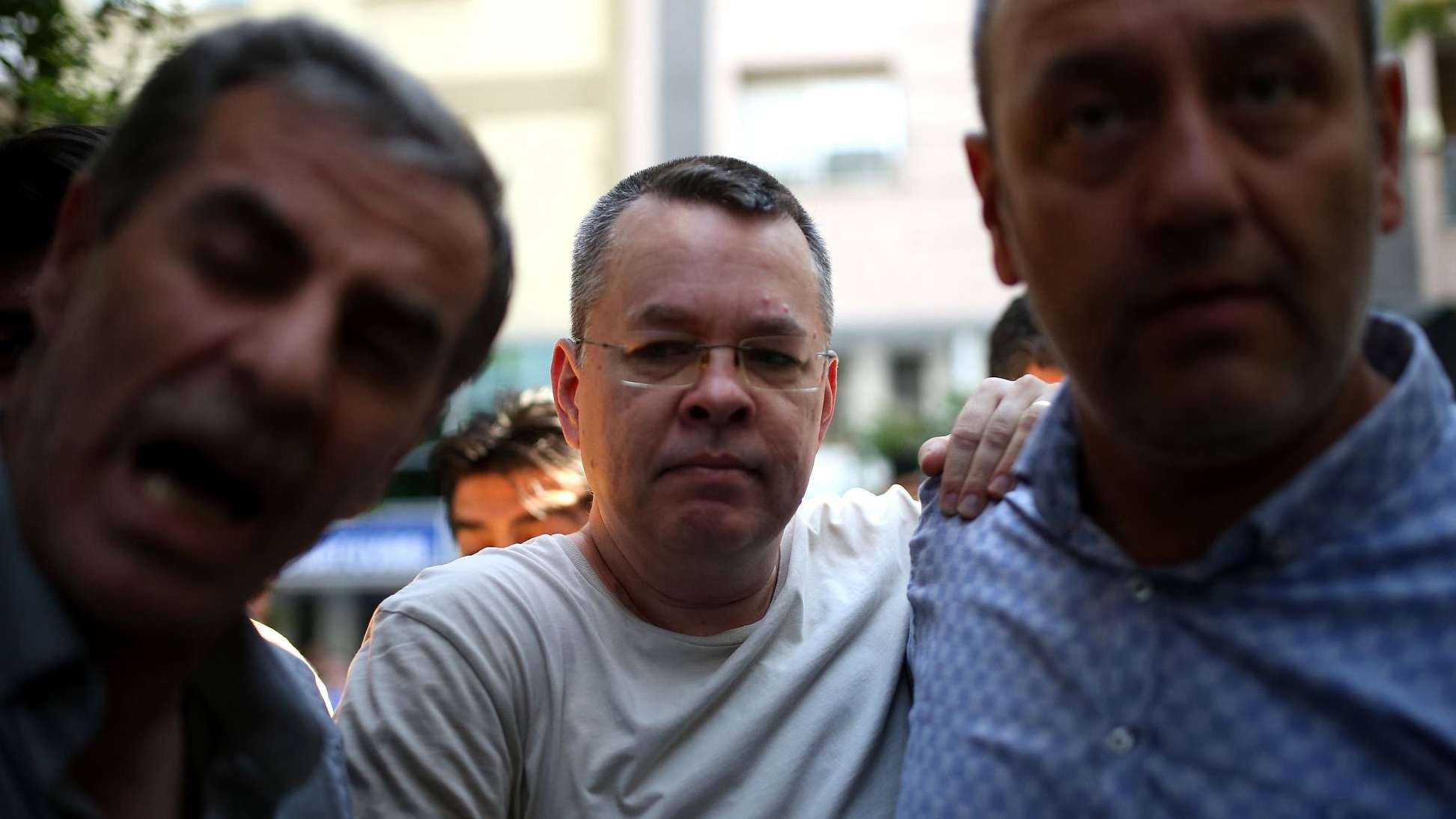
At the center of the current standoff between Ankara and Washington is a US evangelical pastor who is under house arrest in Turkey. For Turkish authorities, Andrew Brunson is a spy with links to a 2016 coup attempt. But the US side sees him as an "innocent" Christian who is being wrongly accused and detained.
Who is Andrew Brunson?
The 50-year-old, a North Carolina native, is a pastor of the small Izmir Resurrection Church, leading about two dozen followers, according to the BBC. He has been in Turkey with his wife and children for over 20 years.
Brunson was arrested in 2016, and accused of having connections to the outlawed Kurdistan Workers' Party (PKK) and Pennsylvania-based Muslim preacher Fethullah Gulen, which Turkey blames for a failed coup attempt the same year.
Brunson, who denies all charges, has been placed in detention since. He could face up to 35 years in jail for espionage if convicted.
"He appears to be held simply because he's an American citizen who as a man of faith was in contact with a range of people in this country who he was trying to help, in keeping with his faith," US Ambassador to Turkey John Bass said in October last year.
US Secretary of State Mike Pompeo tweeted last month, saying "We have seen no credible evidence against Mr. Brunson."
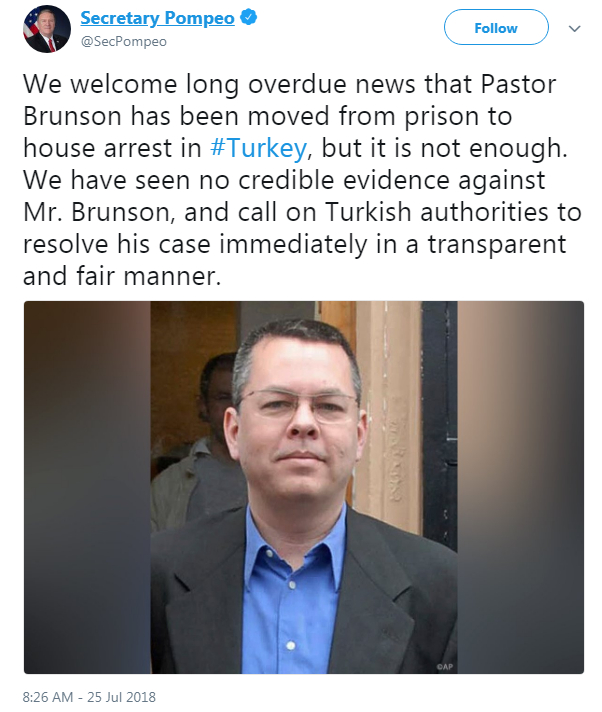
Screenshot of a tweet by US Secretary of State Mike Pompeo
Screenshot of a tweet by US Secretary of State Mike Pompeo
Brunson is now under house arrest with an electronic monitoring device, due to "health problems" following a Turkish court decision.
US sanctions against Turkey
Calling Brunson "innocent" and "a great Christian, family man and wonderful human being," Trump threatened on July 26 that "large sanctions" will be imposed against Turkey if Brunson was "not released immediately."
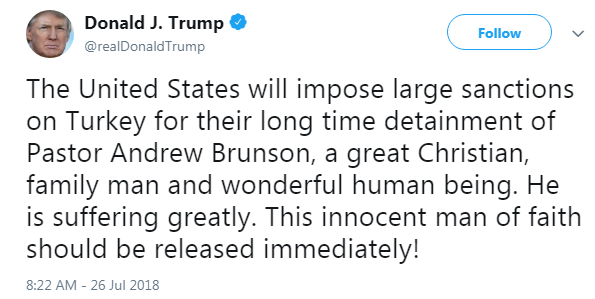
Screenshot of a tweet by US President Donald Trump
Screenshot of a tweet by US President Donald Trump
"Release Pastor Andrew Brunson NOW or be prepared to face the consequences," Vice President of the US Mike Pence – also an evangelical Christian – wrote on twitter just hours later.
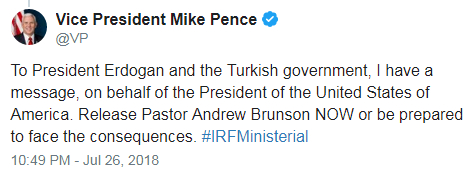
Screenshot of a tweet by US Vice President Mike Pence
Screenshot of a tweet by US Vice President Mike Pence
Almost a fortnight later, Trump authorized the doubling of tariffs on steel and aluminum from Turkey, which included a 20 percent duty on aluminum and 50 percent on steel.
"Our relationship with Turkey are not good at this time," Trump wrote on Twitter last Friday.
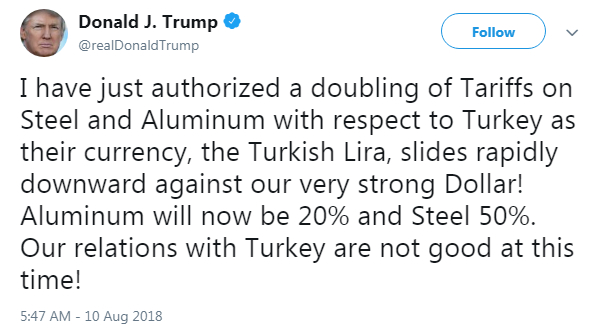
Screenshot of a tweet by US President Donald Trump
Screenshot of a tweet by US President Donald Trump
Right after the announcement, the Turkish lira crashed 19 percent to 6.6 against the US dollar, then fell even further to an all-time low of 6.87 against the greenback, shedding almost 24 percent of its value.
Sanctions were also placed against two Turkish ministers.
"At the president's direction, the Department of the Treasury is sanctioning Turkey's minister of justice and minister of interior, both of whom played leading roles in the arrest and detention of Pastor Brunson," White House spokeswoman Sarah Sanders said.
Turkey hits back
"We are together in NATO and then you seek to stab your strategic partner in the back. Can such a thing be accepted?" Erdogan asked on Monday in Ankara.
Calling Trump's tariff sanctions a "political plot," the Turkish president said Turkey could look to other partners. He termed the crisis as an "economic war."
"We will give our answer, by shifting to new markets, new partnerships and new alliances, to the one who waged an economic war against the entire world and also included our country," Erdogan said.
“You dare to sacrifice 81-million Turkey for a priest who is linked to terror groups?"
On Wednesday, Turkey announced its decision to increase tariffs on a series of US imports including passenger cars, alcohol, tobacco, rice and coal, as the country' official Gazette reported.
The decree, signed by Erdogan, raised the tariffs on passenger cars by 120 percent, on alcoholic drinks by 140 percent and on leaf tobacco by 60 percent.
On Tuesday, the Turkish president said Turkey would boycott electronic products from the US.
"If (the United States) have the iPhone, there's Samsung on the other side," he said.
Read more:
Multiple factors
While Brunson is at the core of the ongoing crisis, his case is not the only factor that has been souring the relations between the two countries. Here are some of the issues ratcheting up tensions:
Iran issue:
The Trump administration announced its decision to withdraw from the Joint Comprehensive Plan of Action (JCPOA) in May, and later imposed a series of sanctions against the Islamic republic.
However, Turkey and Iran have close economic ties. Turkey imported more than three million tons of crude oil from Iran in the first four months of 2018, accounting for 55 percent of Turkey's total crude imports.
Syria issue:
Turkey has threatened in February to attack US-allied Kurdish forces in Manbij, northern Syria, whom Ankara regards as terrorists.
In response, a top US general said his forces would "respond aggressively" to any Turkish-backed attack.
Four months later, the two sides agreed on a plan to withdraw Kurdish fighters from the northern Syrian city of Manbij as to "resolve" the tension, temporarily at least.