
Analysis
21:39, 04-Mar-2019
Canada and U.S. breach human rights for political gains
 ["china"]
Share







Copied
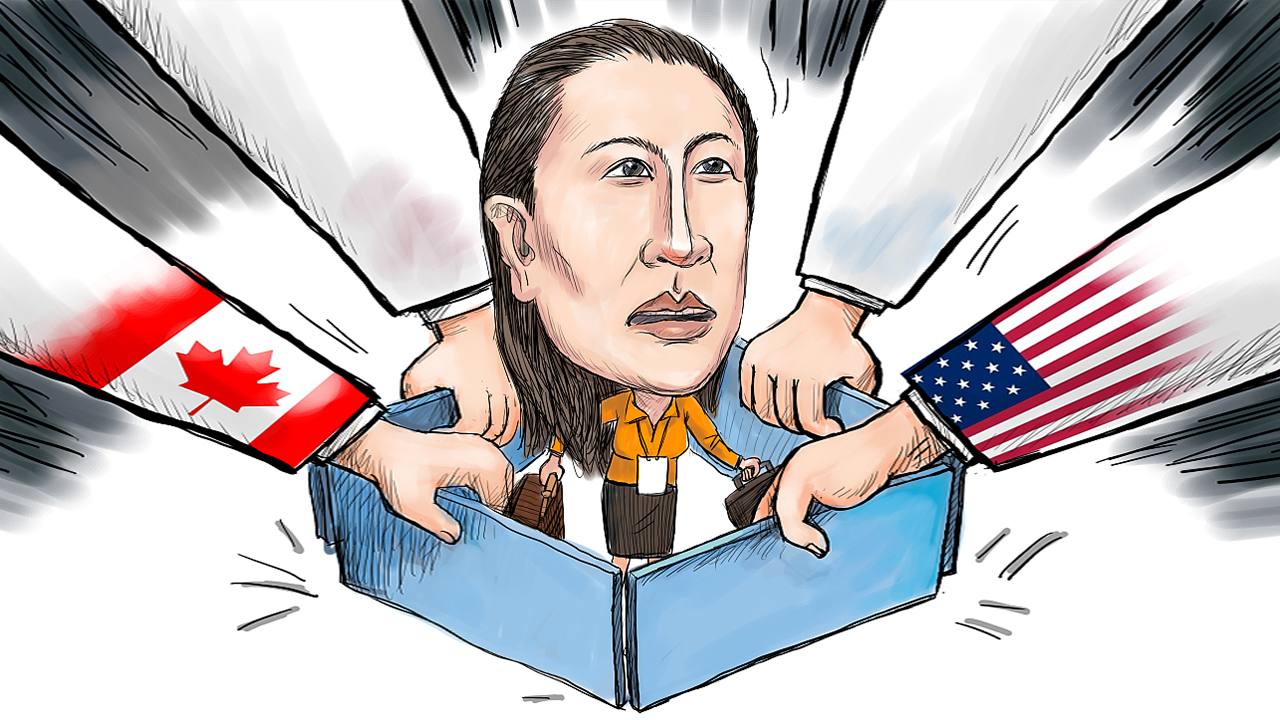
Days after Ottawa approved the extradition proceedings, Huawei CFO Meng Wanzhou launched a counterstrike, filing a civil suit against the Canadian government, the national police force and the border agency for “serious violations” of her constitutional rights.
Canadian authorities were alleged to have interrogated Meng “under the guise of a routine customs” examination and seized Meng for three hours before informing her of the arrest.
“This case concerns a deliberate and pre-meditated effort… to obtain evidence and information from the plaintiff in a manner which they knew constituted serious violations of plaintiff's rights,” the Guardian quoted the claim as saying.
“Instead of immediately arresting Meng, Canadian authorities detained, searched and interrogated the innocent plaintiff for hours. This is undeniably a violation of Meng's personal freedom,” Kong Qingjiang, dean of the School of International Law under China University of Political Science and Law, told CGTN, adding that “as a ‘bastion of freedom and democracy,' Canada is wantonly breaching Meng's basic human rights for political ends.”
Apart from illegally interrogating Meng, Ottawa's approval of the extradition hearing, according to Kong, is also a contravention of the double criminality doctrine.
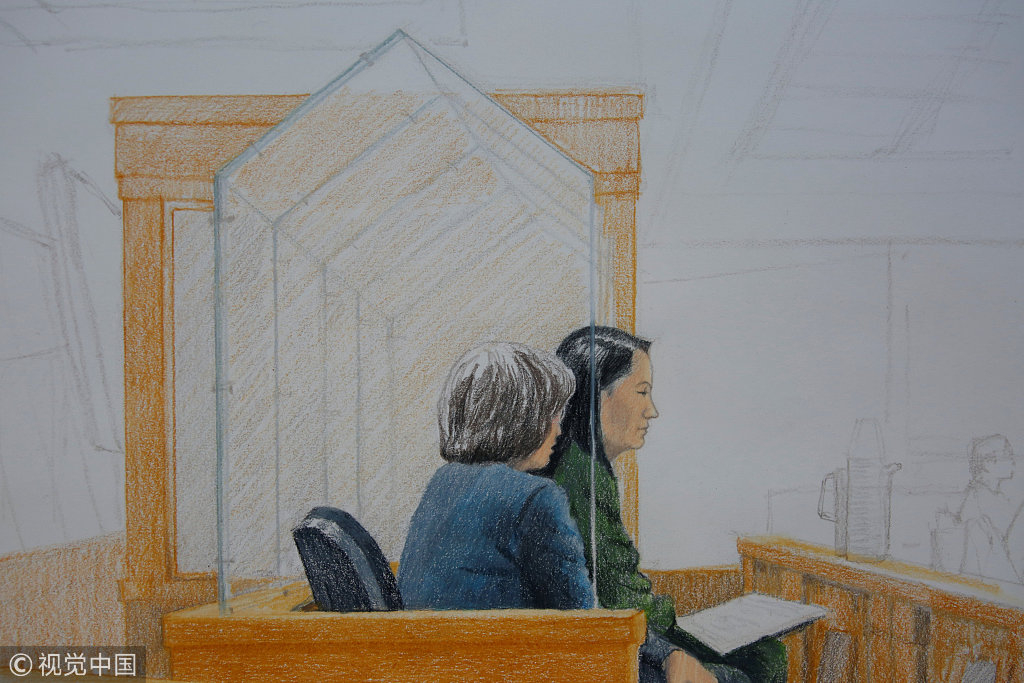
Huawei CFO Meng Wanzhou, who was arrested on an extradition warrant, appears at her B.C. Supreme Court bail hearing in a drawing in Vancouver, British Columbia, Canada, December 7, 2018. /VCG Photo
Huawei CFO Meng Wanzhou, who was arrested on an extradition warrant, appears at her B.C. Supreme Court bail hearing in a drawing in Vancouver, British Columbia, Canada, December 7, 2018. /VCG Photo
“Under the Canadian Extradition Act and the U.S.-Canada Extradition Treaty, the conduct must be considered criminal both in the United States and in Canada before extradition is sought,” Kong said.
Meng is innocent of any wrongdoing. Canada is apparently pursuing political gains at the sacrifice of its judicial independence. A judicial-independent country would have immediately released Meng in accordance with its law, but Ottawa, unwilling to offend Washington, had no alternative but to proceed with Meng's extradition.
“Whether Meng will be extradited to the United States is still early to predict at the current stage,” Wang Yong, a professor at the School of International Studies and director of the Center for International Political Economy at Peking University, told CGTN, stressing that “Meng's case is a serious political incident.”
“The Donald Trump administration is using state power to prosecute a Chinese high-tech company, and the outcome of Meng's hearings will, to a large degree, depend on Sino-U.S. trade talks,” said Wang.
Since the outbreak of the trade fight, the Chinese telecommunications giants including Huawei and ZTE have been used as a bargaining chip at the negotiation table. After months of talks, Trump is eager to clinch a deal with China. This, according to Wang, means that the United States may soften its Huawei stance.

Logo of Huawei. /VCG Photo
Logo of Huawei. /VCG Photo
Earlier, Trump said on Twitter: “I want the United States to win [in 5G technology] through competition, not by blocking out currently more advanced technologies.” Although Trump did not name Huawei, the tweet is widely believed as Washington's olive branch to China.
A fundamental accord with the world's second-largest economy is undeniably a diplomatic victory for the GOP, an essential tool to woo more voters ahead of the 2020 presidential election and the most convenient way to save Trump out of the political quagmire. A friendlier Huawei policy is seen by many as a prerequisite to the deal.
Moreover, given its irreplaceable status in 5G technology, sanctioning Huawei and its CFO would bring the United States more losses than gains. Compared with Huawei's equipment, those from Ericsson, Samsung and Nokia are less efficient but more expensive.
Furthermore, most of Huawei's chip providers are from the United States, for instance, HiSilicon Technologies and Qualcomm. “An upset in this supply chain would strike a heavy blow to American high-tech companies,” Wang warned.
Given the above, the U.S. would shoot itself in the foot if it insists on tough measures on Meng. In the era of global integration, cooperation, instead of dirty political tactics, is the solution to long-term growth and stability.
(If you want to contribute and have specific expertise, please contact us at opinions@cgtn.com.)