
Opinion
20:48, 03-May-2019
Prompt steps needed for growing anti-Semitism in the U.S.
 ["china"]
Share






Copied
Editor's note: Yu Feng is an assistant research fellow at the Institute of American Studies of Chinese Academy of Social Sciences. The article reflects the author's opinion, and not necessarily the views of CGTN.
American Jews were shocked by two recent incidents. On April 27, 2019, 19-year-old John Earnest opened fire at a synagogue in the city of Poway, California, on the last day of Passover, killing one and injuring three.
The incident is considered a hate crime against Jewish people, as police found an “open letter” detailing the shooter's hatred towards Jews circulating online before the shooting happened.
Coincidentally, The New York Times published an offensive anti-Semitic cartoon in its international version on the same day, showing President Trump wearing a Jewish yarmulke and walking a dog representing the Israeli Prime Minister on a leash with a Jewish Star of David.
The two incidents happened exactly six months after the deadliest attack on Jews in U.S. history, the massacre at the Tree of Life synagogue in Pittsburgh in which Robert Bowers killed 11 people, yelling “All Jews must die!” They reminded American Jews of one stunning fact: there is a trend of growing hostility towards Jewish people.
Anti-Semitism has never been new in the United States. In the 19th century, Jews were once considered as a threat to the hard-working American people due to their stereotype of being affluent and cunning.
Since the Civil Rights Movement, along with the general reduction of racism in the United States, mainstream attitudes towards Jews in the U.S. has generally become more positive.
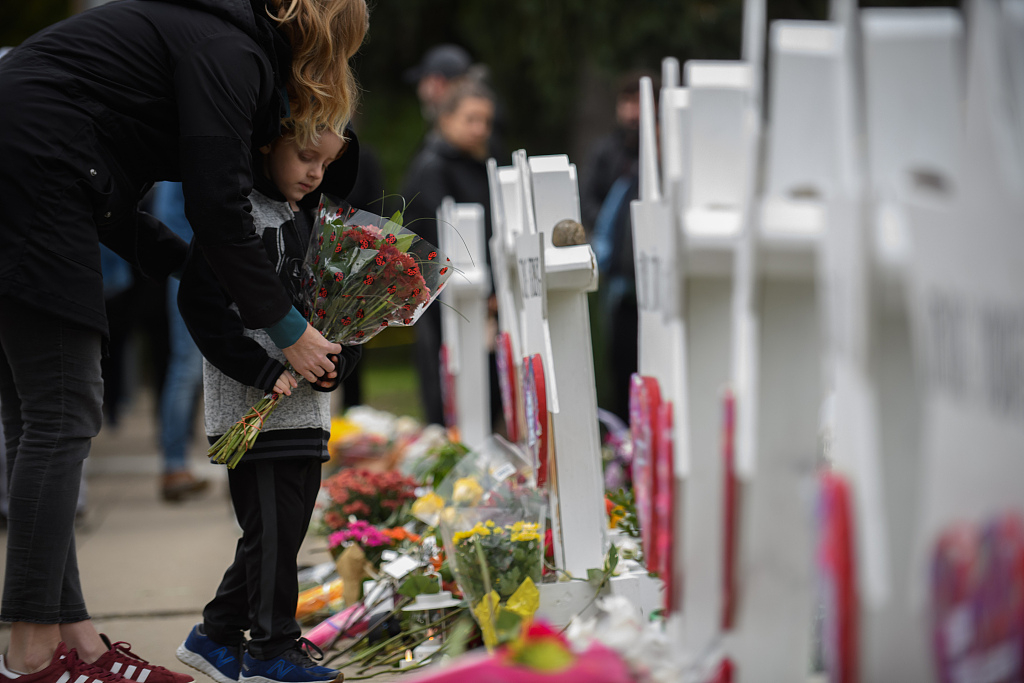
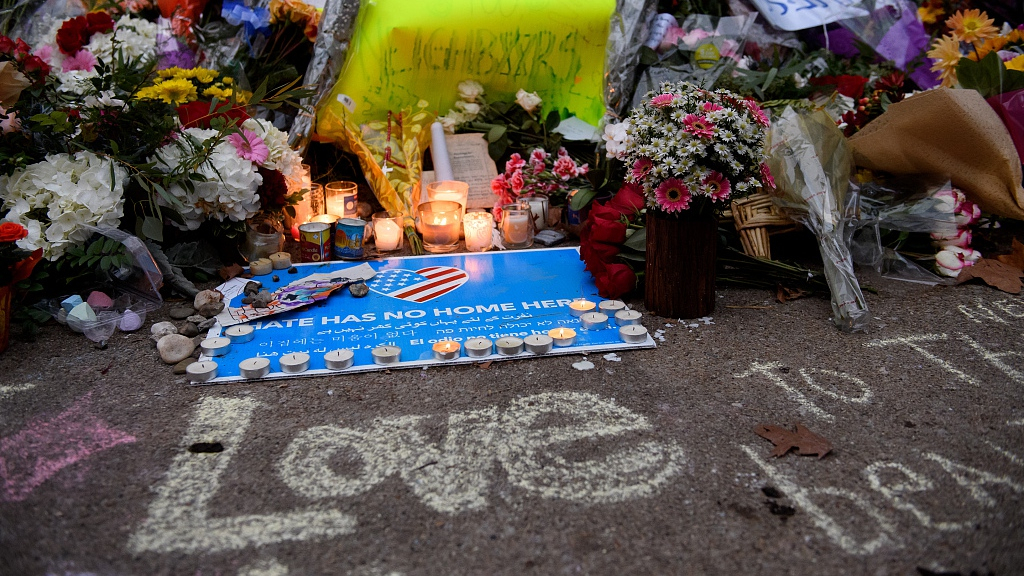
Flowers are placed at a memorial for victims of the mass shooting that killed 11 people and wounded 6 at the Tree Of Life Synagogue in Pittsburgh, Pennsylvania, October 29, 2018. /VCG Photo
Flowers are placed at a memorial for victims of the mass shooting that killed 11 people and wounded 6 at the Tree Of Life Synagogue in Pittsburgh, Pennsylvania, October 29, 2018. /VCG Photo
However, things started to change years ago, especially during the Trump administration. A survey conducted by Pew Research Center in March 2019 found a sharp rise in the share of Americans saying Jews face discrimination since 2016.
The ADL (Anti-Defamation League), an international organization which aims to stop the defamation of Jewish people, has tracked incidents of anti-Semitic harassment, vandalism and assault in the United States since 1979.
It found that anti-Semitic incidents surged nearly 60 percent in 2017, marking the largest single-year increase on record and the second highest number reported since 1979. While the overall number of incidents in 2018 is five percent lower than in 2017, it still remained at near-historic levels.
The trend of growing anti-Semitism in the United States can be attributed to a combination of factors.
Rising anti-Semitism in America now is just a demonstration of worsening racism there, which to a large extent should be ascribed to the influence of extremist groups, especially the far-right groups (including Neo-Nazis and white supremacists).
According to 2018 ADL Audit, extremist groups or individuals inspired by extremist ideology were responsible for 13 percent of anti-Semitic incidents in 2018, which marked the highest level since 2004. Far-right groups such as Patrick Little propagated anti-Semitic conspiracy theories, attracting many followers and even inspiring hate crimes against Jews in America.
Besides, President Trump's reckless rhetoric and his tolerance for white nationalism have promoted anti-Semitism. During his campaign in 2016, Trump re-tweeted messages from anti-Semitic supporters and defamed Hilary Clinton through implicating her unlawful connections with rich Jews in America.

U.S. President Donald Trump makes a statement for the press while meeting with members of the 2019 NCAA Division I champion at the White House in Washington, DC, April 29, 2019. /VCG Photo
U.S. President Donald Trump makes a statement for the press while meeting with members of the 2019 NCAA Division I champion at the White House in Washington, DC, April 29, 2019. /VCG Photo
After he took office, the White House didn't mention Jews or anti-Semitism on Holocaust Remembrance Day in 2017. When the race riot in Charlottesville took place, President Trump failed to strongly rebuke the neo-Nazis who chanted “Jews will not replace us” while marching.
All these have fanned the flames of the anti-Semitic groups, encouraging them to freely express their hatred towards Jews and even commit hate crimes.
Furthermore, social media has made it cheaper and easier for far-right groups to spread their anti-Semitic conspiracy theories and attract followers, which consequently intensified anti-Semitism in the United States.
Online platforms, from fringe web communities, such as 8chan, 4chan and Gab, to mainstream networks, such as Facebook and Twitter, have now become perfect sites for anti-Semitic propaganda and the breeding ground for violence against Jews in real world.
In the case of the Pittsburgh shooting, Bowers was inspired by white supremacy and hate against Jews on Gab. In the Poway shooting, Earnest was inspired by 8chan's anti-Semitic views and comments and the massacre at two mosques in Christchurch, New Zealand, last month.
Last but not the least, the growing anti-Semitism in the United States has placed its roots in the economic recession since 2008. Anti-Semitism usually increases when the United States encounters a serious economic crisis for that's generally when Christian nationalism surges.
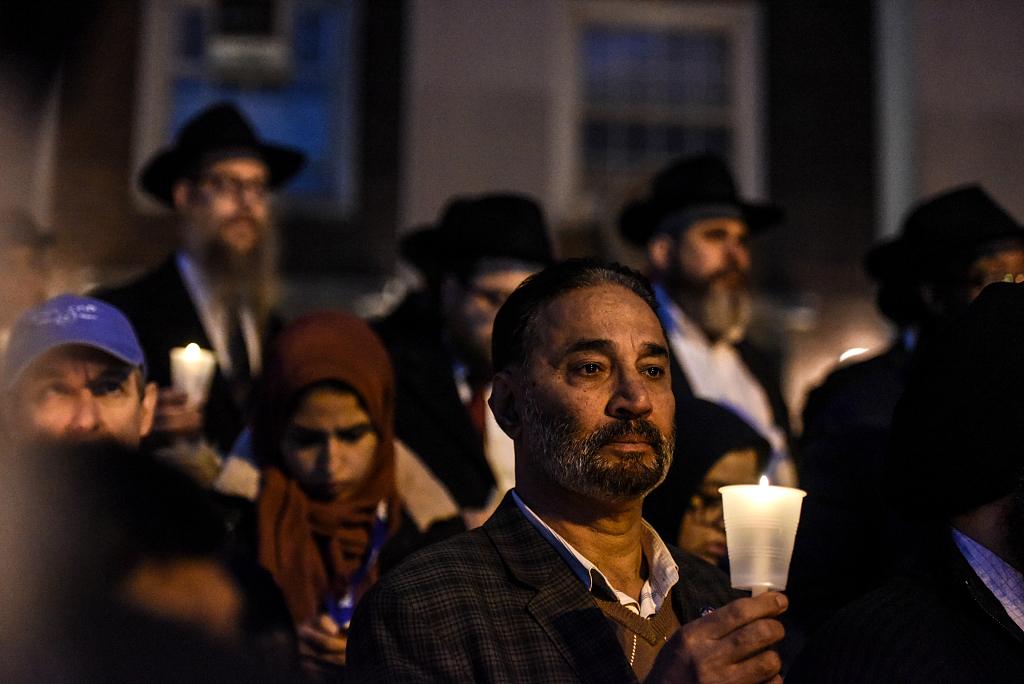
People participate in a candlelight vigil in memory of the victims of the mass shooting at the Tree Of Life Synagogue on the steps of Queens Borough Hall in New York City, October 29, 2018. /VCG Photo
People participate in a candlelight vigil in memory of the victims of the mass shooting at the Tree Of Life Synagogue on the steps of Queens Borough Hall in New York City, October 29, 2018. /VCG Photo
Known as a melting pot, the nation was integrated by the American creed of liberty, equality and justice. However, political ideology can never make nation-states. With the unemployment and underemployment of many whites, especially those of lower education, America was torn apart.
Fear of replacement, ordinary American whites tended to blame immigrants and minority ethnic groups for their worsening livelihood. White nationalism, Christian nationalism and protectionism revisited and degenerated into far-right extremism.
With many prominent Jews on corporate boards, Wall Street and even political arena, ordinary American whites became jealous and dissatisfied, which made them susceptible to the conspiracy theories about the increasing Jewish control in government, business and media throughout the country.
The rising anti-Semitism in the United States is real. It was directly caused by the growing influence of far-right ideology including white nationalism, white supremacy and neo-Nazism which had its roots in the economic recession of the country and was boosted by the tolerance of the Trump administration and the facility of social media. It is not only a noteworthy problem to American Jews.
Along with the worsening racial situation and deepening partisan division, it has constituted potential threats to the stability and democratic mechanism of the country, which may require the U.S. government to take prompt actions now.
(If you want to contribute and have specific expertise, please contact us at opinions@cgtn.com.)