
Opinions
14:08, 09-Jul-2018
Opinion: Population aging in China: What's the response?
Updated
13:12, 12-Jul-2018
 ["china"]
Share







Copied

Editor's note: Zheng Zhenzhen is a professor of the Institute of Population and Labor Economics under the Chinese Academy of Social Sciences. The article reflects the author's opinions, and not necessarily the views of CGTN.
As World Population Day falls on Wednesday this year, the international community is focusing on how to deal with the scenario an aging population has brought to the developed world and many emerging economies. For China, a country that has experienced dramatic socio-economic changes over the past decades, this problem has become increasingly exacerbated.
In China, the proportion of the elderly population aged 65 or above was 11.4 percent in 2017, or about 158 million. The figure is estimated to reach 25 percent by 2030; by then, China will be blighted by depopulation.
The aging of the population is a global trend in the 21st century, but the process in China is progressing at a faster rate than many other countries. The major driving forces of aging lie in low fertility rates and greater longevity, as well as fertility and mortality changes in the past decades. The persistently low fertility plays a key role in the speed of population aging.
However, studies show that any possible change in fertility rates would not slow down the process significantly.
Concerns about the negative consequences of population aging are often about economic ramifications due to aging of the labor force and labor shortage, about the ability to support the elderly on social welfare, health care, and daily care. China will inevitably face these challenges soon. Although there are different opinions and estimations about the impact of an aging population, becoming prepared is the common consensus.
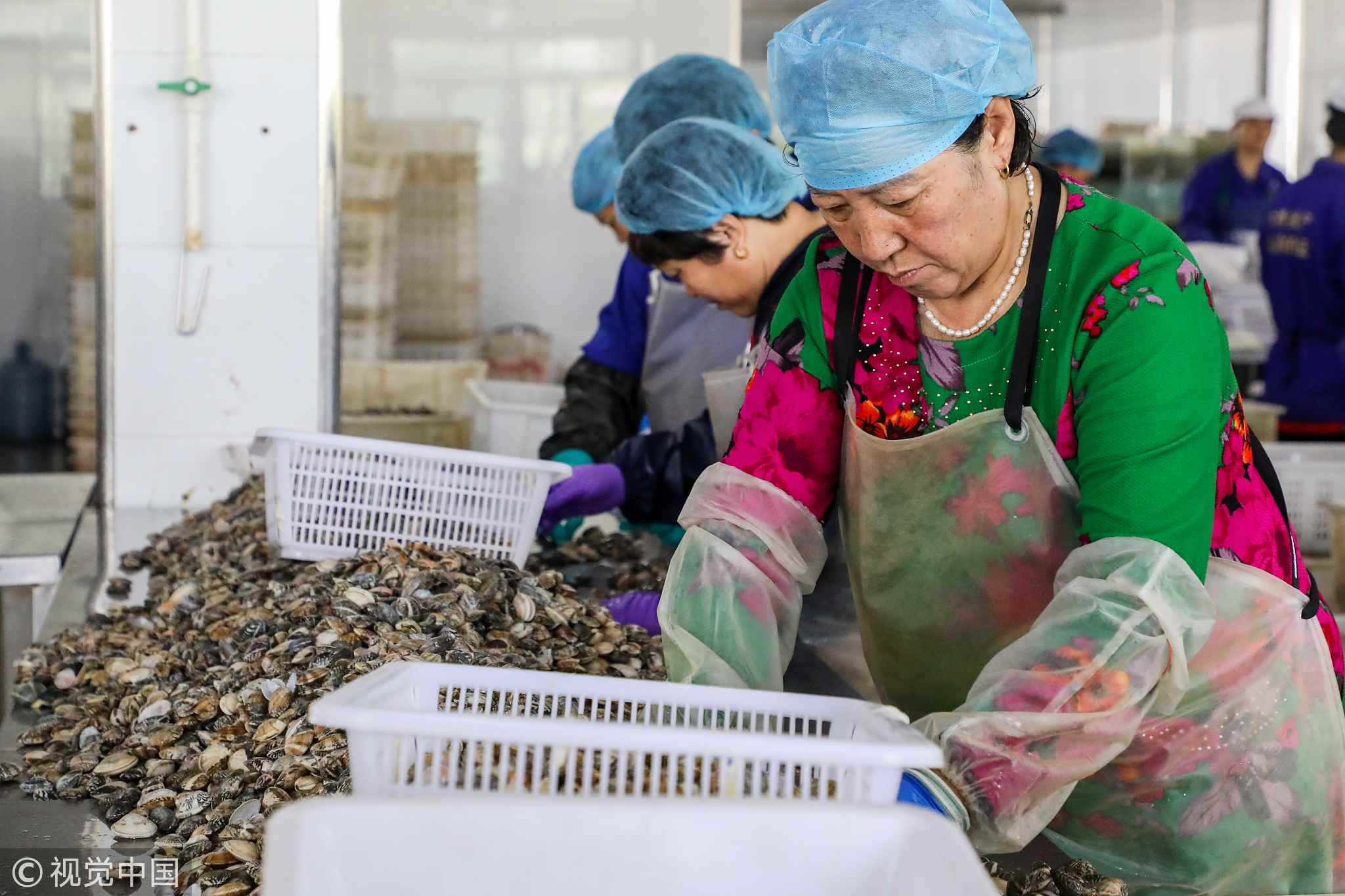
Women aged around 60 are processing clams in Dadong City, northeast China's Liaoning Province, June 9, 2017. /VCG Photo
Women aged around 60 are processing clams in Dadong City, northeast China's Liaoning Province, June 9, 2017. /VCG Photo
China is confronted with multiple challenges not only brought about by population aging, but also by its associated effects, such as changes in family size, structure, urbanization and migration, as well as other socio-economic factors.
To address the possible challenges and to remedy these negative consequences, the Chinese government has taken action, especially in the last decade. For example, the first five-year development plan on aging (2011-2015) focused on such issues as medical insurance and pension system reform, non-communicable disease prevention, as well as policy support and community capacity building for elderly care, to name a few.
Many community daycare or activity centers for elderly people have been established in cities in recent years, development of a long-term care insurance system is on the way, and enterprises related to elderly care or services have boomed since 2016.
As senior citizens live longer and healthier, utilizing and mobilizing human resources of the elderly is another important issue that seems to be overlooked somehow, although promoting their social participation has been mentioned in the development plan as well as other related governmental documents.
Making this idea work requires many changes to existing institutions, such as the pension and employment system, and also changes in the culture and values about the elderly (as we used to believe that being a certain age is good for doing certain things). We could also learn from the experiences or lessons of many other countries that are already "old."