
Opinion
21:21, 19-May-2019
Sino-Australian ties: Protracted security concerns, robust economic ties
Updated
22:30, 19-May-2019
 ["china"]
Share







Copied
Editor's note: The article is based on an interview with Chen Xiangmiao, a research fellow at the National Institute for the South China Sea and also an expert on Asian-Pacific security issues. The article reflects the author's opinion, and not necessarily the views of CGTN.
The security frictions between Australia and China may remain as Scott Morrison, Australia's conservative Prime Minister and leader of the Liberal Party, landed a surprise victory in Australia's federal elections on Saturday, defeating the once strong competitor Bill Shorten, the leader of the center-left Labor Party.
Shorten, who was regarded as the front-runner in the just-concluded election to be Australia's next prime minister, holds a more friendly attitude toward China than his rival Morrison. During the election process, it was reported that Shorten's Labor Party was considering dealing with Australia's frictions with China over security issues, hoping for a better bilateral relationship.
Now with Morrison continuing to serve as Australia's Prime Minister, the two countries' frictions over security may continue and not be solved shortly. "Morrison will follow the U.S. pace over the 'China threat' theory and continue his party's previous tough stance over China in the security field," Chen Xiangmiao, a research fellow at the National Institute for the South China Sea and an expert on Asian-Pacific security issues, highlighted.
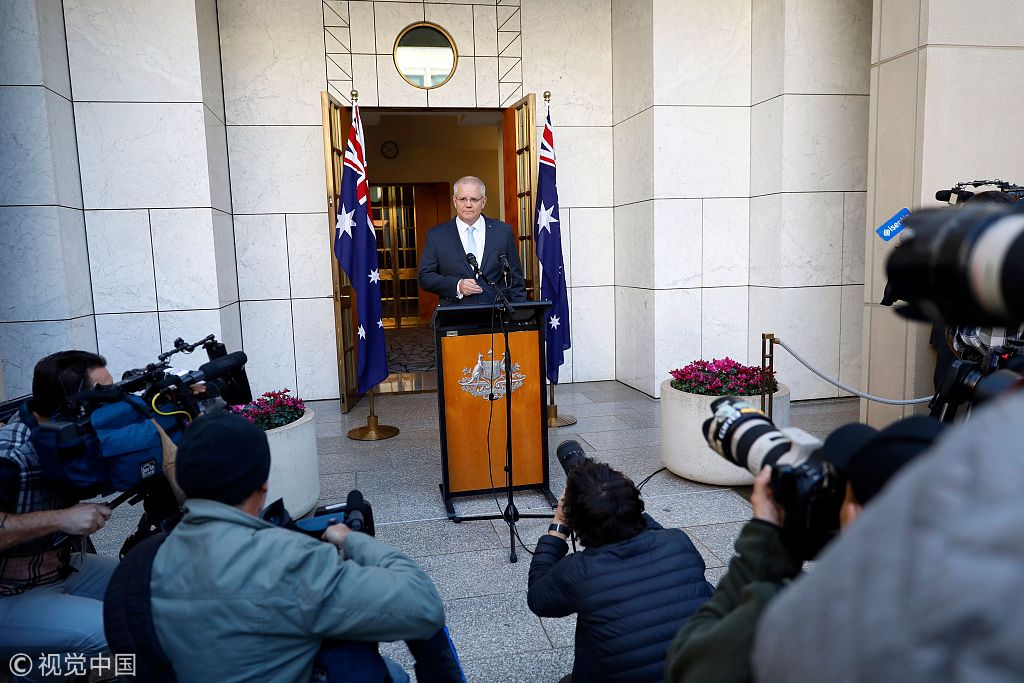
Australian Prime Minister Scott Morrison speaks at a press conference at the Parliament House in Canberra, April 11, 2019. /VCG Photo
Australian Prime Minister Scott Morrison speaks at a press conference at the Parliament House in Canberra, April 11, 2019. /VCG Photo
"More specifically, the two countries' frictions over Huawei, the South China Sea issue and human rights will hold and may even deteriorate," Chen added.
In last August, Australia blocked the Chinese telecommunications giant Huawei from installing fifth-generation cellular networks in the nation, citing potential threats to national security. However, in Chen's views, the national security concerns are only an excuse for banning Huawei's involvement in Australia's telecommunications industry. The ban, in fact, is for supporting the U.S. strategy to contain China in the Asia-Pacific and is also driven by the Liberal Party's overinterpretation of the "China threat."
For dealing with this, Chen called for the joint efforts of governments and companies. According to Chen, the Chinese government can lodge complaints at the WTO to urge Australia to create a fairer, an opener and a more transparent competition environment for Chinese companies. Besides, Huawei can communicate with related governments, think tanks and organizations in Australia and even sign transparent agreements with related parties to dissolve their concerns.
In spite the lingering disputes over security shadowing Canberra and Beijing, their economic ties have embraced a high-speed and prosperous development, with China being the biggest trade partner of Australia since 2009. For decades, Australia's economy has been boosted by exporting natural resources to China, as well as money from Chinese tourists, students and investors.
In last year, China imported 28.26 million tons of coking coal from Australia, accounting for 43.5 percent of its total imports. And 1.43 million Chinese tourists have traveled to Australia in 2018.
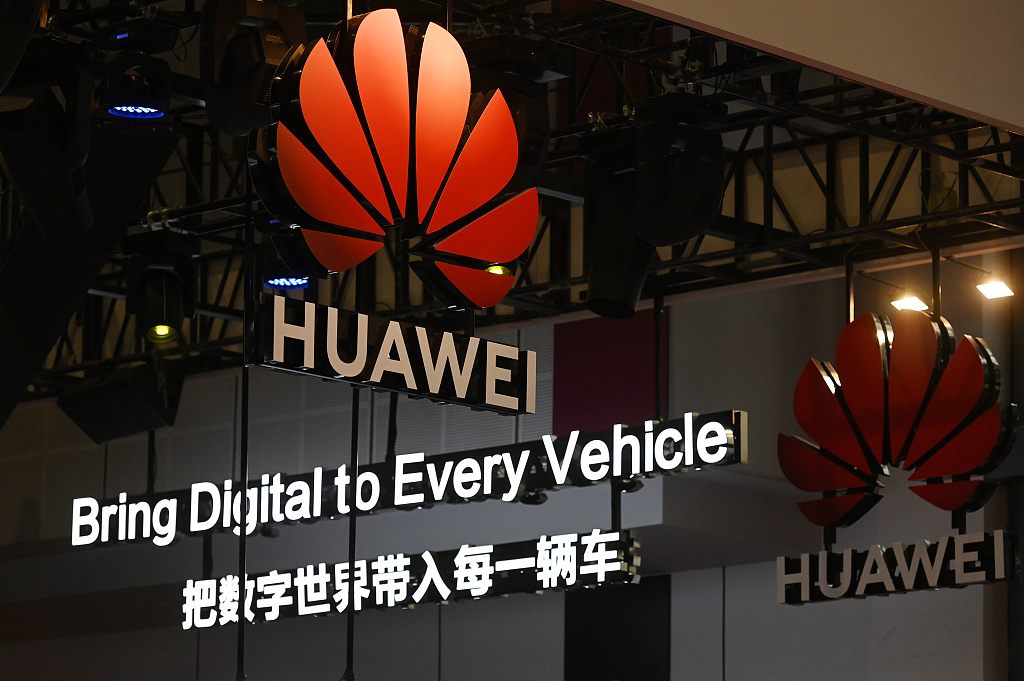
Signs are displayed at the Huawei stand at the Shanghai Auto Show in Shanghai, April 17, 2019. /VCG Photo
Signs are displayed at the Huawei stand at the Shanghai Auto Show in Shanghai, April 17, 2019. /VCG Photo
"Canberra enjoys a trade surplus with Beijing, and its economic development relies much on Beijing," Chen said. It is thought that Morrison will continue to strengthen his country's economic and trade relations with China in the future.
The strong economic ties also influence Australia's stance over the escalating trade frictions between China and the U.S. which saw the U.S. impose a tariff hike from 10 to 25 percent on 200 billion U.S. dollars worth of Chinese imports, and China take countermeasures by increasing tariffs on U.S. goods worth 60 billion U.S. dollars.
Australia, in Chen's views, will not take sides with the U.S. on the Sino-U.S. trade war and will not impose tariffs on China, considering the interconnected economic ties between Canberra and Beijing. In addition, as a trade-dependent country, Australia needs a free and an open international market. Nevertheless, what the U.S. has done to China is making the international market head in the opposite direction.
It is expected that Canberra will take a pragmatic approach to strike a balance between its security ties with Washington and trade ties with Beijing. And this just echoes Morrison's recent words over Australia's position in the protracted trade war, "You stand by your friends, and you stand by your customers as well."
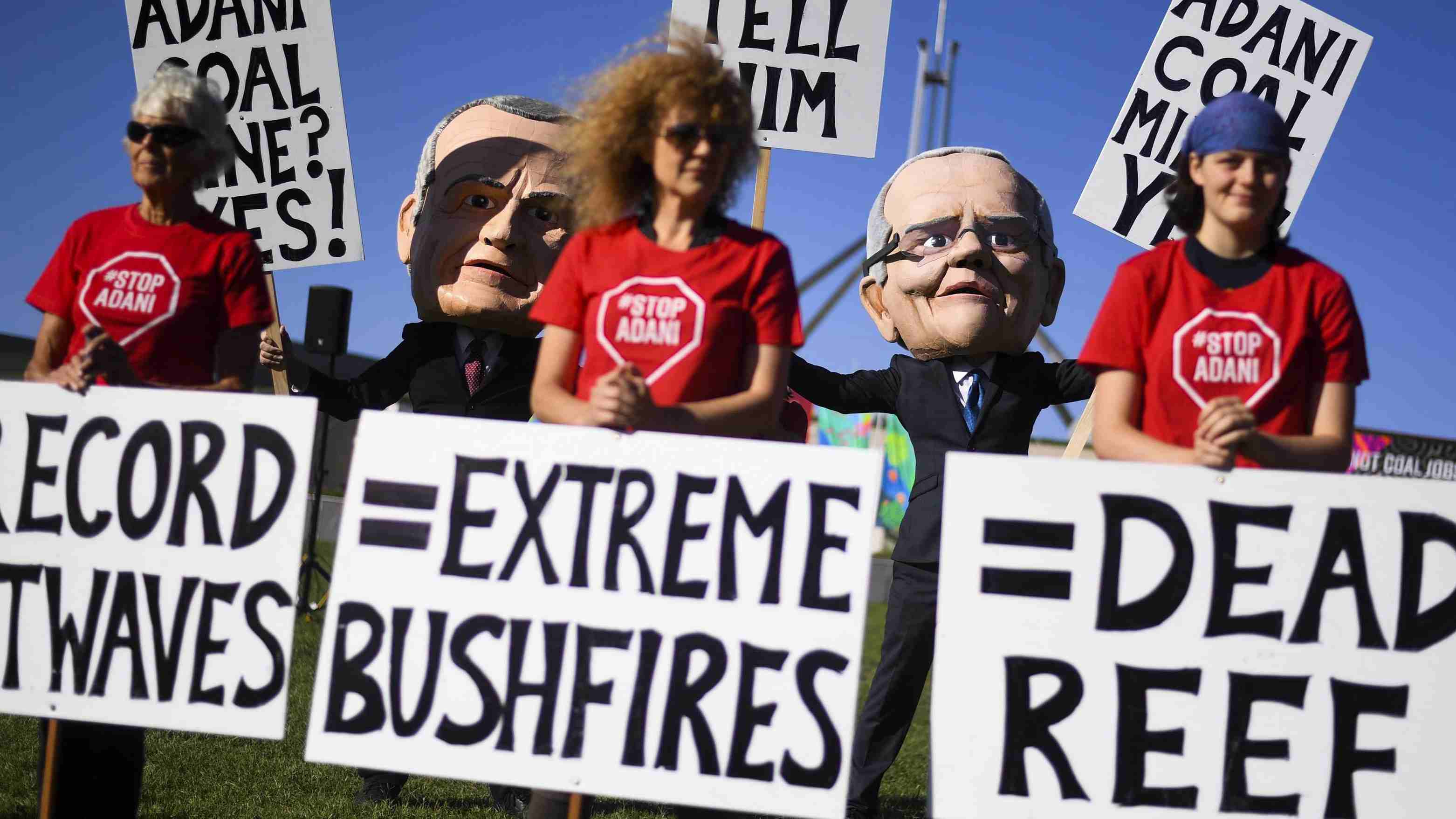
(Cover: Protesters wearing giant puppet heads resembling Australian Prime Minister Scott Morrison and Australian opposition leader Bill Shorten are seen during a Stop Adani protest outside Parliament House in Canberra, Australia, February 12, 2019. /Reuters Photo)
(If you want to contribute and have specific expertise, please contact us at opinions@cgtn.com)