
Culture
21:54, 10-Jul-2018
A man in NE China’s Heilongjiang Province spends his whole life protecting wild birds
Updated
21:49, 13-Jul-2018
 ["china"]
Share







Copied
04:56

CGTN
CGTN
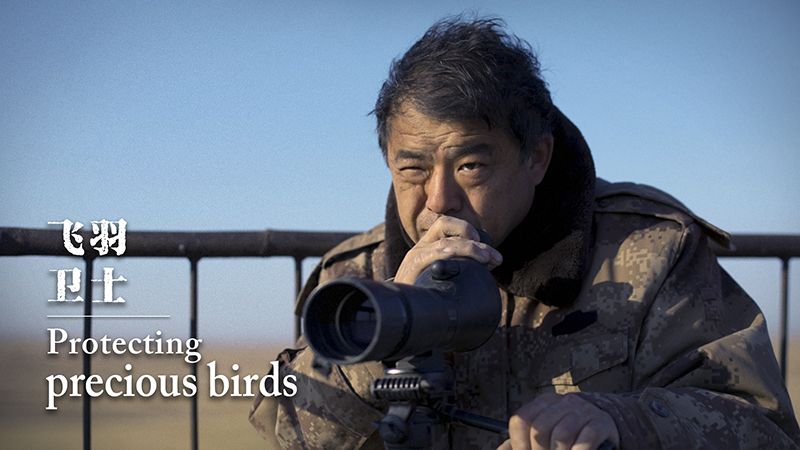
Fu Jianguo has been guarding over 290 kinds of wild birds in Lindian wetland in northeast China’s Heilongjiang Province for more than thirty years. He is often on the lookout for illegal poachers and has fought off quite a few.
Fu was born in 1962 in Lindian, Heilongjiang Province. He fell in love with birds when he was a child, as he always watched his father taking care of cranes for the zoo.
In 1984, he started working in Lindian wetland. He has previously been a wildlife photographer, a bird guide, and involved in scientific wildlife activities. Then, he found that birds have been an inseparable part of his life. He then set up the Daqing Lindian Wildlife Conservation Society. He devotes all his time to wildlife conservation and leads a group of members doing conservation work together.

CGTN Photo
CGTN Photo

Fu is used to using a telescope to watch the birds’ behavior and monitor poaching activities.
Fu is used to using a telescope to watch the birds’ behavior and monitor poaching activities.
Lindian wetland, spanning around 500 square kilometers and filled with insects and crustaceans, provides a perfect feeding ground for multiple bird species during the migration seasons. It is also a breeding ground for endangered species like the red-crown crane, great bustard, and oriental white stork.
Due to the wetland’s high biodiversity, poachers often have their eyes on plenty of the birds there. They use poison, nets, snares, and traps to kill or catch the birds. They even steal the birds’ eggs during the breeding season. In order to save the birds from poaching, Fu is busy patrolling day and night during the migration seasons.
While conducting a patrol in May 2018, Fu caught suspects he believed had stolen some birds’ eggs. He immediately searched for evidence and soon found two buckets of eggs, one in the poacher’s car, and the other hidden in the reed. He seized a total of 74 eggs. Fu recognized that four of the eggs were from the pied avocet, and the others were from wild ducks. The eggs were still tepid when Fu found them. If they had not been stolen, they would have hatched sooner.
Fu alerted the police at once. Policemen soon came to the scene, took the evidence and arrested the suspected poachers. This was the second time that Fu found poachers stealing eggs this year. Compared with the previous years, things are changing for the better. “Once I found a poacher who had attempted to steal almost 1,000 eggs in one day,” said Fu.
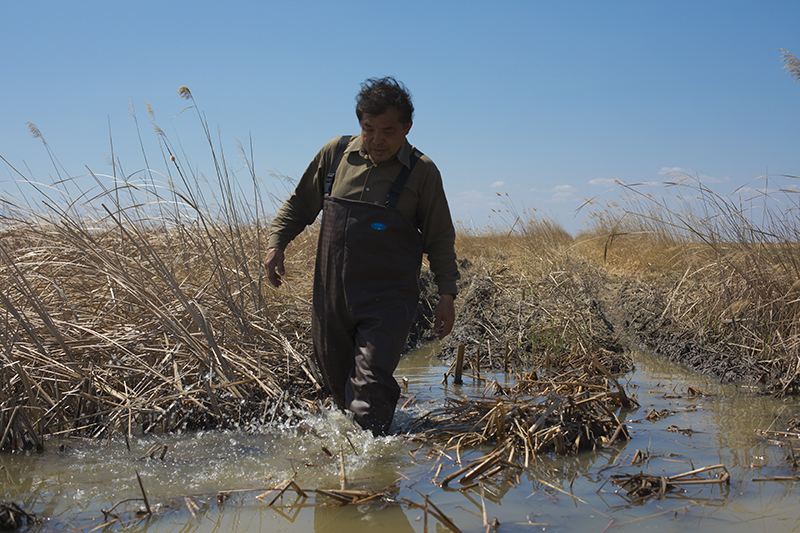
In order to find the evidence of stealing eggs, Fu walks in the wetlands.
In order to find the evidence of stealing eggs, Fu walks in the wetlands.
Fu spends most of his time in his dark green second-hand jeep while patrolling the area. His patrol jeep runs from the mild green reed lands to the severe cold white ice lands, day after day, year after year. Once during winter, in order to protect the endangered great bustard species, he stayed in an old bus insulated with sheets of foam for 45 days. Temperatures there can drop as low as minus 36 degrees Celsius.
Apart from patrolling, there is one big task that Fu has to work on in winter, and that is to make artificial nests for the oriental white storks. Oriental white storks, a class I protected species in China, were listed as an endangered species in the IUCN Red List of Threatened Species.
There are only around 3,000 left in the wild. Their main breeding places are in the northeastern regions of China and far eastern regions of Russia. They love to build nests on high trees in wetlands. But due to human activities, the amount of habitats the storks need to build their nests is becoming less and less.
In 1984, Fu discovered that one stork couple found no place to build a nest, so they chose to nest on an old aerial pole. After that, an idea ran through his mind, to make artificial nests for oriental white storks. In 1989, he began his first attempt at making three artificial nests in the Zhalong nature reserve. When spring arrived, two stork couples were successful breeding in the nests. He was pleased.
Since then, he has continued to make nests in the wetland. It was miraculous that storks breed in one of the nests continuously for 11 years since 2007.
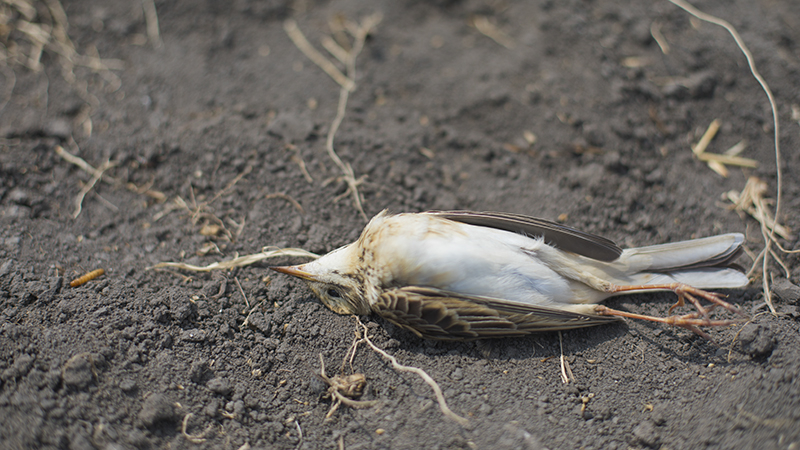
Poachers use poison to kill birds.
Poachers use poison to kill birds.
Building artificial nests for oriental white storks could promote their breeding and it plays a good role in protecting them,” said Li Lin, an ornithologist at the Wildlife Institute of Heilongjiang Province.
It is not easy to build an artificial nest in the wetlands. It takes time to think about the location and materials. It must be completed in winter when the wetlands are frozen. In order to save money, Fu called on many volunteers, found disused electric poles, and bought reinforcement bars from a flea market. They completed the process including sealing-in and drilling all by themselves.
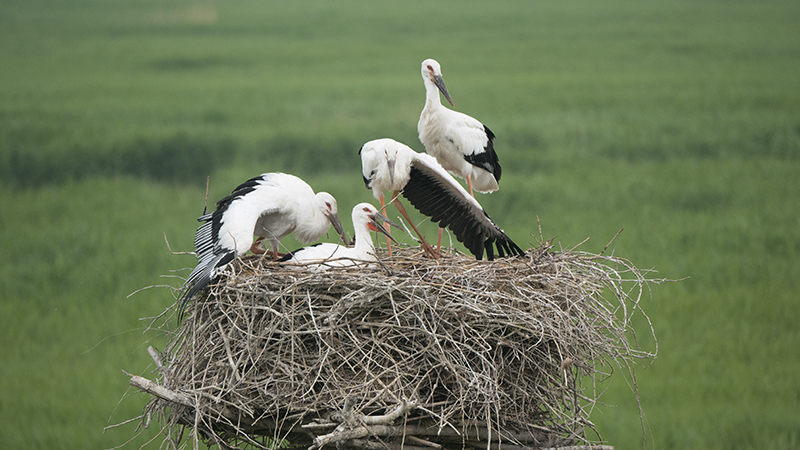
One of the artificial nests made by Fu has witnessed the most recent chicks of oriental white storks for eleven years in a row.
One of the artificial nests made by Fu has witnessed the most recent chicks of oriental white storks for eleven years in a row.
300 days of the year, Fu is on the field with the birds. He sleeps whether in an old bus or in a guard station. The guard station is right inside the wetland, 50 kilometers away from the nearest town. During the rainy season, the road becomes muddy, which makes driving around the area difficult. It is normal if there is no power and no mobile phone signal there.
It was in the year 2000 that Fu rescued a golden eagle. “The bird did not get the necessary treatment in time and it was not able to live in the wild. We tried to release it to the wild many times, but we failed,” said Fu. Till now, Fu kept the golden eagle for 18 years. Fu feeds it more than 500 grams of meat every day, which is not a small expense.
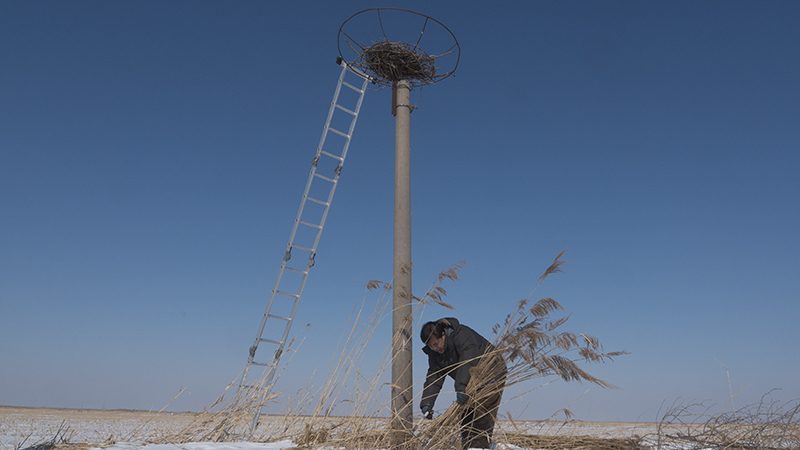
Fu is making artificial nests for oriental white storks in winter, as it’s easier to work on wetlands while it is frozen.
Fu is making artificial nests for oriental white storks in winter, as it’s easier to work on wetlands while it is frozen.
Fu gets funds from volunteers and foundations to support his conservation work. He usually tries to make the most with little expenses. He is easily satisfied with his life, rice with one dish is enough for a meal. He even uses a second-hand mobile phone.
The work he does is hard, and he doesn’t have any income, but he insists in doing it for the rest of his life. He loves observing birds, making nests in spring, watching chicks learn to fly in the summer, watching them migrant to the south in autumn, and babysitting resident birds in the winter.
“Every effort is worth it if our next generation gets to see all the species that I have seen, that’s enough,” said Fu.
(Video and story by Lin Yingying)

The story is one in The 1.3 Billion series exploring the diverse lives that make up China.
The story is one in The 1.3 Billion series exploring the diverse lives that make up China.