
Opinions
15:23, 13-Sep-2018
Opinion: China-Japan ties go beyond economic gains
Updated
14:36, 16-Sep-2018
 ["china"]
Share







Copied
05:26
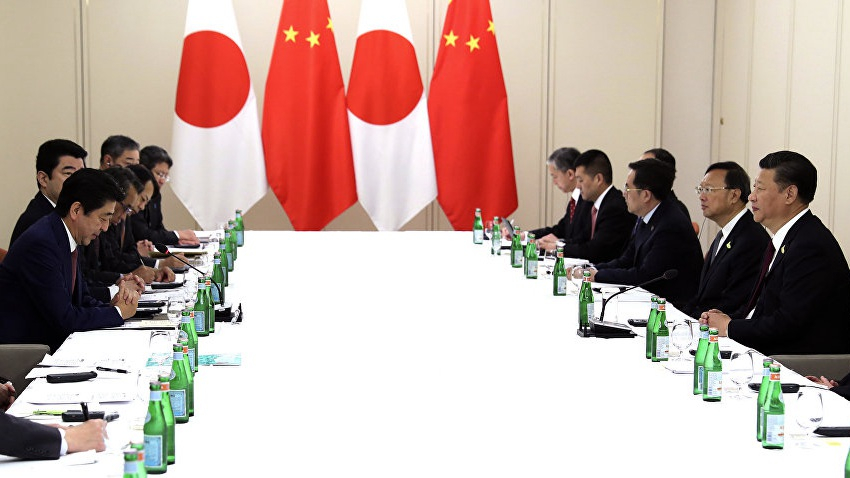
Chinese President Xi Jinping has met with Japanese Prime Minister Shinzo Abe on the sidelines of a forum in Vladivostok. The two countries are working to improve once-strained ties. President Xi said the world's two major economies should take responsibility for global peace and prosperity, and to protect multilateralism and trade rules under the WTO.
President Xi welcomed Tokyo's involvement in China's reform and opening-up, encouraging Japan to join the Belt and Road Initiative (BRI). Abe said Japan wants closer bonds with China, as its neighbor's development in recent decades has had a good impact on Japan. He promised that Tokyo would properly handle sensitive issues regarding Taiwan and World War Two history.
This year has witnessed intense diplomacy between China and Japan.
Victor Gao, a current affairs commentator, said if the world's second and third largest economies can handle their historical issues involving the World War II, there are huge trade and economic potentials between them and both countries can benefit from closer economic ties.
05:26

The two sides have made great efforts to improve their once-strained relationship since this year. In April, Chinese State Councilor and Foreign Minister Wang Yi visited Japan and met with his Japanese counterpart Taro Kono. The pair resumed a high-level economic dialogue after an eight-year hiatus.
Only a month after, Chinese Premier Li Keqiang visited Japan. It was the first by a Chinese premier in eight years. In June, the two counties launched the maritime and air liaison mechanism in an effort to avert accidental clashes through direct communication. Warmer ties seem to be continuing. Japanese Prime Minister Shinzo Abe on Wednesday confirmed his plans to visit China this year. It will be the first trip to China by a Japanese prime minister since 2011.
Kazuto Suzuki, professor of international politics at Hokkaido University in Japan said that Japan's motives of rapprochement with China are not only confined to economic reasons. He said Japan expects China to play a bigger role in the denuclearization on the Korean Peninsula, and it also wants to avoid an accidental incident in the East China Sea with China by building communication mechanism.
In addition, Suzuki said Japanese companies want to grasp the investment opportunity of the BRI. He said in many years Japan regarded BRI as an expression of expansionism and a way to wield influence in the region. However, gradually Japan understands the initiative is more economic than a strategic project, said Suzuki. What's more, He said US President Donald Trump has pushed China and Japan closer by his protectionist policies.
Asia Today is a 30-minute daily news magazine program airing at 1100 GMT and 1900 BJT. Aiming to tell Asian stories from an Asian perspective, Asia Today provides news and in-depth coverage on various topics from across the continent. Asia Today also runs special series covering a wide range of issues of concern to people in Asia.