
Archeology
10:58, 04-Oct-2018
Mysterious female pottery face sends 7,300-year-old smile
Updated
10:19, 07-Oct-2018
 ["china"]
Share







Copied
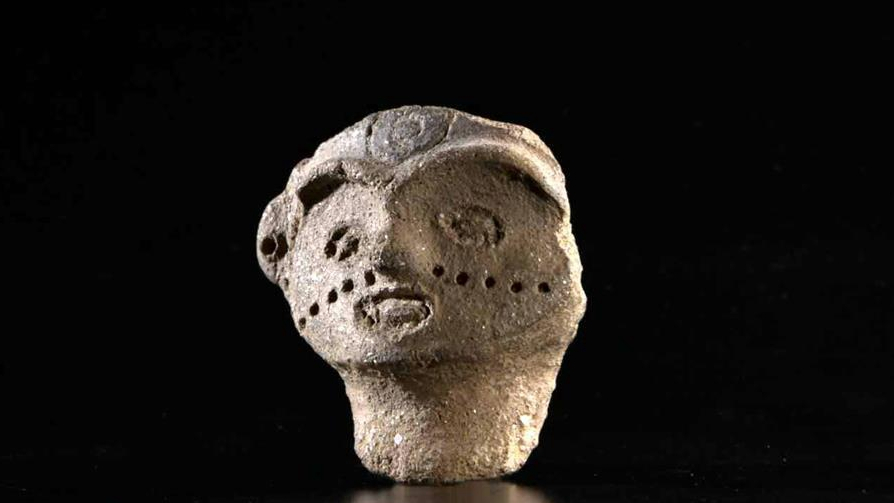
A mysterious piece of pottery shaped as a female head sends a smile from 7,300 years ago, as its host museum in Bengbu City, east China's Anhui Province starts a global naming bid for the ancient relic.
Ji Yong, curator of Anhui Bengbu Museum said that the statue was among 600 pieces of pottery unearthed from a New Stone Age site at Shuangdun village in Anhui Province in 1985.
Using Carbon 14 technology, the relics were dated back to 7,300 years ago.
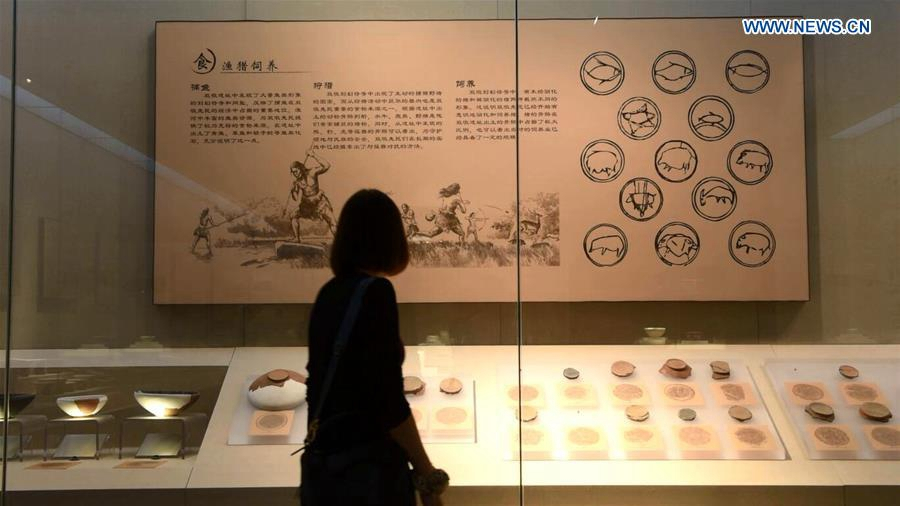
A visitor looks at exhibits at Anhui Bengbu Museum in east China's Anhui Province. /Xinhua Photo
A visitor looks at exhibits at Anhui Bengbu Museum in east China's Anhui Province. /Xinhua Photo
However, it is still unknown what the statue was used for and why it was the only one of its kind, with the rest being utensils bearing inscriptions of various symbols believed to be origins of Chinese characters.
The statue, made with earth containing mica powder and quartz, is a flickering tattooed female face with marks emblazoned on her forehead that archaeologists have judged as a sun symbol.
Measuring 6.5 centimeters in height and width, the relic is the earliest example of such pottery ever found in China.
Zhang Dong, professor at the Chinese Academy of Social Sciences, said international archaeological experts tended to link the inscriptions on the pottery items from Shuangdun to drawings in the Olmec civilization and hieroglyphic inscriptions in Mayan culture.
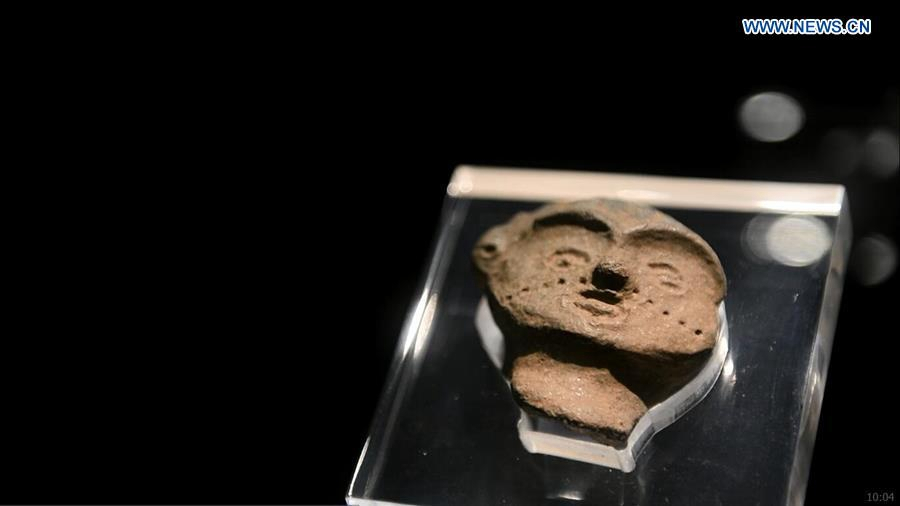
The statue on display at Anhui Bengbu Museum. /Xinhua Photo
The statue on display at Anhui Bengbu Museum. /Xinhua Photo
Ji said that following the global naming bid, the museum would hold an international symposium on the the item.
"I think it is the earliest and the most beautiful facial portrait, and suggests the humans had developed from emotional thinking to rational thinking," said Xu Xiaohong, a member of China Sculpture Society.
He suggested naming the statue "The Goddess of the Huaihe River," since the ruins were found on the bank of the Huaihe River, which is located in the midway of China's two largest rivers, the Yangtze and Yellow rivers.
Shuangdun culture appears in the same period as the late Neolithic group known as Yangshao, which originated from the middle reaches of the Yellow River, and Majiabang culture where archaeologists excavated 6,000-year-old rice grains in the lower reaches of the Yangtze in present-day Shanghai.

Details of the statue. /Xinhua Photo
Details of the statue. /Xinhua Photo
In the museum, the statue's caption says "pottery human head portrait with facial tattoos."
Wang Jihuai, a researcher with the academy, said although a consensus had not been reached, those involved with Shuangdun archaeological research tend to believe that the civilization was a matriarchy with a sorceress dominating the community.
"The portrait might be the image of a sorceress," Wang said.
There are four-handled kettles and cooking devices unearthed in the ruins, where massive animal bones were also discovered.
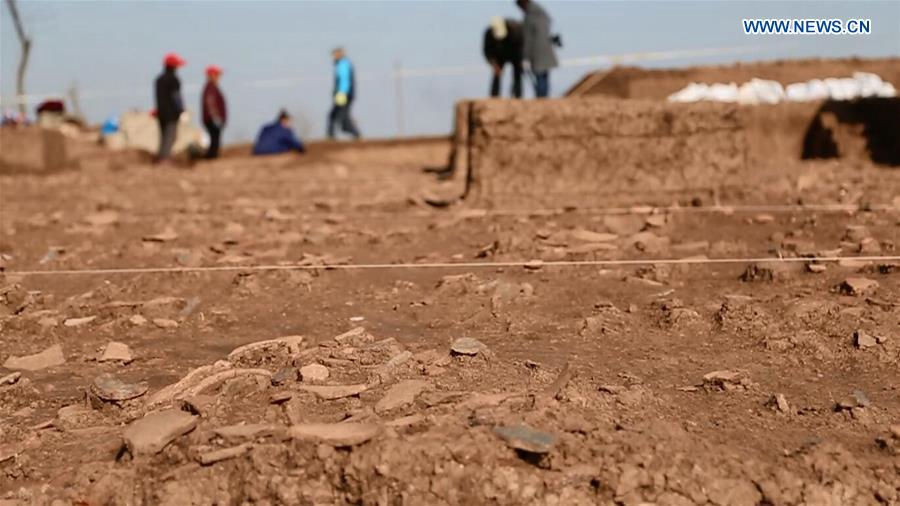
A New Stone Age site at Shuangdun Village in Bengbu City. /Xinhua Photo
A New Stone Age site at Shuangdun Village in Bengbu City. /Xinhua Photo
"The discovery of Shuangdun culture suggests that the Huaihe River Basin was one of the origins of Chinese civilization and Chinese characters," Wang said.
Since the museum launched the bid to name the smiling portrait through media outlets and Chinese social media in September, it has received considerable feedback.
"The portrait just has a head, and the decoration on the forehead suggests she was someone high ranking. Maybe we should name her Big Cheese," said Muhammad Firdaus Samijadi from Surinam.
Enzo Hilbert from France said the portrait was certainly a female figure. "She must have been a flamen. I'd like to name her Watermelon Girl or Druidess," he said.
Xun Yiran, a Bengbu local, said that since the portrait embodied the ancient culture of the Huaihe River, the name should carry its origin. "I suggest to name her the Mother of the Huaihe River," he said.
Source(s): Xinhua News Agency