
Law
23:13, 27-Apr-2018
China passes people's assessors law
 ["china"]
Share







Copied
02:53

The National People's Congress (NPC) Standing Committee, China's top legislature, has passed a law on "people's assessors," suggesting that assessors be granted a bigger role in court.
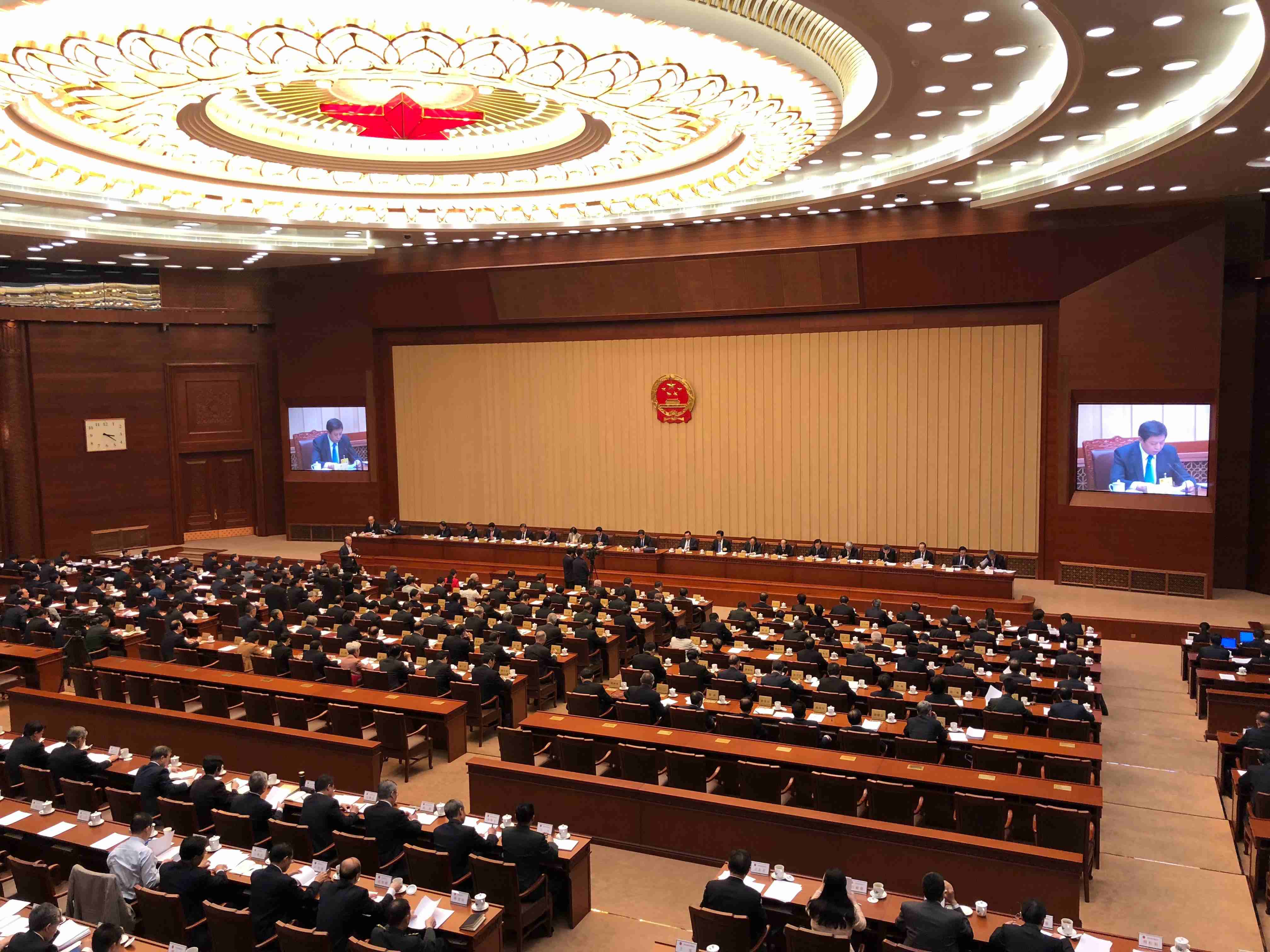
NPC wraps up its bimonthly session, April 28, 2018 /CGTN Photo
NPC wraps up its bimonthly session, April 28, 2018 /CGTN Photo
This is the second deliberation on the law. It states that Chinese citizens aged 28 or older who have received high school education or higher can be selected as assessors. In courts, an assessor exercises the same power as a judge but cannot hear a case alone nor act as chief judge of a collegial panel.
The assessors are also allowed to participate in legal proceedings in which the death penalty is possible and in other cases with "severe social impact." Assessors are mostly selected randomly from eligible local residents, and only less than 20 percent will be chosen based on personal applications and recommendations by entities.
During the panel discussions, some lawmakers have laid out the problems.
"There are many qualified citizens who are willing to be selected but don't have the chance to be assessors. And some who have been selected, turned down the chance. Therefore, we adopt both random selection and recommendations by entities and individuals," said Lin Wenxue, deputy director of the Political Department of the Supreme People's Court.

Legislators vote on bills at the closing ceremony. /CGTN Photo
Legislators vote on bills at the closing ceremony. /CGTN Photo
During the panel discussion, some lawmakers also suggested an upper age limit and continuous training for assessors.
The draft was first submitted to the NPC Standing Committee last December. The legislation was based on a Standing Committee decision in 2004 to improve the use of people's assessors and a pilot program in ten provincial-level regions starting in 2015.
According to a report on the pilot program delivered by Zhou Qiang, president of the Supreme People's Court, a total of 13,740 assessors had participated in the pilot program as of April. People's assessors have participated in hearings on 30,659 criminal cases, 178,749 civil cases, and 11,846 administrative cases in regions since the pilot program started in 2015.
During the three-day bimonthly session, lawmakers also deliberated and passed a revision unanimously to the draft law on protecting the reputation of heroes and martyrs. People who glorify wars such as posing in imperial Japanese military uniforms will be punished in accordance with the law. The new clause was added during the second review, which mainly targets acts that glorify the Japanese invasion and invaders. It also clearly states that such behavior won't be tolerated.
19km