
Opinions
11:39, 02-Aug-2018
Opinion: Google's emerging China strategy
Updated
10:56, 05-Aug-2018
 ["china"]
Share







Copied
Editor's Note: James LaLonde is co-founder and CEO of yoli, a serial entrepreneur in China, author, and speaker. The article reflects the author’s opinion, and not necessarily the view of CGTN.
This year Tencent added support for games in its WeChat Mini Program (MP) framework, and the response has been incredible. Many thousands of these “WeChat MP games” have been released in the first six months bringing the total number of MP’s developed by third-party developers to well over 1 million in just 18 months.
In July, Google joined the fray by releasing a new WeChat MP Game with a name in Chinese (猜画小歌) that roughly translates to “Guess My Sketch.” The game is a newer AI-oriented take on Zynga’s older Draw Something Facebook game app where players try to guess what others are drawing. The game is fun and easy to play and has been spreading virally in the WeChat community since it was released. The splash screen makes it clear that the MP is from Google's AI team.
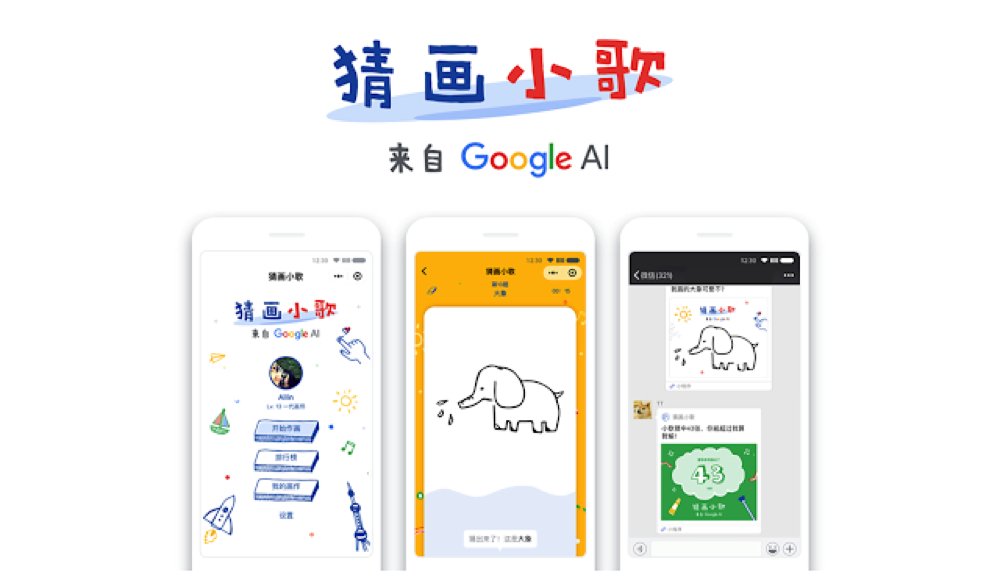
Google's Chinese blog
Google's Chinese blog
So why has Google put out an MP game in the ecosystem that is most threatening to the existence of app stores like its own Google Play app store? Well, for one, in China there is no Google Play app store, so why not? Moreover, there is the fact that there is just no better place than WeChat to get the kinds of massive user interaction and data sets that serious AI research requires.
The Google's Chinese blog post emphasized the fact that the MP game is using the world's largest dataset of hand-drawn sketch pictures that reside in Google's neural network. Obviously, if Google wants to increase the size of its hand-drawn sketch dataset quickly, the fastest way possible is to do it on WeChat via an MP game that gets played by millions of people every day on WeChat.
While we are talking about Google, let’s not forget that among non-Chinese tech firms, Google’s rival Microsoft has been the historical leader in leveraging WeChat as a full-fledged live test bed for its technology.
As early as 2014, Microsoft Research’s China arm released “Xiao bing” which is a WeChat-based chatbot you can add as a friend on WeChat and have human-like conversations with in Chinese. In 2016, Microsoft Research came out with "Xiao ying" for studying English via word meaning lists and pronunciation practice.
While Microsoft makes progress on the WeChat platform and AI in their way, Google has been quietly making progress in China of late by opening an AI research lab in Beijing and a small office in Shenzhen. Product-wise, in addition to the WeChat MP, Google recently released a Chinese version of its “Files Go” Android device management App partnering with four third-party Android App stores in China for distribution.
More critical strategically, however, is the massive patent cross-licensing agreement that Tencent and Google made in January of this year which is rumored to be valued at over 500 billion US dollars. This agreement will allow both companies to cooperate aggressively in the future without worrying about infringing on each other's intellectual property.
If there were no big plans in the future to collaborate, a deal this big and this comprehensive would not have been struck. The ramifications of this agreement will likely play out over the next decade in many ways: search technology, AI technology, ad platform operation technology, retail, logistics and other big data applications.
Separately, Google made two investments in Chinese companies of note: 500 million US dollars in e-commerce giant (and Tencent partner) JD and 400 million yuan in mobile game live streaming service Chushou which is similar to the US-based Twitch platform Google lost to Amazon in a bidding war. While the investment amounts are small for a company of Google’s size, they both reveal a certain level of sophistication in regards to the Chinese market that Google’s rivals simply do not possess.

VCG Photo
VCG Photo
So, what is Google’s strategy vis-a-vis China? Does a cohesive one even exist? Anyone can see why they would want to be more involved with the Android and AI scene here simply because both are extremely large in China and the risk of being left behind is huge.
However, this latest effort via a WeChat MP game could be easily be construed as one of three things: a way to train up their young AI talent on new ecosystems like WeChat, a plan to productize something based on this picture data or merely a small PR play to show they remain relevant in China.
Somehow, when I talk to the Chinese players in the tech space here in China and Google China’s employees, I get the feeling that Google is slowly dipping its feet back into the Chinese marketplace, albeit in a carefully considered and highly strategic manner.
As a worldwide technology leader and a bastion of innovation, Google still commands a great deal of respect from the general Chinese population. Recently Google has dealt with the unpleasant business reality of being a dominant worldwide tech leader: accusations of data privacy violations and tax avoidance issues by the EU, being forced to testify before the US Congress and hire thousands of staff self-regulate their content in the US, etc.
Still a relatively young company, Google's adolescent phase is finally over. I believe the current management team now takes a more pragmatic and less idealistic approach to their strategy in key markets worldwide now.
Despite their past – mostly self-inflicted – missteps in the China market previously, there is no reason why Google can't re-establish itself and exist comfortably alongside the local giants in the market. They need to make careful, yet confident moves forward and maintain the momentum they have created of late.