
World
17:20, 11-Jul-2018
Women in South Korea dare the economy to run without them
Updated
16:22, 14-Jul-2018
 ["other"]
Share







Copied

Forty-three years ago, 90 percent of women in Iceland went on strike – from work, school and any “home duties” – in a challenge to the country to function without them. Earlier this month, a group of South Korean women are daring their economies to do the same, by taking back what may matter most – their pocketbooks.
Putting a capitalist bent on the traditional boycott, the “Korean Women's General Consumption Strike” aims to fight gender discrimination by showing the value of the female dollar – or in this case, the won.
On the first Sunday of every month, women are boycotting all spending with the goal of zero consumption. Using the hashtag #KWGCS, participants in the July 1 boycott shared experiences of walking to work, rather than paying for bus fare, and canceling plans to eat out, opting instead to eat at home.
Calling it an example of “online feminism,” the grassroots movement has over 5,000 followers on Twitter.
Targeting specifically the practice of charging women more than men for the same products – what some call the “pink tax” – the group said the movement hopes to “raise awareness of issues such as discrimination of [the] pink tax and biased advertising.”
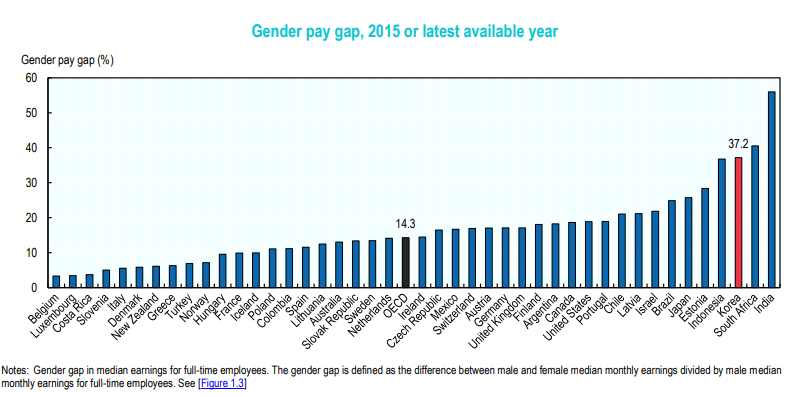
The gender gap is defined as the difference between male and female median monthly earnings divided by male median
monthly earnings for full-time employees. / Chart from OECD
The gender gap is defined as the difference between male and female median monthly earnings divided by male median monthly earnings for full-time employees. / Chart from OECD
On a macro scale, the group’s organizers told CGTN that “we want women be the part of society with the rightful authority as consumers. It may sound like a distant story, but we hope to make the world without [a] gender wage gap through strike, like Iceland and Spain did.”
Despite having one of the world’s largest economies, the country deals with a significant gender gap that has left many of its women behind.
At 63 percent, South Korea has the largest gender wage gap among all 35 member countries of the Organization for Economic Cooperation and Development (OECD). This means for every dollar a man in South Korea makes, a woman earns just 63 cents.
Looking at other economic factors, the OECD’s 2017 report writes: “The situation in S.Korea appears quite daunting as there are major gender gaps in earnings, labor market participation, and representation in government.”
Like many other countries, South Korea also lacks female representation in upper management. The country’s Ministry of Gender Equality and Family reports that women make up only 5.6 percent of employees in high-ranking positions.
The country’s challenges are rooted in cultural stereotypes of women and patriarchal social structures. Up until 2005, women could not legally be designated as the head of the household under the country’s hoju system. And Chung Hyun-back, the country’s family minister has said that she chose not to start a family because “it was extremely difficult – if not impossible – to juggle an academic career while getting married and raising children.”
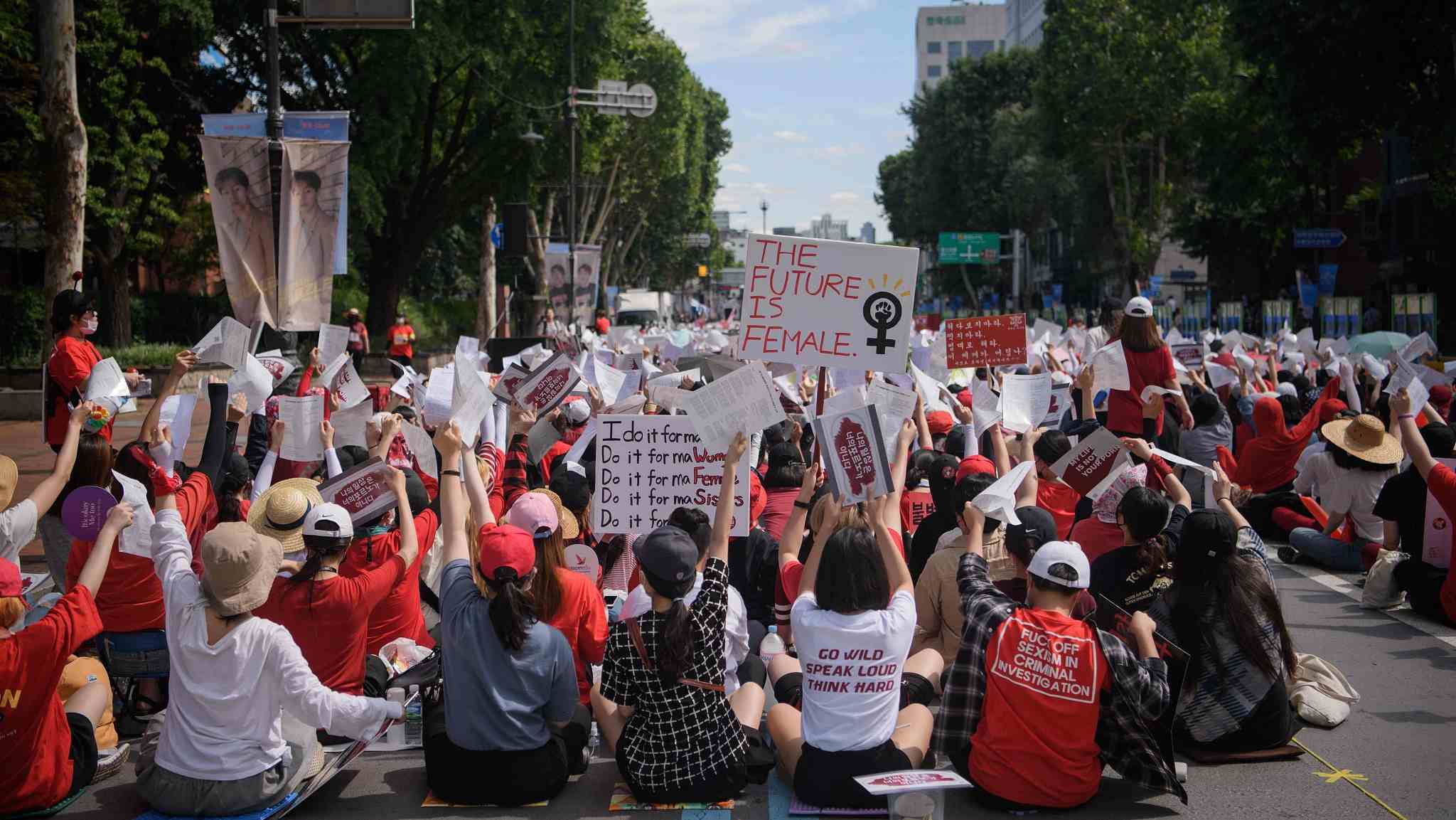
Female protesters call for South Korea's government to crack down on widespread spycam porn crimes during a rally in Seoul on July 7, 2018 / VCG photo
Female protesters call for South Korea's government to crack down on widespread spycam porn crimes during a rally in Seoul on July 7, 2018 / VCG photo
Despite these challenges, feminists are seeing some traction in South Korea. Last weekend, tens of thousands of women gathered in Seoul to protest the persistent problem of spy cam pornography, in one of the country’s largest female-only protests.
(Top photo: A pedestrian walks past an advertisement for plastic surgery clinic at a subway station in Seoul on March 26, 2014. / VCG photo)