
Opinions
22:52, 16-Jul-2018
Opinion:Is America really "first" under Trump?
Updated
22:16, 19-Jul-2018
 ["china","north america"]
Share







Copied
Editor’s note: The article is based on an interview with Chen Ping, a professor at Fudan University and Beijing University, and a senior research fellow at the China Institute. The article reflects the author's opinion, and not necessarily the view of CGTN.
“Happy Birthday, America!” tweeted Donald Trump on US Independence Day, with a picture of fireworks lighting up the sky. Two days later on July 6, the mutually imposed tariffs between the US and China took effect.
Ironically, 99 percent of the consumer fireworks used to celebrate Independence Day comes directly from China, according to Julie Heckman, the executive director of the American Pyrotechnics Association.
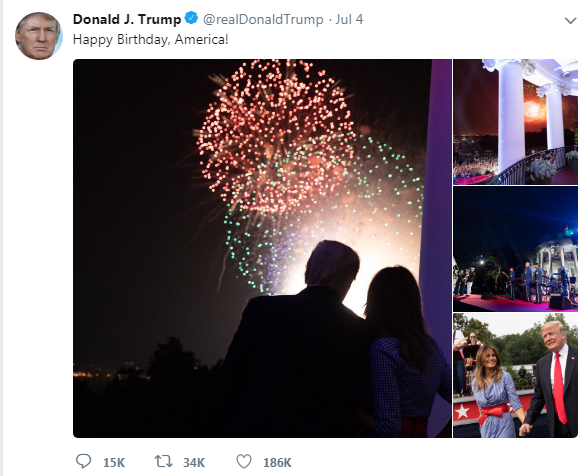
US President Donald Trump tweets on US Independence Day.
US President Donald Trump tweets on US Independence Day.
Regardless of the close trade relations between the two largest economies in the world, Donald Trump fired the first shot by introducing tariffs on billions of dollars’ worth of Chinese goods. China was forced to take countermeasures to safeguard its own interest.
Later, the White House unveiled plans to impose another round of tariffs on 200 billion US dollars’ worth of Chinese goods. Responding with “completely unacceptable,” the Chinese Ministry of Commerce announced that the Chinese government would take necessary countermeasures.
Outer war to divert inner antagonism
According to Professor Chen Ping, the primary reason Trump has ignited a trade war is to divert attention from domestic political crises. Since Trump took office, or even before he became the US President, he has always been controversial.
His series of offensive comments toward women, which, according to former presidential rival Hilary Clinton, has lasted for 30 years. Meanwhile, his “Muslim ban” embroiled his administration in a legal battle, and his “zero-tolerance policy” against illegal immigrants elicited criticism from the international community and even his close advisers.
Moreover, his Russia-gate “scandal” has sunk his approval ratings to a historical low. According to a CNN report from Nov. 9 last year, 44 percent of Americans say that they are very concerned about the contact suspected Russian operatives had with Trump’s presidential campaign, an increase from the 27 percent from July 2017.
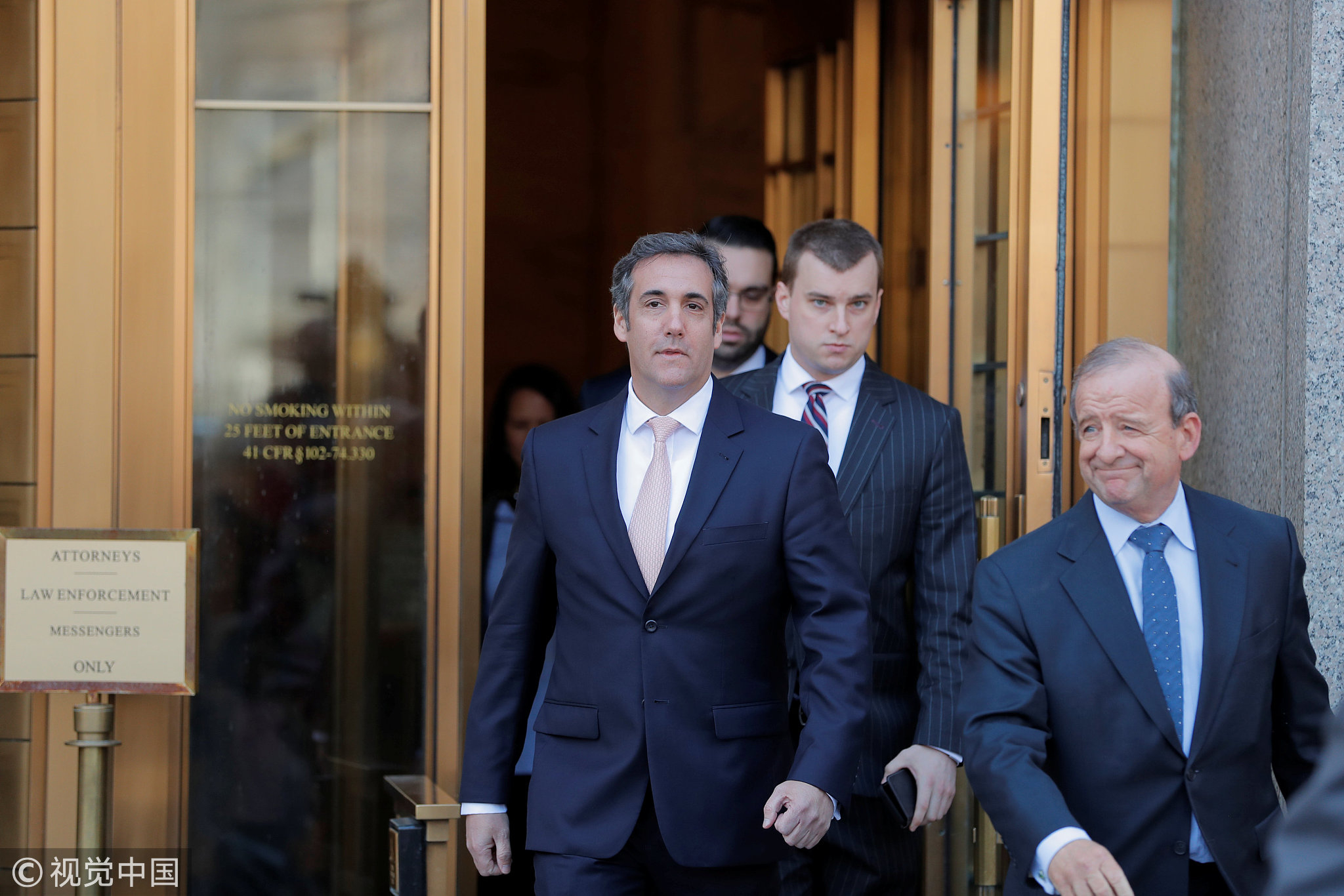
US President Donald Trump's personal lawyer Michael Cohen leaves the federal court in the Manhattan district of New York, US, April 26, 2018./VCG Photo
US President Donald Trump's personal lawyer Michael Cohen leaves the federal court in the Manhattan district of New York, US, April 26, 2018./VCG Photo
Trump’s approval rating was just 36 percent at that time, one of the lowest in his presidency, and much lower than the average rate of approval (53 percent) of American presidents from 1938 to 2018, according to the polling company Gallup.
“Trump tended to use the trade war to divert the focus on his series of controversial issues, to prove his patriotism, to show that he dares to do something his ex, Barack Obama, dared not to do,” said Chen.
America not really "first" under Trump
According to Chen, agriculture-heavy states in the US will be the first ones to oppose the trade war. China is the second largest importer of US agricultural products, accounting for 15 percent of total US agricultural exports. China is also the largest US soybean importer, accounting for 62 percent, according to United States Department of Agriculture.
After the tariffs on US products came into force, US soybeans also became less competitive on the Chinese market. The crop’s price will increase 700-800 yuan per ton, which will be 300 yuan higher than the Brazilian soybeans per ton, according to experts from the China National Grain and Oils Information Center.
The escalating trade war with China worries farmers in the US. A leading agriculture trade lobby group published two statements on Friday condemning the tariffs imposed by Trump on Chinese exports, saying they will cost American farmers in the field and also incur losses of future market opportunity.
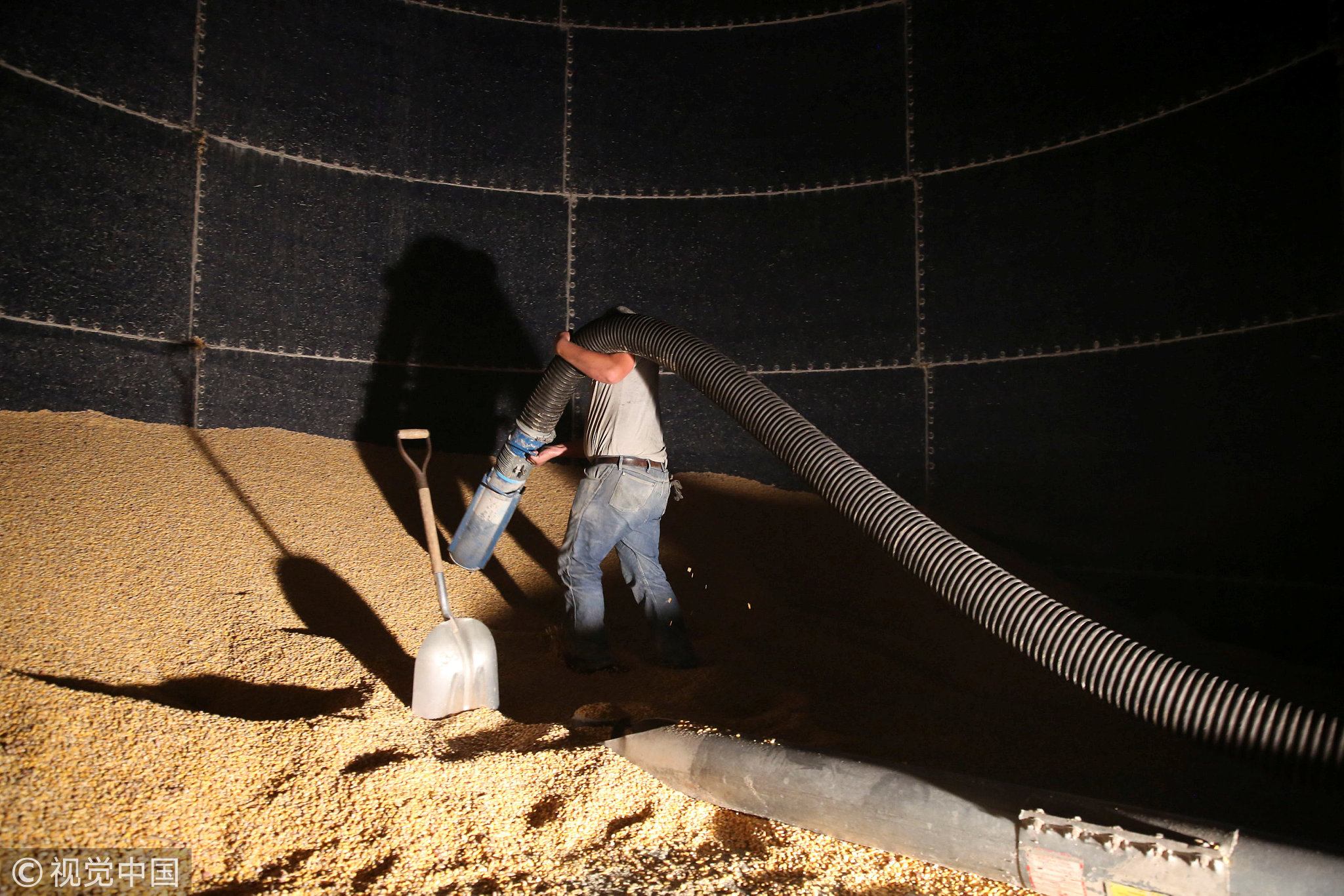
Jud Wright uses a grain vacuum to remove corn from a silo at a farm in Tiskilwa, Illinois, US, July 6, 2018. /VCG Photo
Jud Wright uses a grain vacuum to remove corn from a silo at a farm in Tiskilwa, Illinois, US, July 6, 2018. /VCG Photo
Also, residents in the southern US state of Texas will be concerned about their businesses with China, according to Chen. As a beneficiary of the "shale revolution,” US transformed itself from an energy importing country into an energy exporting country. Meanwhile, Texas produces more crude oil than any other state or region in the country. In 2017, the average crude oil production in the state was 3.5 million barrels per day, according to US Energy Information Administration.
Moreover, China has surpassed Canada as the largest consumer of US crude in some months, according to CNBC. If the trade war continues to escalate, the oil market might be affected.
According to energy consultancy Wood Mackenzie, it is easier for China to find an alternative source such as West Africa, which has a similar quality to US crude, than have the US find an alternative market that is as big as China.
Another US state that might be affected is California, where the high-tech industry dominates. The cost of upgrading technology is very high, so it depends a lot on its global market to reduce the average cost. China, with its large population and a growing economy, is definitely one of the most important markets, according to Chen.
Take Apple Inc. as an example. According to the company’s financial reports, the revenue of its products in China last year was 45 billion US dollars, accounting for 19 percent of its total sales.
Ignoring all opposing voices, ignoring all observed or estimated losses, Trump persists in starting a trade war with China. Who really has priority under his “America First” policy?