
Politics
15:32, 13-May-2018
Ambassador cautions against 'glass curtain' between China, US
 ["china"]
Share







Copied
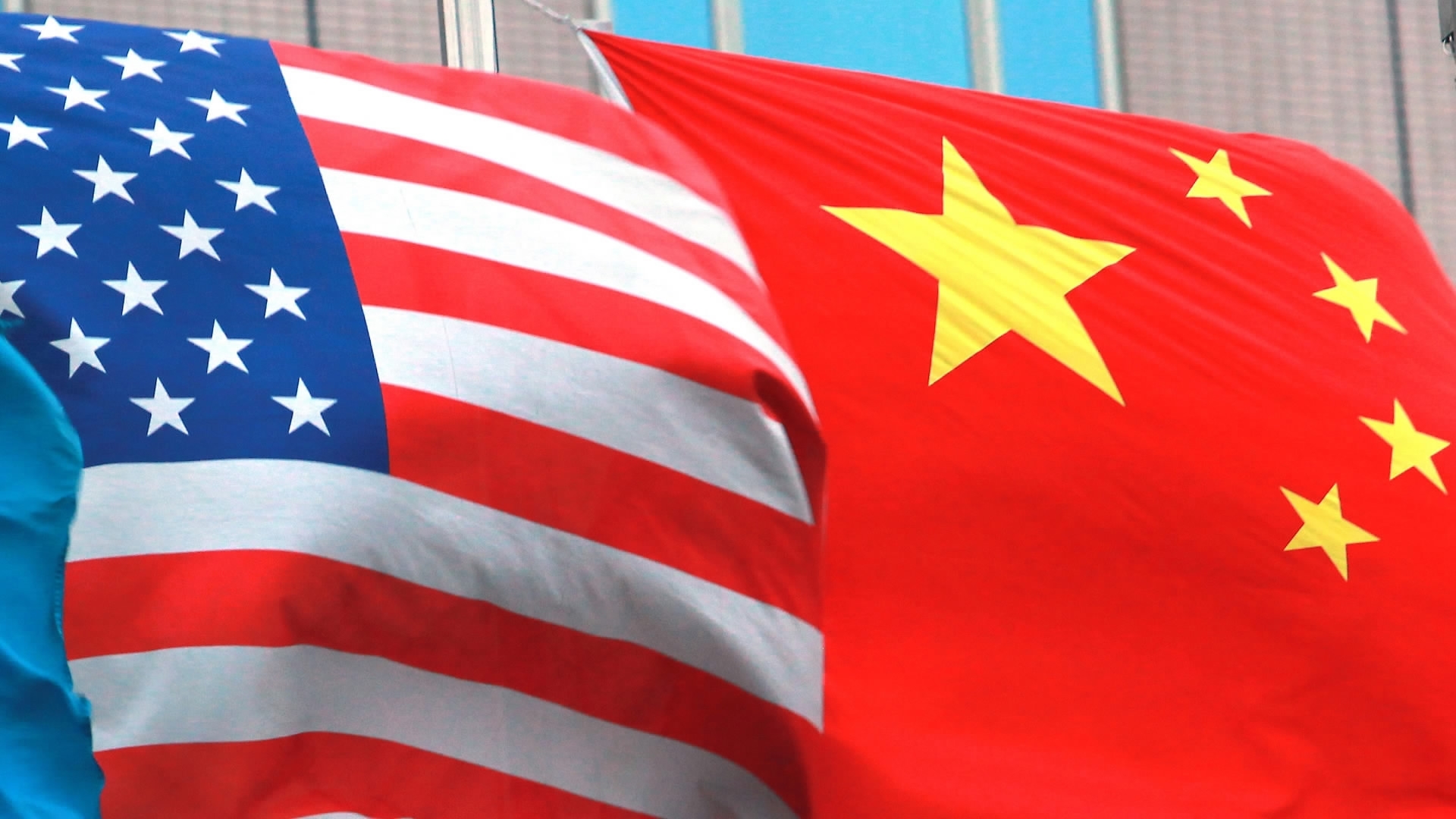
Chinese Ambassador to the United States Cui Tiankai has cautioned that some people in the United States are trying to place a "glass curtain" between the two countries, calling for enhanced dialogue to eliminate the "deficit of mutual understanding."
Cui made the remarks on Friday at the panel discussion "Forty Years of US-China Relations" hosted by the Center for Strategic and International Studies (CSIS), a policy research organization based in Washington, DC.
The event, gathering over 200 people from politics, business, academia and media, was held to discuss "the twists and turns in the relationship over the last four decades and the challenges that lie ahead," the CSIS said on its website.
China and the United States will mark the 40th anniversary of the establishment of diplomatic relations next year.
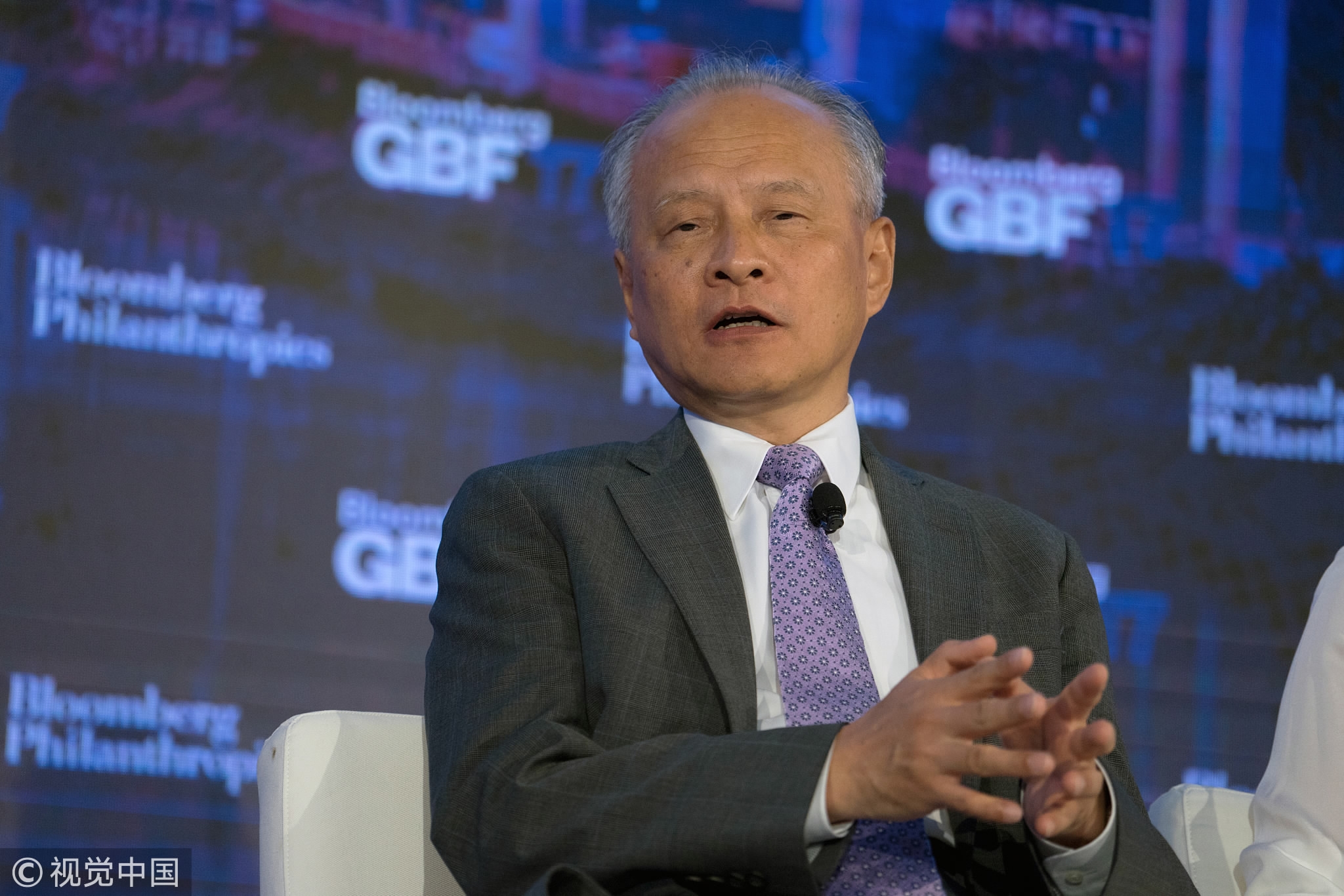
September 20, 2017: Cui Tiankai, China's ambassador to the US, speaks during the Bloomberg Global Business Forum in New York, US. /VCG Photo
September 20, 2017: Cui Tiankai, China's ambassador to the US, speaks during the Bloomberg Global Business Forum in New York, US. /VCG Photo
Common interests stronger than differences
Beijing and Washington, coming together for 40 years by common strategic interests, have seen the expansion of their cooperation and common interests in bilateral, regional and global issues, the ambassador said.
As history proves, the common interests of China and the United States are greater than their differences, Cui said, adding that this will ensure the sustainable and healthy development of bilateral ties.
Referring to crises in bilateral relations, including the US bombing of the Chinese Embassy in Yugoslavia in 1999, Cui said that the incidents took place either in or near Chinese territory.

June 17, 2016: Chinese President Xi Jinping and his wife Peng Liyuan pay homage to the Chinese martyrs killed in the NATO bombing of the former Chinese embassy in the Federal Republic of Yugoslavia in May 1999, after arriving in Belgrade for a state visit to Serbia. /Xinhua Photo
June 17, 2016: Chinese President Xi Jinping and his wife Peng Liyuan pay homage to the Chinese martyrs killed in the NATO bombing of the former Chinese embassy in the Federal Republic of Yugoslavia in May 1999, after arriving in Belgrade for a state visit to Serbia. /Xinhua Photo
Those incidents were triggered by moves from the US side that harmed China's interests, and that China had to take actions to defend its legitimate rights, Cui said.
He called on China and the United States to enhance dialogue to eliminate the "deficit of mutual understanding."
China has no desire to contend for global dominance with the United States; rather, it wishes to work with the US side for a new type of relations featuring non-conflict, non-confrontation, mutual respect and win-win cooperation, he said.
Glass curtain
It would be naive to hope that good faith could serve as the basis of nation-to-nation relations, however, it would be more dangerous to see a country's foreign policy defined by hostility, fear and suspicion, Cui said.
There are some people in the United States who are trying to place a "glass curtain" between the two nations, so as to impede bilateral exchanges in economy, science and technology, and people-to-people engagements, and even stoke suspicion against exchange students and research fellows from China.
China hopes these ominous trends will not be recognized by US mainstream society, Cui said.
Cui said that the biggest challenge for large countries now is not posed by foreign competitors, but by their domestic governance.
The right choice for the United States is to increase engagement with China, rather than to confront, he said.
Like a race, Cui said the correct way to compete is to run faster and not to look back to see who is catching up or standing in one's way.
Talking about China's requirement that foreign airlines not list China's Hong Kong, Macau and Taiwan as "countries," Cui said any foreign company doing business in China shall abide by its laws as required by widely recognized international standards.
Among regional affairs of mutual concern, Cui talked about the nuclear issue on the Korean Peninsula, saying any future negotiations should give full consideration to the security concerns of all parties, including the Democratic People's Republic of Korea, South Korea, China, the United States, Russia and Japan.
Source(s): Xinhua News Agency