
Opinions
21:49, 26-May-2018
First Thought: Warnings to Taipei as Burkina Faso comes back to China-Africa family
 ["china"]
Share







Copied
Editor’s note: Shen Shiwei is the Research Fellow of the Charhar Institute and former Business and Government Relations Consultant permanently staying in several African countries. The article reflects the author’s opinion, and not necessarily the views of CGTN.
With the re-establishment of China-Burkina Faso diplomatic relations in Beijing since the breakoff in 1994, a new member has joined the China-Africa family.
The right time to come back
The West African nation Burkina Faso has rejoined the China-Africa family.
It is a new member, but an old friend for the China-Africa cooperation. In 1984, leader of Burkina Faso Capt. Thomas Sankara, also known as “Africa's Che Guevara,” visited China.
Despite not having had official ties for years, bilateral trade increased to 200 million US dollars in 2017.
Now, it is the right time to push bilateral cooperation for more practical results, especially for the Forum on China-Africa Cooperation (FOCAC) summit scheduled this September in Beijing.
“The changing world and the current socio-economic challenges of our country and region warrant that we reconsider our position,” said Alpha Barry, foreign affairs minister of Burkina Faso.
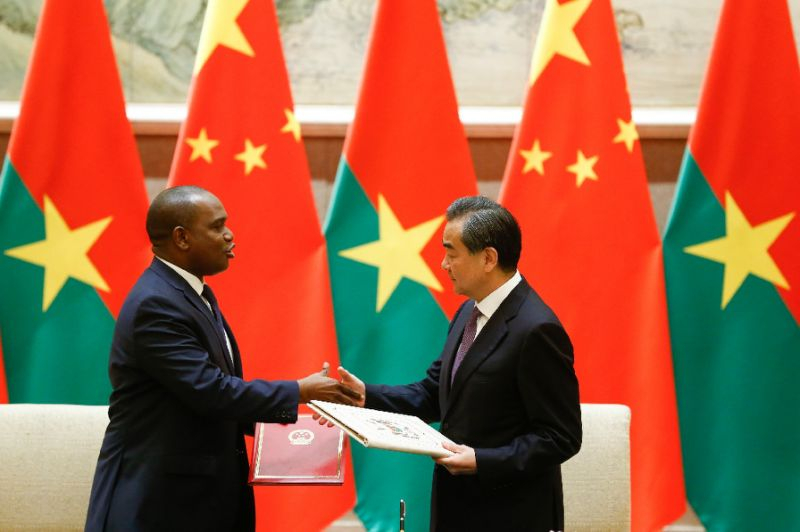
Chinese Foreign Minister Wang Yi shakes hands with his Burkina Faso's counterpart Alpha Barry as the two countries re-establish diplomatic ties in Beijing, China, May 26, 2018. /AFP Photo
Chinese Foreign Minister Wang Yi shakes hands with his Burkina Faso's counterpart Alpha Barry as the two countries re-establish diplomatic ties in Beijing, China, May 26, 2018. /AFP Photo
The landlocked poor Burkina Faso, even by West African standards, has suffered from military coups and economic turmoil since 2014. Recurring droughts are endangering the output of cotton, the main cash crop for the country and its 18.6 million people.
In 2016 and 2017, cotton output decreased by 5.6 percent to 553,000 tons. Much of the labor force sought jobs in neighboring countries like Cote d'Ivoire and Ghana. Years of terrorist attacks and poor safety conditions even in the capital Ouagadougou made foreign investors more cautious.
For Burkina Faso’s 18.6 million people, China is a potential partner to enhance its local economic and social development.
China’s investments in energy development, cotton cultivation and processing and pharmaceutical manufacturing have built up a good reputation in the neighboring Mali, Cote d'Ivoire and Ghana. China could also provide experience, equipment and training in countering terrorism and safety management since the Chinese peacekeeping force has conducted many operations with relevant parties in Mali for years.
Another blow to Taipei’s pro-independence
When a nation switches diplomatic ties to Beijing, Tsai Ing-wen will accuse Beijing of providing huge assistance to isolate Taipei from the international arena. However, it is Taipei that is playing the “Dollar Diplomacy” to keep the tottering diplomatic allies to delay the humiliating breakoff and continually challenging the one-China principle.
Solomon Island Prime Minister Rick Houenipwela’s recent visit to Taipei got 28 million US dollars in return. He raised the issues in front of Tsai Ing-wen at a banquet.
In 2017, Taipei paid Belize 60 million US dollars. For the Dominican Republic, Taipei also spent millions of dollars worth of military equipment and development programs to maintain their fragile ties.
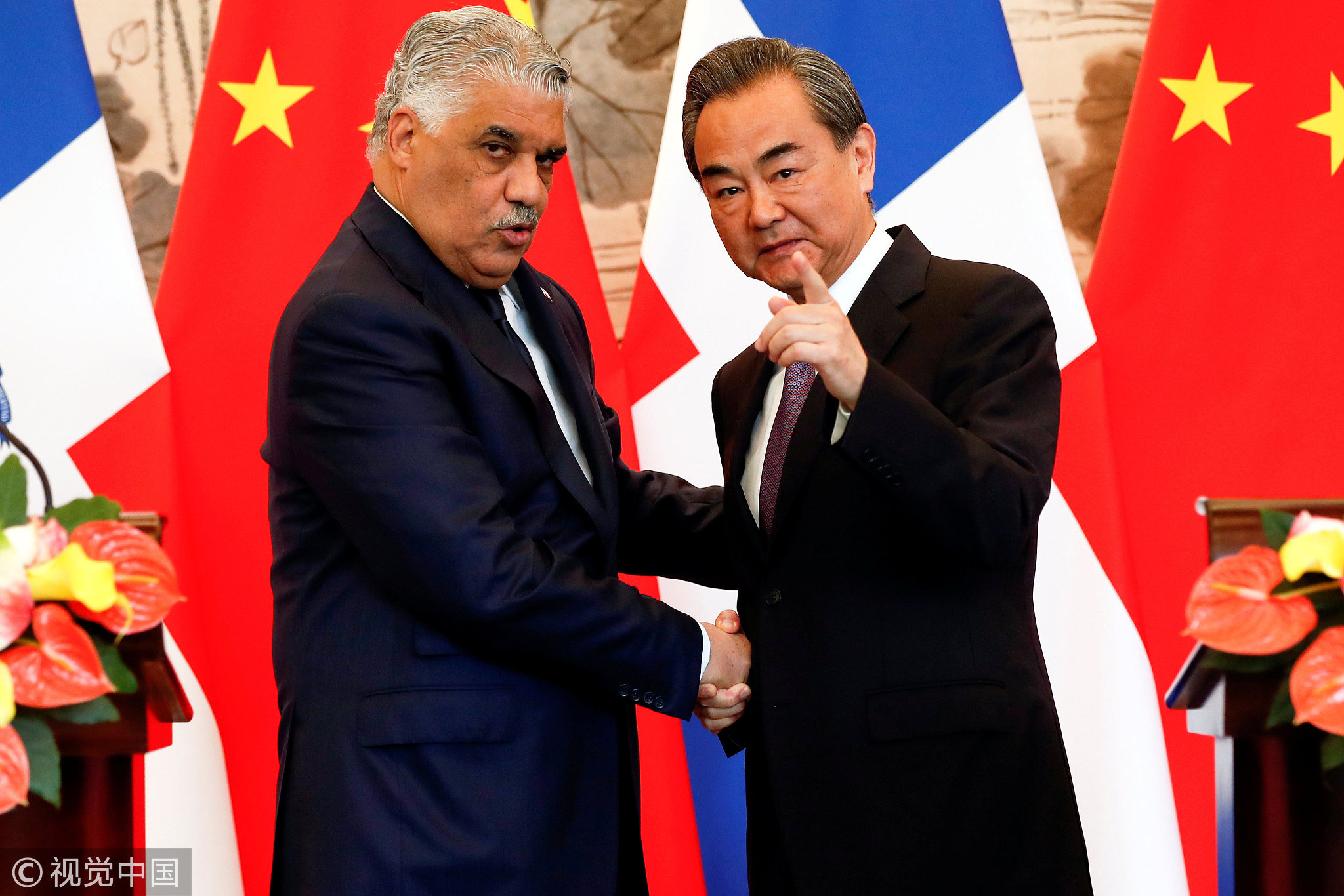
China's State Councilor and Foreign Minister Wang Yi shakes hands with Dominican Republic's Chancellor Miguel Vargas during a signing ceremony in Beijing, China, May 1, 2018. /VCG Photo
China's State Councilor and Foreign Minister Wang Yi shakes hands with Dominican Republic's Chancellor Miguel Vargas during a signing ceremony in Beijing, China, May 1, 2018. /VCG Photo
But the attempts are doomed to fail in the face of Taipei’s continuing challenge to the one-China principle and pro-independence stance. The Dominican Republic abandoned Taipei few weeks ago.
It is foreseeable that the only ally of Taipei — the small Kingdom of Swaziland – could switch diplomatic ties to Beijing and unswervingly adhere to the one-China policy soon. And it will not be surprising that any of the rest of the 18 countries, most of them poorer nations in Central America and the Pacific, along with the Vatican, abandon Taipei at any time.
Alert to Tsai Ing-wen and external provocations
Within one month, two countries have abandoned Taipei and firmly adhered to the one-China principle. Two more countries including Panama and Sao Tome and Principe shut out Taipei in the interim.
Pressures on Taipei are increasing, while Beijing shall give more warnings to the pro-independence Tsai Ing-wen, who could take more risks to hijack eternal external powers since Tsai intends to push more practical ties with Japan and the US.
By June 12, we will see US attendants in the opening ceremony of the American Institute in Taiwan’s new compound, a sensitive place for Beijing and Taipei. More concerns are about whether the US Marine Corps will come in uniform or not.
If Taiwan separatists and external power trigger more risky provocations, Beijing may take further and tougher actions to safeguard national sovereignty and territorial integrity.