
Tech & Sci
12:42, 01-May-2018
Illegal hunting driving migratory birds to extinction
 ["other","Abu Dhabi"]
Share







Copied
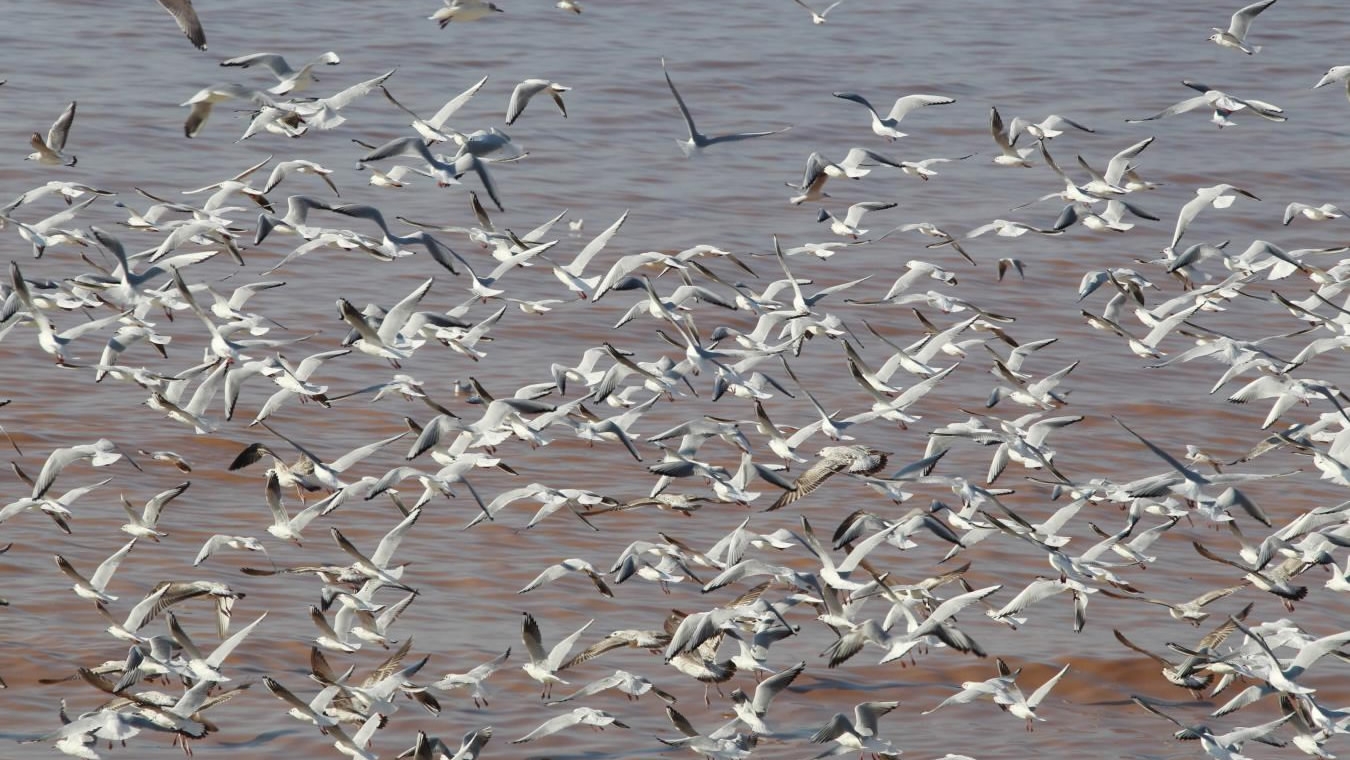
More than a quarter of world’s migratory birds face extinction due to illegal hunting or netting – with nearly half of the birds being killed in Italy, Egypt, Syria and Lebanon, according to a recent report released at the Global Flyaway Summit in Abu Dhabi.
“In the Mediterranean alone, an estimated 25 million migratory birds are illegally killed or taken each year, and work elsewhere is revealing that this is a widespread issue,” Barend van Gemerden, BirdLife’s Global Flyways Programme Coordinator said.
Every year, millions of birds travel thousands of miles, crossing three major global flyways: Africa-Eurasia Flyway, Americas Flyway, and East Asia-Australasia Flyway. Along the way, they are affected by excessive hunting, habitat loss, pesticide poisoning, and collision with power transmission lines.
According to International Union for Conservation of Nature (IUCN), nearly 13 percent of migratory species globally have been put under the vulnerable, endangered or critically endangered category.
In the last 300 years, agriculture has increased more than six-fold, and farmland occupies 38 percent of Earth’s land, a steep hike from six percent in 1700. “The conversion of natural habitats to farmland is now occurring most rapidly in tropical regions – driven by global demand for commodities such as coffee, cocoa, sugar, palm oil and soya,” the report said.
Even farmlands are not safe with the massive use of neurotoxic insecticides known as Neonicotinoids across North America, Europe and in other countries to pre-treat crops, which “has impaired birds’ migratory orientation.” Experts suggest using herbicide instead in farmlands that hosts migratory birds.
China's five decisions
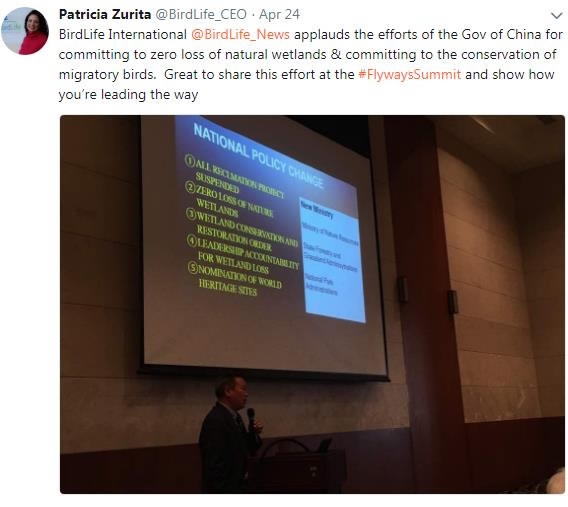
A senior delegate tweeted about China's action to protect wetlands, a crucial habitat of migratory birds. /Twitter Screenshot
A senior delegate tweeted about China's action to protect wetlands, a crucial habitat of migratory birds. /Twitter Screenshot
Amidst the grim realities threatening the existence of migratory birds, China’s recent policy changes to protect winged guests won applause at the conference. China is located midway on the East Asia-Australasia Flyway, and provides wintering and breeding grounds to millions of birds including the spoonbill sandpiper.
For centuries, China’s food-rich intertidal mudflats around the Yellow Sea have attracted more than 50 million migratory birds annually from the Arctic region, Australia and New Zealand. In the last few decades, massive land reclamation and hunting had decimated their population and habitat.
Lei Guangchun, a professor at Beijing Forestry University, spoke to delegates at the conference about China's five decisions aimed at protecting migratory birds. The government recently banned reclamation projects and is striving for zero loss of natural wetland.
The government has also initiated projects to revive the destroyed wetland. “In a bid to ensure the implementation of wetland conservation and protection, [the country] has made local leaders accountable for wetland loss. The fifth most effective action is of nominating wetland as world heritage sites,” Guangchun told CGTN.
Terry Townshend, director of Eco-Action pointed out that coastal wetlands along the Yellow Sea is a crucial stop for migratory birds to layover, rest, and refuel on marathon journeys. “China’s recent announcements to protect wetlands mean that the future for these birds is a little brighter,” he added.
[Top Image: Seagulls roam over rubbish on the shore of Beirut's southern suburb of Ouzai, Lebanon February 2, 2016. /Reuters Photo]