
Smartphone
22:41, 01-Aug-2018
Samsung borrows from Chinese playbook in battle for India's smartphone market
Updated
21:48, 04-Aug-2018
 ["china"]
Share







Copied
Sometimes keeping ahead of the game means learning some tricks from rivals – a strategy Samsung Electronics Co. Ltd. has adopted in India where Xiaomi Corp. and other Chinese brands have made hefty inroads.
Pages pulled from their playbooks include becoming savvier with online marketing to millennials as Samsung seeks to reinvent itself as a "younger brand," as well as providing sales staff for smaller stores and even finding a new love for cricket with a sponsorship deal.
Combined with a slew of new models – many aimed at undermining Chinese dominance of the 150- to 300-US-dollar phone segment – the new tactics are paying off with the South Korean tech giant reclaiming the No. 1 spot in the second quarter.
“Samsung was living in a sort of denial of the threat that Xiaomi, Oppo, Vivo posed but now they’ve come out of the ostrich hole,” said Rushabh Doshi, research manager at industry tracker Canalys. “Now they are fighting back, definitely.”

An attendee holds a Xiaomi Corp. Mi A1 dual camera device during the smartphone's launch in New Delhi, India, Sept. 5, 2017. /VCG Photo
An attendee holds a Xiaomi Corp. Mi A1 dual camera device during the smartphone's launch in New Delhi, India, Sept. 5, 2017. /VCG Photo
Its Galaxy J6 launched in May and the J8 sold from July have been doing especially well, each selling 50,000 a day, according to Samsung. In an appeal to millennials, the phones have a new “chat over video” feature which allows users to view videos without interruption even as they chat by text due to a transparent keyboard.
To be sure, Samsung has long dominated the premium end of the smartphone market in India and features like “chat over video,” designed at its Indian R&D center, underscore its tech prowess. It has also built up a wide retail network in the country.
But Samsung, which logged slower profit growth in April-June, knows it has to pull out the stops in India if it wants to avoid harsh lessons.
Just five years ago, it had 20 percent of the Chinese market only to see that fall to less than 1 percent this year, outgunned by Huawei, Xiaomi, Oppo and Vivo, particularly on pricing.
And India is too big a prize to lose – the world’s No. 2 smartphone market with about 400 million users and worth an estimated 20 billion US dollars annually.
It’s also the world’s fastest-growing major mobile phone market, expanding about 20 percent last quarter from a year earlier. For Samsung, India is its biggest market outside the US and one where it has invested heavily, by opening the world’s biggest smartphone factory outside New Delhi last month.
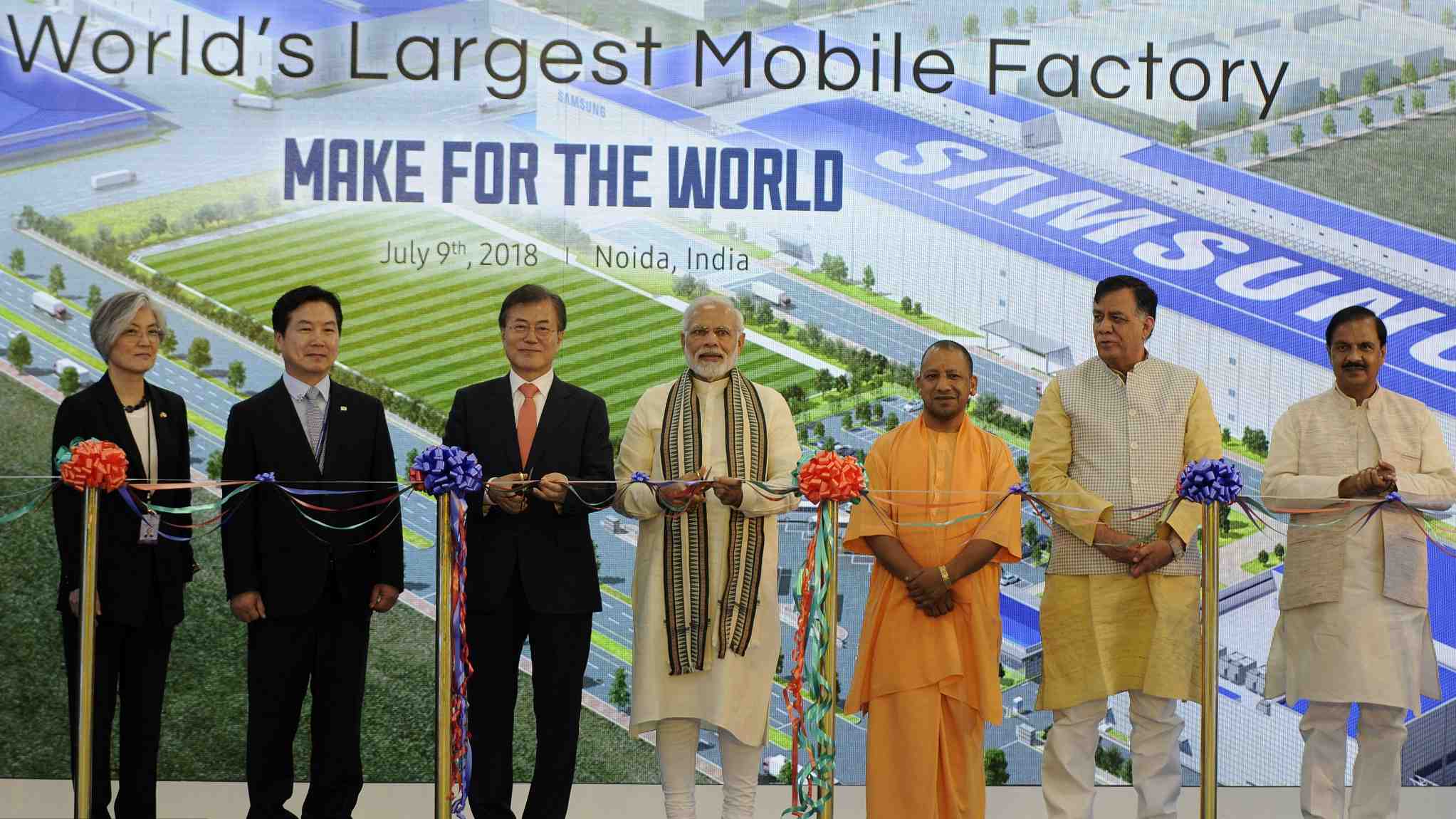
Indian Prime Minister Modi (fourth from left) and South Korean President Moon Jae-in (third from left) cut the ribbon at the inauguration ceremony of Samsung Electronics mobile phone manufacturing facility in Noida, India, July 9, 2018. /VCG Photo
Indian Prime Minister Modi (fourth from left) and South Korean President Moon Jae-in (third from left) cut the ribbon at the inauguration ceremony of Samsung Electronics mobile phone manufacturing facility in Noida, India, July 9, 2018. /VCG Photo
But Chinese brands now account for every one in two phones sold in India with Xiaomi making the greatest strides. After its 2014 market entry, the “Mi” brand steadily gained share to knock Samsung from the top spot last December.
Although Samsung regained the title last quarter, it was only by a hair’s breadth – 29 percent market share to Xiaomi’s 28 percent, according to research firm Counterpoint. Samsung started selling three new phones in the quarter while Xiaomi had one product release.
Samsung’s India unit did not respond to a request for comment on its strategies in the country.
A younger, hipper Samsung
To promote its 210-US-dollar Galaxy On6 smartphone launched last month, Samsung has eschewed traditional TV advertising. Instead it embarked on one of its most aggressive online campaigns, enlisting Bollywood heartthrob Tiger Shroff and uploading videos and photos to Facebook, Instagram and Twitter.
“It’s not just one ad which you’ll see again and again. Because millennials will get bored. What we want to do is to engage them...and whichever platform they are on, we’ll be there,” Ranjivjit Singh, Samsung India’s chief marketing officer, said in an interview.
But some analysts warn that Samsung will have to come up with creative social media strategies if it wants to maintain its lead over Chinese rivals and establish a stronger one.
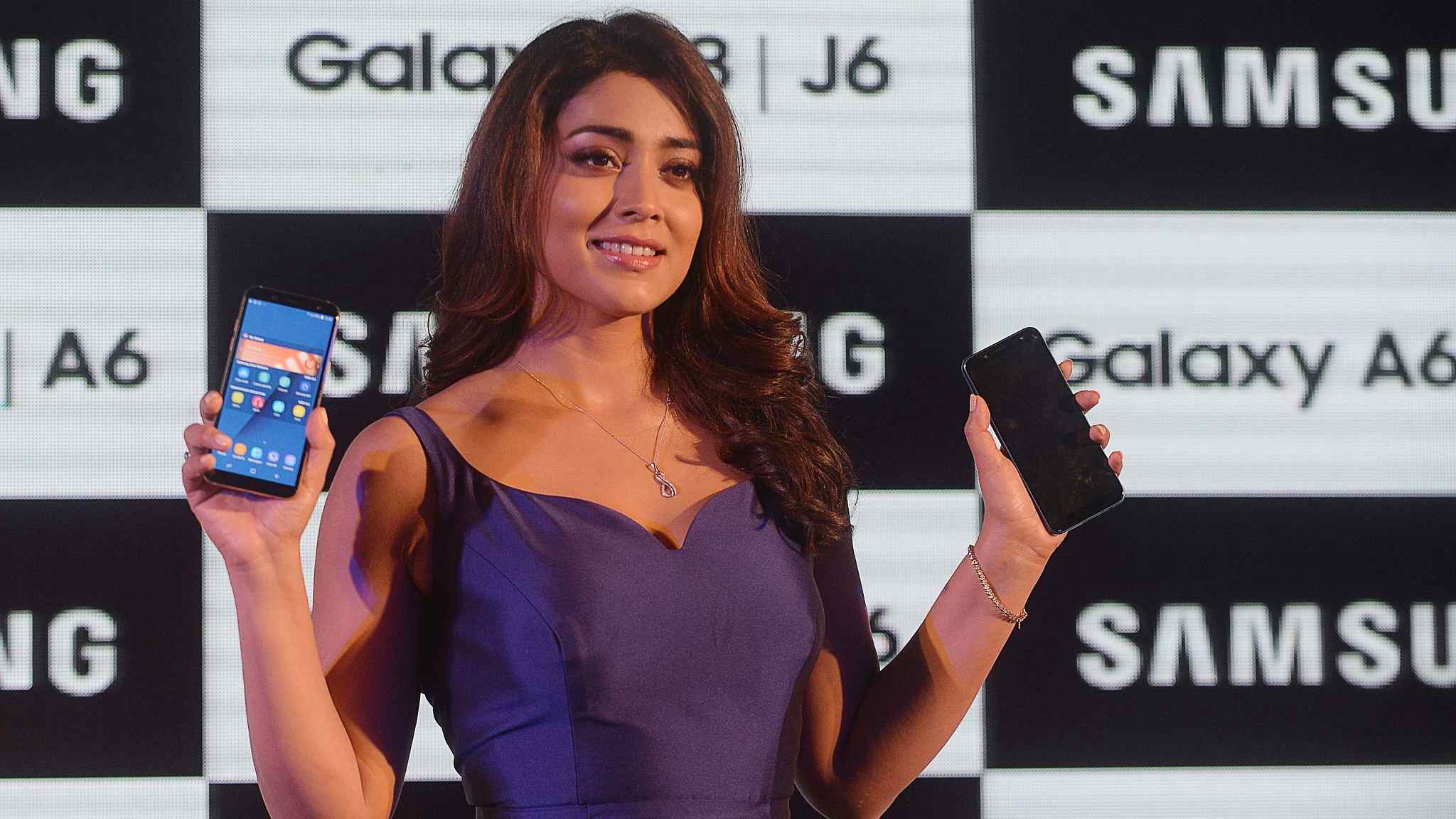
Indian Bollywood actress Shriya Saran poses with Samsung Galaxy A6 and J8 series phones during a launch in Chennai, India, May 21, 2018. /VCG Photo
Indian Bollywood actress Shriya Saran poses with Samsung Galaxy A6 and J8 series phones during a launch in Chennai, India, May 21, 2018. /VCG Photo
“Chinese brands such as Xiaomi, OnePlus have built a strong presence in India by targeting the youth with grand fan festivals when they launch models,” said Neil Shah, research director at Counterpoint.
Another new tactic has been Samsung’s sponsorship of the Mumbai cricket team. Cricket has worked well for rival Vivo, which has become a strong player in India on the back of its sponsorship of the country’s cricket league.
Company sources said Samsung has increased spending on marketing but declined to say by how much. But with its deep pockets, it can afford to invest heavily – a strategy that competitors may struggle to match longer term.
In brick-and-mortar stores too, Samsung has had to step up to match its Chinese rivals.
Previously it only paid for a Samsung sales specialist for stores with monthly sales of more than 1 million rupees (about 14,600 US dollars), but over the past year or so, it has halved that threshold following similar actions by Oppo and Vivo, said retail sources familiar with the matter.
The sources also said Samsung was developing financing products independently of current tie-ups with financial firms – a move which could help it offer customers a smoother sales process and even lift profit margins.
But its rivals aren’t standing still, moving further into the premium segment.
Huawei this year launched its flagship P20 Pro phone, which has three cameras, in India for about 950 US dollars in direct competition to Samsung’s S9. Vivo this month started selling the NEX, which has a camera that pops out, for roughly 655 US dollars.
“Chinese brands are launching these phones to prove that they don’t just make phones for the lower end of the market, but that they are master innovators,” Counterpoint’s Shah said.
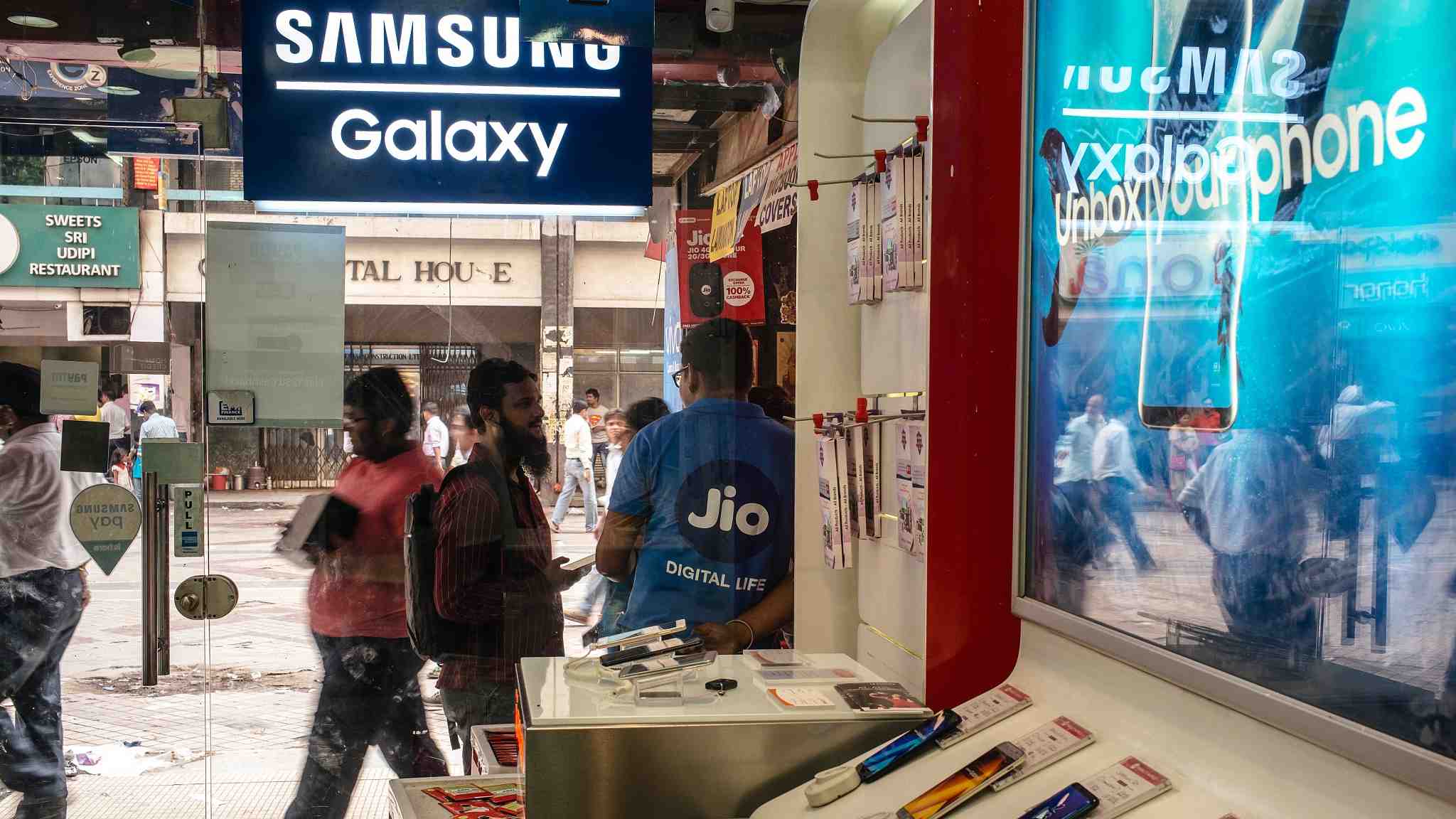
(Top image: A store selling Samsung Electronics Co. smartphones at the Nehru Place IT Market in New Delhi, India, May 30, 2017. /VCG Photo)
Source(s): Reuters