
Opinions
10:21, 09-Aug-2018
The Heat: US sanctions on Iran drift it away from world
Updated
10:03, 12-Aug-2018
 ["north america","other","Middle East"]
Share







Copied
01:01
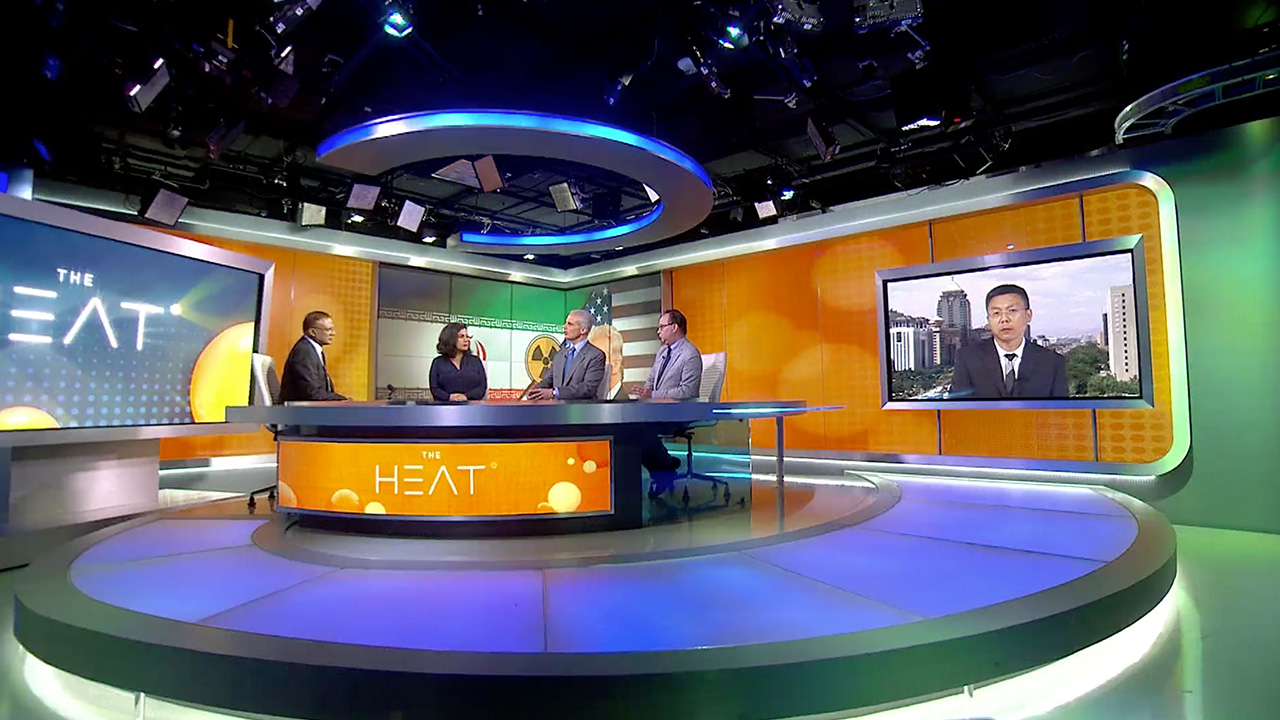
Despite opposition from the European Union and other US allies, the Trump administration is restoring sanctions on Iran with the first wave of punitive measures banning Tehran from dealing with US currency, targeting its auto industry and prohibiting it from trading with gold, minerals and metals.
Negar Mortazavi, an Iranian-American journalist covering Iran in English and Persian, said the impact of the sanctions has greatly escalated, with aviation companies for example unable to access new civilian planes for decades.
Opinions varied about the final effects of the punitive measures.
John Sitilides, a Washington DC-based geopolitical strategist and diplomacy consultant to the US Department of State, is a keen supporter of the policy.
"Companies will continue to do business with the US until the sanction really kicks in," said Sitilides. "The EU said that they are going to keep the deal alive, but lawyers in all of the big companies are not going to risk business with the US and will force their companies to comply with the sanction."
Opponents of pulling out of the landmark 2015 deal criticized the US for leaving probably the best non-proliferation agreement that can possibly be achieved by all major powers in the world.
Nathan King, CGTN's correspondent in the White House, recalled the many times representatives left the negotiating table before finally reaching an agreement.
"The EU countries are trying to stay in the deal, because they know that if they don’t, Iran is free to pursue nuclear weapons," warned King.
Discussions of the sanction expanded beyond the EU club and reached other geographically distant countries like South Korea.
"You hear Asian companies like those from South Korea talking about pulling out," suggested Mortazavi. "There is going to be a diversity of companies: Larger ones will probably pull out while the medium-sized ones will stay in some way."
Efforts from the international community are preventing the status quo from worsening. EU foreign policy chief Federica Mogherini said the EU is trying to keep Iran in the deal by ensuring its economic benefits.
"We believe this is not just a security interest of the region but also of the world," Mogherini noted. "If there is one piece of the non-proliferation agreement that is delivering, that has to be maintained."
Iranian President Hassan Rouhani also suggested in a recent interview that the possibility of negotiation would rise only when the US "negotiates in a logical way." Mortazavi suggested that for Iran, Trump's offer is attractive but also dangerous.
"The no-precondition proposal is certainly appealing, but accepting Trump’s offer is high in political cost," she said.
However, most analysts suggested that the chance for achieving a better deal than the current one is rare, given the difficulty of another round of negotiations. King even described Trump’s act as departing from "a non-proliferation agreement that everyone agrees except on 1600 Pennsylvania Avenue."
Mortazavi weighed in on that point, suggesting that the current sanctions will not be as successful as the measures imposed by the Obama administration, which were backed by the international community.
But Trump's supporter argued that the real battle here has little to do with sanctions or other tactics, but the willingness to avoid violence.
"It’s the time when you realize which side is more for peace," said John. "And Washington will win the battle."
By refusing to reduce oil imports from Iran, China has projected a strong voice in defending the economic interest of Iran. Since China's imports are equivalent to more than one-quarter of Iran’s oil exports, the Asian powerhouse is essentially helping Iran shake off the sanctions.
"The market is reacting with confidence," said Xu Qinduo, a political analyst at China Radio International. "This will also expand the use of yuan."
The Heat with Anand Naidoo is a 30-minute political talk show on CGTN. It airs weekdays at 7:00 a.m. BJT and 7:00 p.m. Eastern in the United States.