
Opinions
18:23, 29-Sep-2018
Opinion: Slamming Trump to his face, Bolivia has more than courage
Updated
17:21, 02-Oct-2018
 ["china"]
Share







Copied
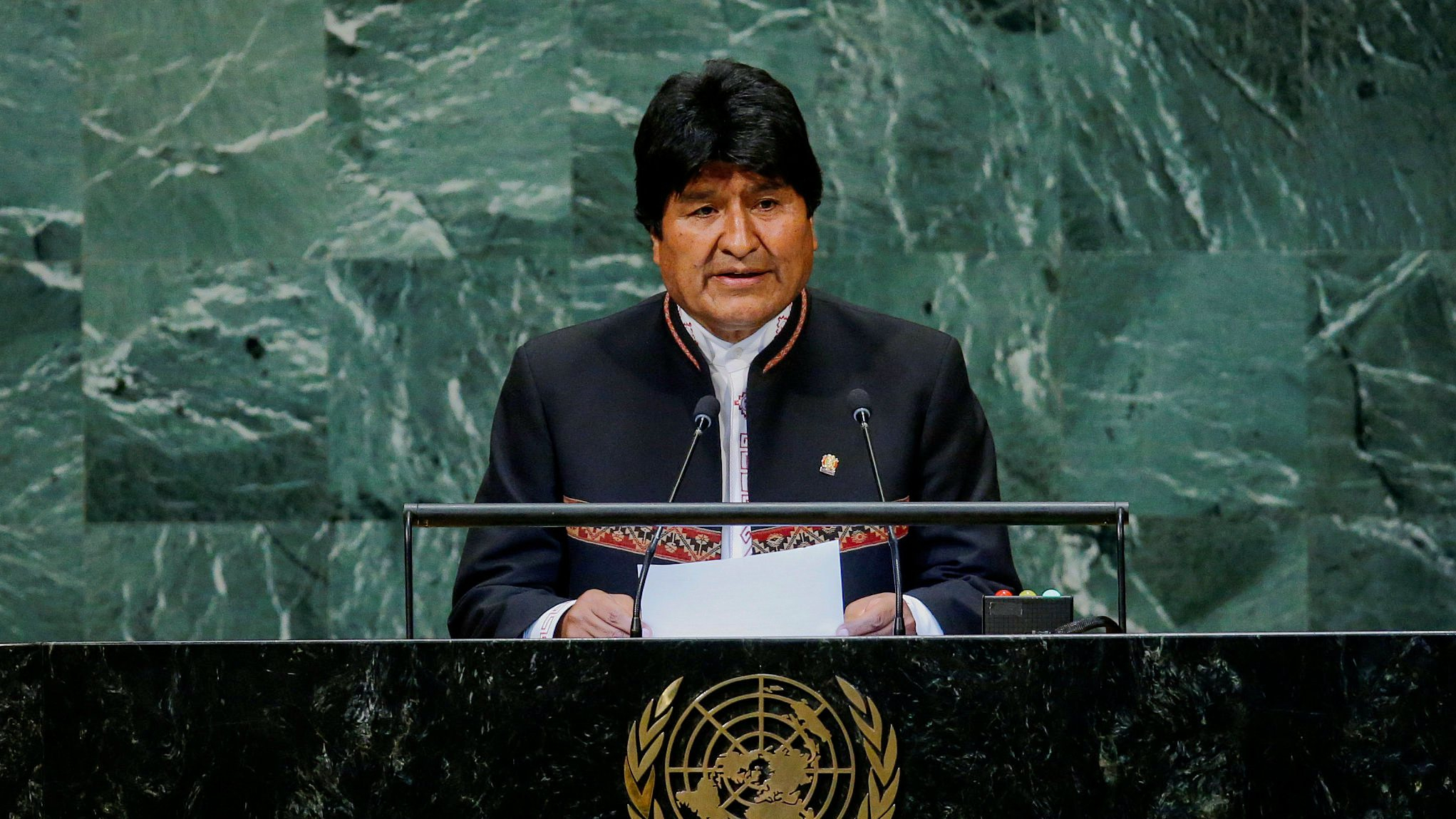
Editor's note: Lyu Yang is an assistant research fellow at the Institute of Latin America Studies under the China Institutes of Contemporary International Relations. The article reflects the author's opinions, and not necessarily the views of CGTN.
When US President Donald Trump chaired the meeting of the United Nations Security Council, which for the first time was held at head-of-state and government level since 2014, he wouldn't have expected to witness the fiercest criticism on him so far.
Neither from Iran who's been quarreling with the US over the nuclear deal, nor from China who's dauntlessly dealing with US' escalation of the trade war, but from Bolivia, by one of the most charismatic leaders in Latin America, President Evo Morales.
The president of Bolivia was the fifth to speak at the meeting, after representatives of the United States, France, Poland, and Equatorial Guinea.
Instead of offering comments on Trump's decision to pull out of the Joint Comprehensive Plan of Action (JCPOA) nuclear agreement with Iran, like most of the other representatives, Morales harshly criticized US' history of intervention.

Chinese President Xi Jinping shakes hands with Bolivian President Juan Evo Morales Ayma during a welcome ceremony at the Great Hall of the People in Beijing, China, June 19, 2018. /VCG Photo.
Chinese President Xi Jinping shakes hands with Bolivian President Juan Evo Morales Ayma during a welcome ceremony at the Great Hall of the People in Beijing, China, June 19, 2018. /VCG Photo.
"In no way is the United States interested in upholding democracy," he said on Twitter, "If that were the case, it would not have financed coups d'etat and supported dictators," referring to Iran's case in 1953. The Bolivian leader also said that the US was responsible for the military invasion of Iraq, military intervention in Libya and Syrian civil war.
Trump is not frequently challenged by world leaders so directly, but the criticism did not come as surprise when it came from Morales - a legendary figure born in a family of subsistence farmers and became Bolivia's first president to come from the indigenous population.
Morales has long been a fierce critic of the US, he raised the well-known Latin American "Pink Tide" alongside with the late Venezuelan President Hugo Chavez and Rafael Correa, Ecuador's former President, all of whom were iconic leaders of Latin American Left.
In 2008, two years after Morales came to power, the Bolivian government expelled the US ambassador and US law enforcement and development cooperation agencies for its attempts to foment a civil unrest against the indigenous president.
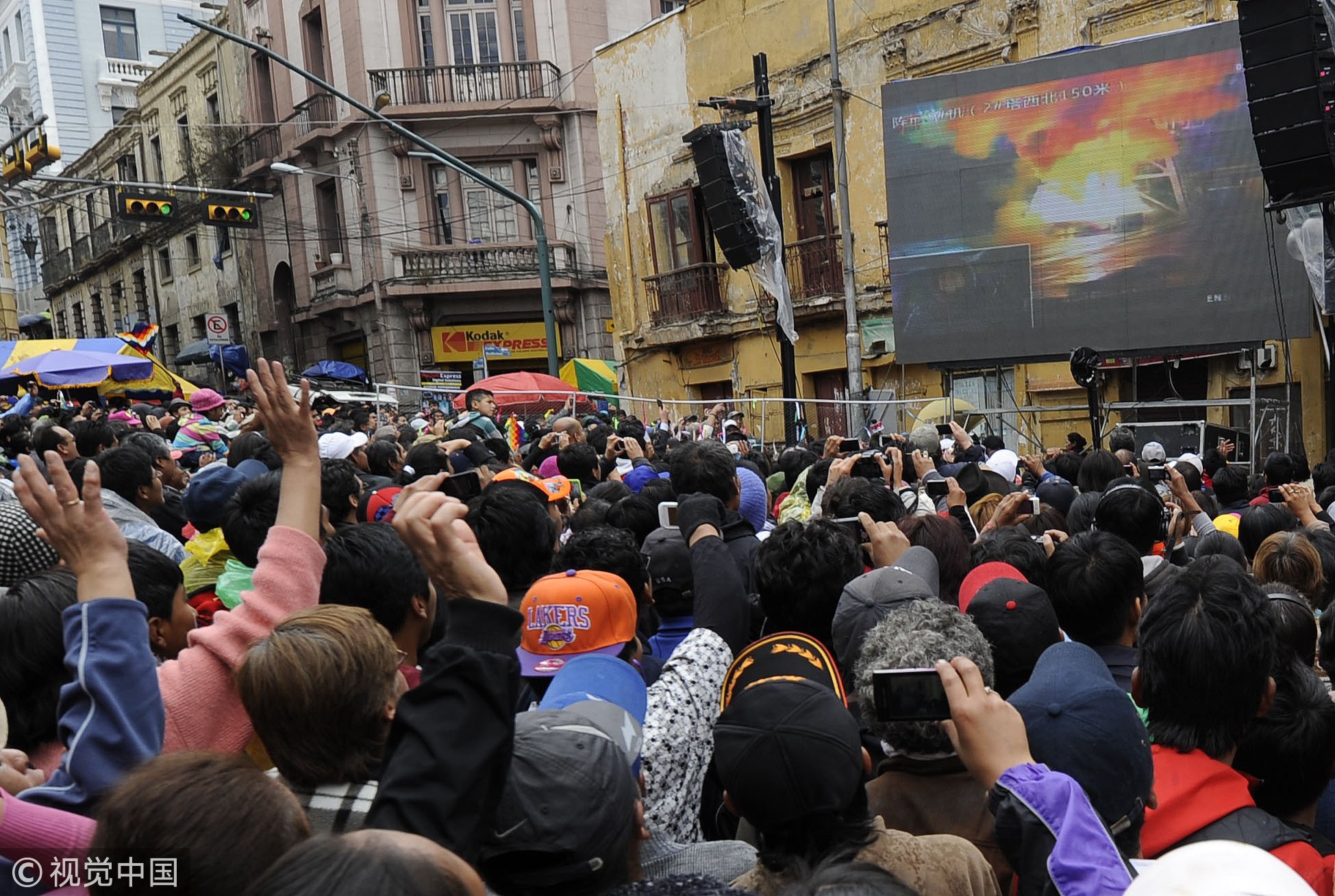
People watching live-broadcast of the launch of the Tupac Katari Bolivian telecommunications satellite from southwest China's Xichang Satellite Launch Center, in La Paz, Bolivia, December 20, 2013. /VCG Photo.
People watching live-broadcast of the launch of the Tupac Katari Bolivian telecommunications satellite from southwest China's Xichang Satellite Launch Center, in La Paz, Bolivia, December 20, 2013. /VCG Photo.
While criticizing the acts of Trump administration Morales recalled US' shameful history of intervening in the internal affairs of Bolivia.
Despite the historical disputes between the two countries, Morales' speech was not only a show of courage but also an expression of confidence and support.
In just 12 years, while practicing the "Socialism of the 21st Century," a farmer's son transformed Bolivia from one of the most undeveloped countries in western hemisphere to a promising economy with an annual GDP growth of more than 4 percent. Morales led the left wing movements of Latin America and participated vigorously in the Non-Aligned Movement (NAM).
But in recent years, with the death of Commandant Chavez and the political-economic crisis of Venezuela, as well as the outgoing of Latin American left leaders such as Ecuador's Rafael Correa and Argentina's Cristina Kirchner, the "Pink Tide" is witnessing a downfall.
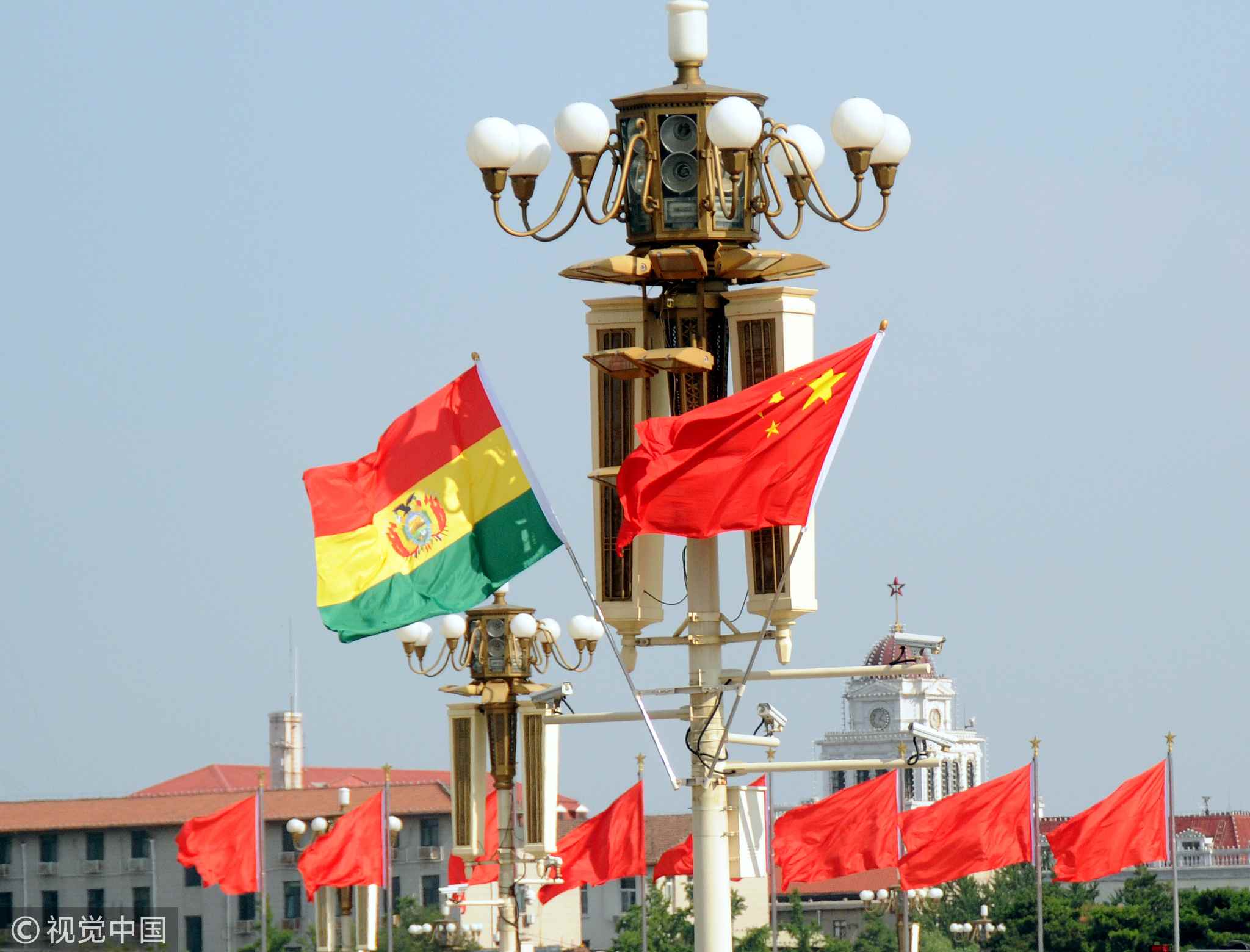
National flags of China and Bolivia waving at the Tiananmen Square during Bolivian President Morales' state visit to China, Beijing, June 19, 2018. /VCG Photo.
National flags of China and Bolivia waving at the Tiananmen Square during Bolivian President Morales' state visit to China, Beijing, June 19, 2018. /VCG Photo.
As one of the few left-wing leaders in power and with high popularity, Morales has to go all out to defend the left-wing political heritage. In his speech, Morales criticized Trump for threatening Venezuela and US' opposition to the International Criminal Court (ICC), extending his support for the "Socialist Comrade" and opposing interference from the North.
By criticizing the Trump administration, the president of Bolivia was also defending multilateralism and Latin American integration process. As a landlocked state, Bolivia is very dependent on foreign trade and therefore advocates actively the regional integration.
The country is now an indispensable leader in the group of Bolivarian Alliance for the Peoples of Our America (ALBA) which includes all the left-wing states of the region, a member of the Union of South American Nations (USAN ), and striving to join the Southern Common Market (MERCOSUR).
Unfortunately, all these efforts came to nothing when the "northern superpower" decided to disrupt the development of ALBA by imposing sanctions on Venezuela and plotting a coup against the Venezuelan government, as well as using the so-called "Venezuelan crisis" and ideological disputes as excuses to trigger tensions between left-wing nations such as Venezuela and Nicaragua and right-wing nations like Colombia and Argentina, which caused a stagnation of the integration process of UNASUR and MERCOSUR.
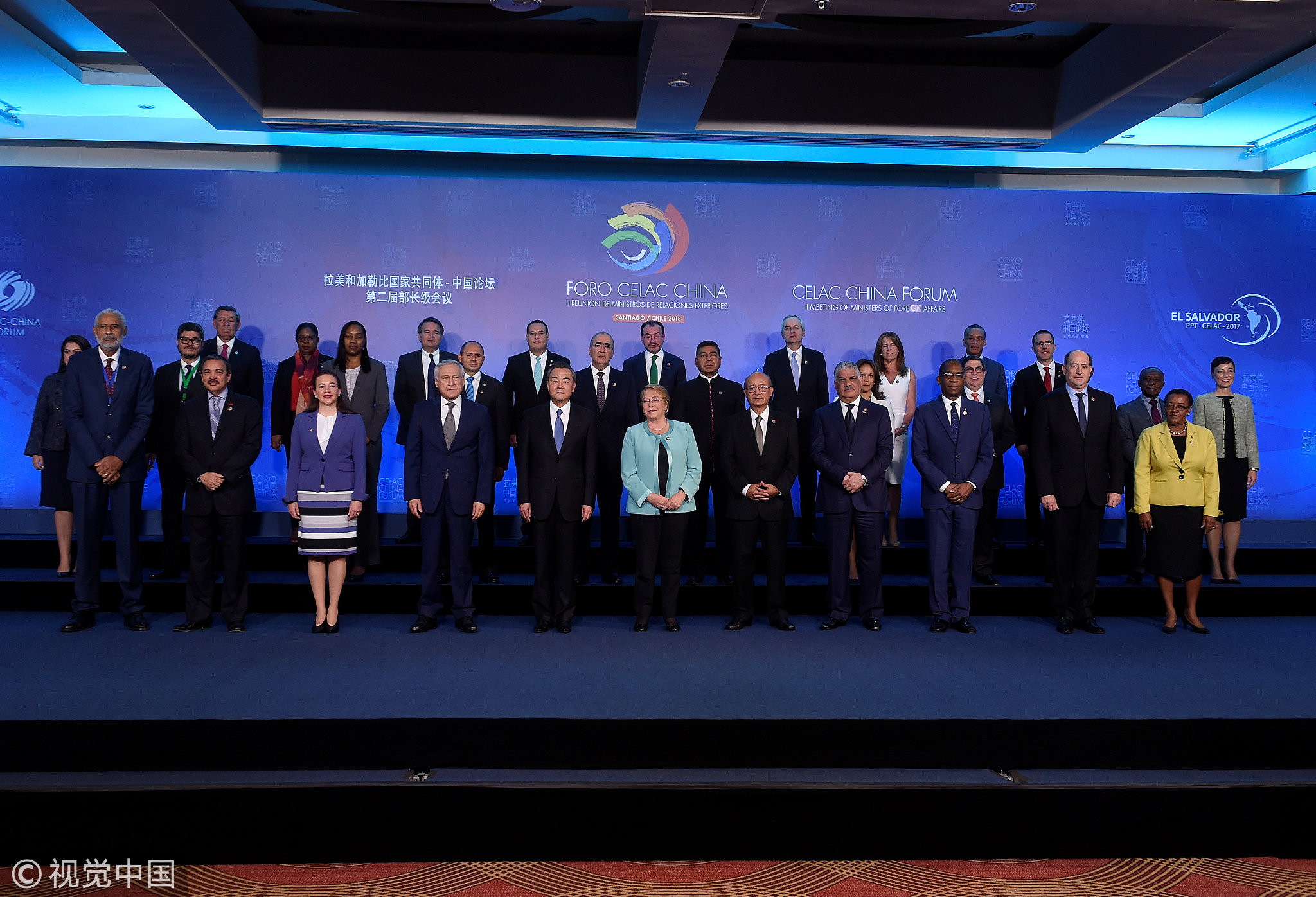
The second ministerial meeting of the Forum of China and the Community of Latin American and Caribbean States (CELAC) in Santiago, Chile, January 22, 2018. /VCG Photo.
The second ministerial meeting of the Forum of China and the Community of Latin American and Caribbean States (CELAC) in Santiago, Chile, January 22, 2018. /VCG Photo.
In that sense, Bolivia had to spare all efforts to fight off foreign interference and call for a regional unity in order to create a better external environment for its trade and investment.
Put aside the aggressive words against Trump, Morales didn't forget to express his gratitude to China's contribution to global affairs. China and Bolivia have maintained a relationship of mutual benefit for more than 33 years. China is now Bolivia's fourth largest trading partner and the third largest source of imports.
China's total stock (flows) of foreign direct investment (FDI) in Bolivia exceeded 7 billion US dollars, which helped tremendously in development of infrastructure, mining, and energy industries.
When Morales paid the state visit to China in June, 2018 at the invitation of President Xi Jinping, the two leaders signed a joint statement on establishing the strategic partnership between the two countries and promised to coordinate positions on UN affairs as well as major international issues such as sustainable development and climate change.
With the support of China and all the other nations, Bolivia will always be an active prompter of a new type of international relationship featuring mutual respect, fairness, justice, and win-win cooperation and joining hands in building a community of shared future for the mankind. When facing hegemonism, interventionism or isolationism, the people of Bolivia would never hesitate to stand out and speak loud.
(If you want to contribute and have specific expertise, contact us at opinions@cgtn.com.)