
Politics
16:08, 02-May-2018
Haley: Support for US positions at UN 'not an acceptable return'
 ["north america"]
Share







Copied
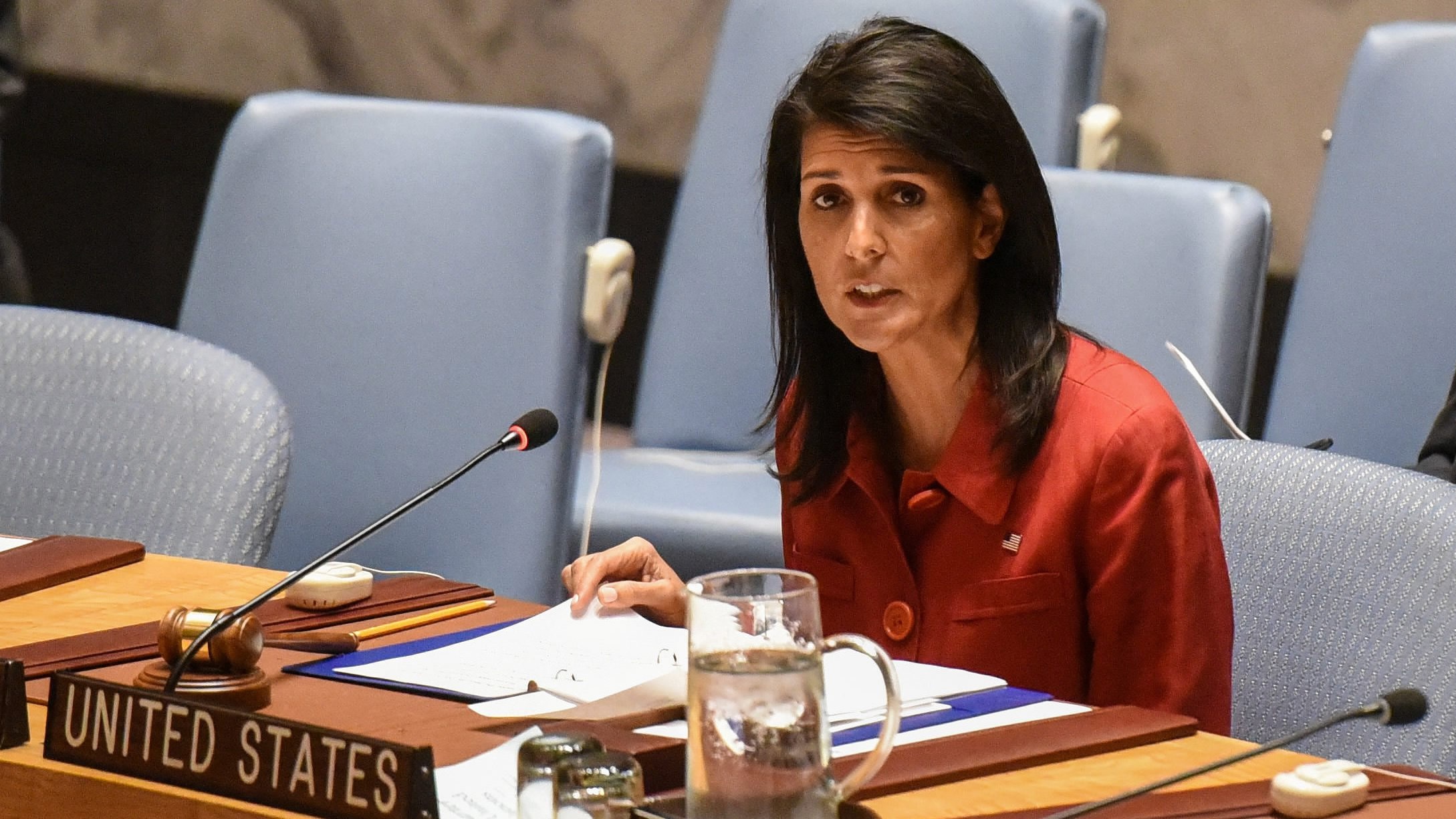
US Ambassador to the United Nations Nikki Haley has criticized the level of support for US positions at the UN as "not an acceptable return on our investment" given Washington's annual contribution to the organization.
In a press release published after the State Department's release of its annual UN Voting Practices Report on April 26, Haley said that the US pays 22 percent of the UN budget but UN members only supported the US position on 31 percent of resolutions voted on in 2017 – a drop of 10 percentage points from 2016.
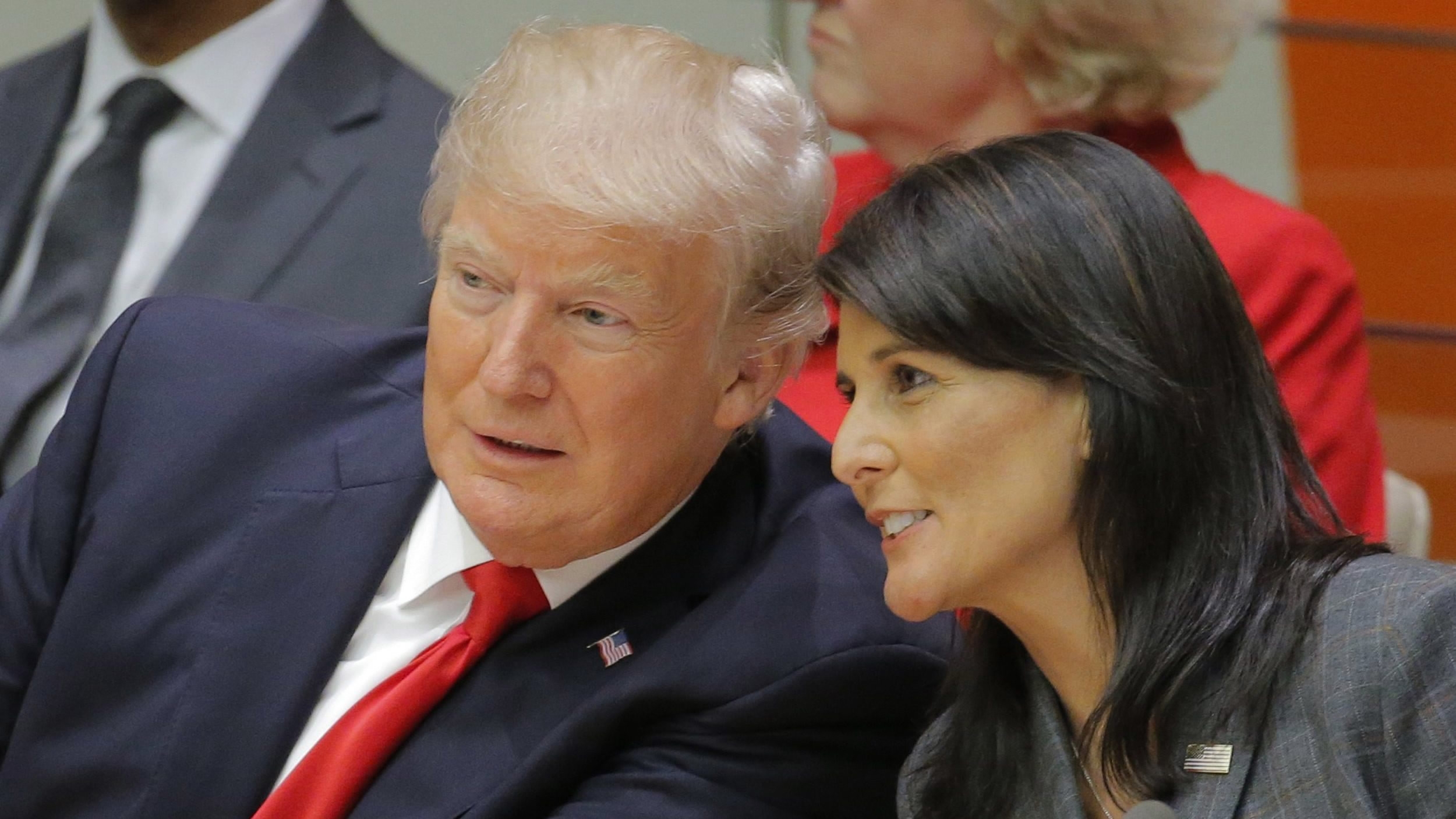
US President Donald Trump talks with US Ambassador to the UN Nikki Haley as they attend a session on reforming the United Nations at UN Headquarters in New York, US, September 18, 2017. /VCG Photo
US President Donald Trump talks with US Ambassador to the UN Nikki Haley as they attend a session on reforming the United Nations at UN Headquarters in New York, US, September 18, 2017. /VCG Photo
"This is not an acceptable return on our investment," Haley said. "When we arrived at the UN last year, we said we would be taking names, and this list of voting records speaks for itself."
"President Trump wants to ensure that our foreign assistance dollars – the most generous in the world – always serve American interests, and we look forward to helping him see that the American people are no longer taken for granted."
However, Mark Leon Goldberg, editor of website UN Dispatch, told Fox News the State Department report did not paint a full picture. The website, which tracks and analyzes the work of the UN, noted that consensus resolutions reflected the majority (230 of 323) adopted by the UN General Assembly last year.
"This report misrepresents the true extent of cooperation and agreement with the United States at the UN because the 2017 report, unlike in past years, excludes decisions that are taken by consensus,” he said.
“Votes by consensus represent the vast majority of decisions taken at the UN. Excluding these decisions from the overall count gives the appearance that the UN is a far more adversarial place than it actually is."
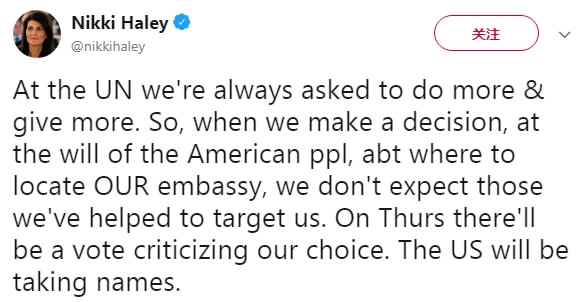
US Ambassador to the UN Nikki Haley tweets on December 19, 2017. /Twitter Screenshot
US Ambassador to the UN Nikki Haley tweets on December 19, 2017. /Twitter Screenshot
Haley's words echo those she used in the wake of Trump's decision in December 2017 to recognize Jerusalem as the capital of Israel. She wrote to other UN ambassadors to say she would be watching how they voted on a resolution opposing the US move, and said the president had requested that she "report back on those countries who voted against us."
The UN General Assembly ultimately voted overwhelmingly – 128 to nine, with 35 abstentions – to reject the US decision.
An internal memo obtained by Foreign Policy in March indicated Haley was considering linking US aid payments to how countries vote at the UN. That position has been backed by new US National Security Advisor John Bolton, who told Fox News before he was appointed to the role, "I've been of the view that votes in the United Nations should cost people, cost countries that vote against us."
According to the State Department report, the 10 countries that voted with the US most often in 2017 were Israel, Micronesia, Canada, Marshall Islands, Australia, the UK, France, Palau, Ukraine, and the Czech Republic.
The 10 countries that voted least often with the US were Zimbabwe, Burundi, Iran, Syria, Venezuela, the Democratic People's Republic of Korea, Turkmenistan, Cuba, Bolivia, and South Africa.