
Opinions
12:50, 19-Oct-2018
Opinion: Moon's Europe trip to prop up Peninsula peace
Updated
12:19, 22-Oct-2018
 ["china"]
Share







Copied
Editor's note: Xu Fangqing is a senior editor with China News Week and a non-resident fellow with the Center for China and Globalization. The article reflects the author's opinion, and not necessarily the views of CGTN.
The nine-day European tour from October 13 to October 21 of Republic of Korea (ROK) President Moon Jae-in seems like a luxury especially considering the "scant common interests" and sparse exchanges between the two sides historically and at present. It's more like a canvassing journey for the peace progress of the Korean Peninsula as we have seen from the arrangement of the five-state visit.
According to the agenda issued by the Blue House, Moon has put the nuclear issue on the Peninsula high on his agenda during his visits to Belgium, France, Italy, Vatican City, and Denmark. Local mainstream media like Yonhap News, JoongAng Ilbo and KBS also highlighted the denuclearization process in their headlines as they reported Moon's trip.
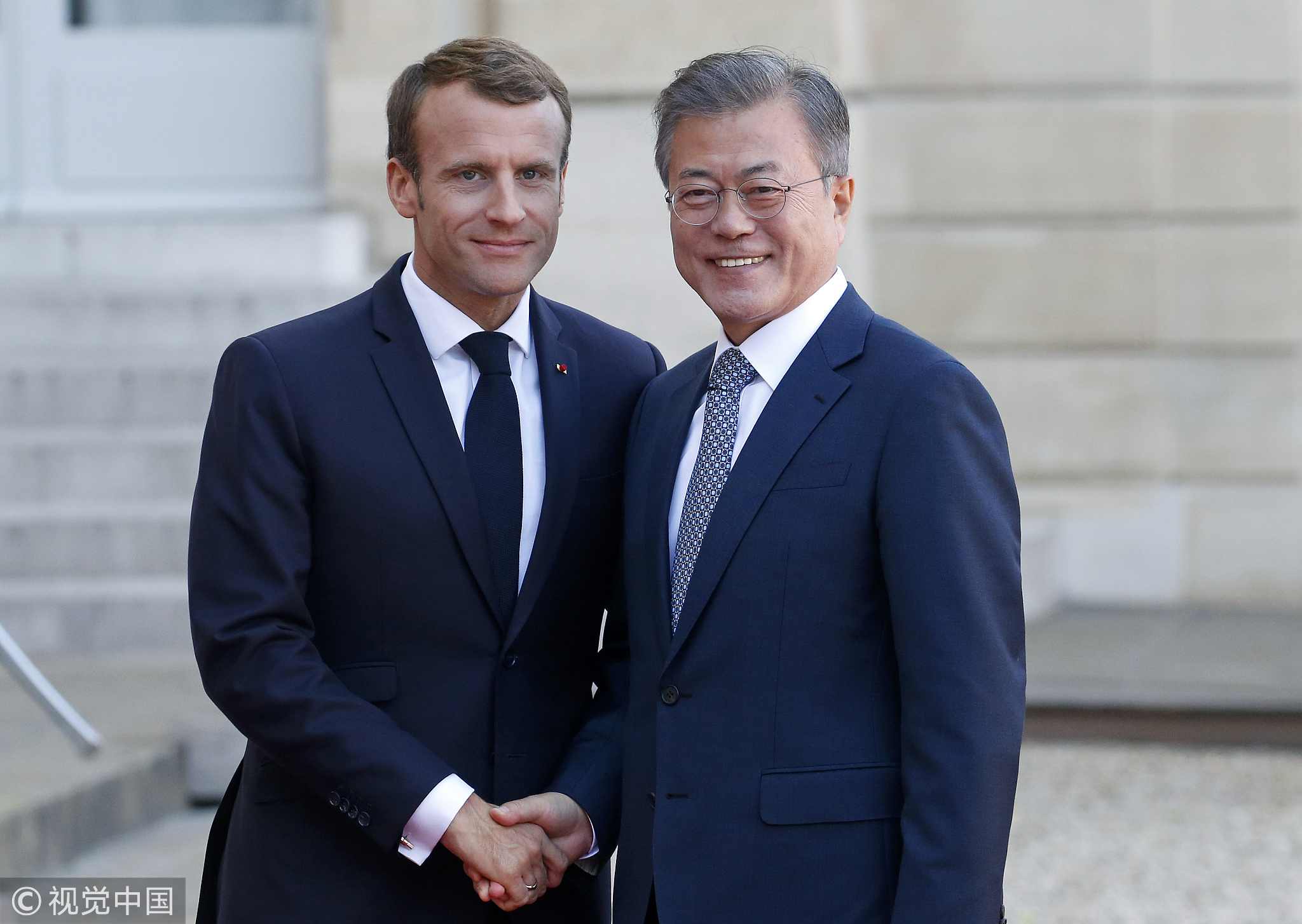
French President Emmanuel Macron (L) welcomes ROK President Moon Jae-in prior to their meeting at the Elysee presidential palace in Paris, October 15, 2018. /VCG Photo
French President Emmanuel Macron (L) welcomes ROK President Moon Jae-in prior to their meeting at the Elysee presidential palace in Paris, October 15, 2018. /VCG Photo
Moon wrapped up his four-day visit to France on October 16, the only permanent members of the United Nations Security Council. Obviously, President Moon gained support from his French counterpart Emmanuel Macron on lifting sanctions against the Democratic People's Republic of Korea (DPRK).
Likewise, Moon's Vatican trip is also expected to bring benefits to the peace progress on the Korean Peninsula. On Thursday he met Pope Francis in the Vatican, and passed on DPRK leader Kim Jong Un's invitation to the pope to visit Pyongyang. The invitation is an olive branch handed out by Pyongyang to the Catholic world and an attempt to soften the DPRK's image on the international stage.
The Vatican lost contact with the DPRK after the breakout of the Korean War in the early 1950s but the city-state has been active in the Peninsula issue and insisted on solving problems peacefully and calling on the international community to give the DPRK more humanitarian assistance.
Pope Francis has also resorted to exercising a bigger and more unique role in global issues, praying for the peaceful outcome of the historical Kim-Trump summit and the inter-Korean summit between Kim and Moon.
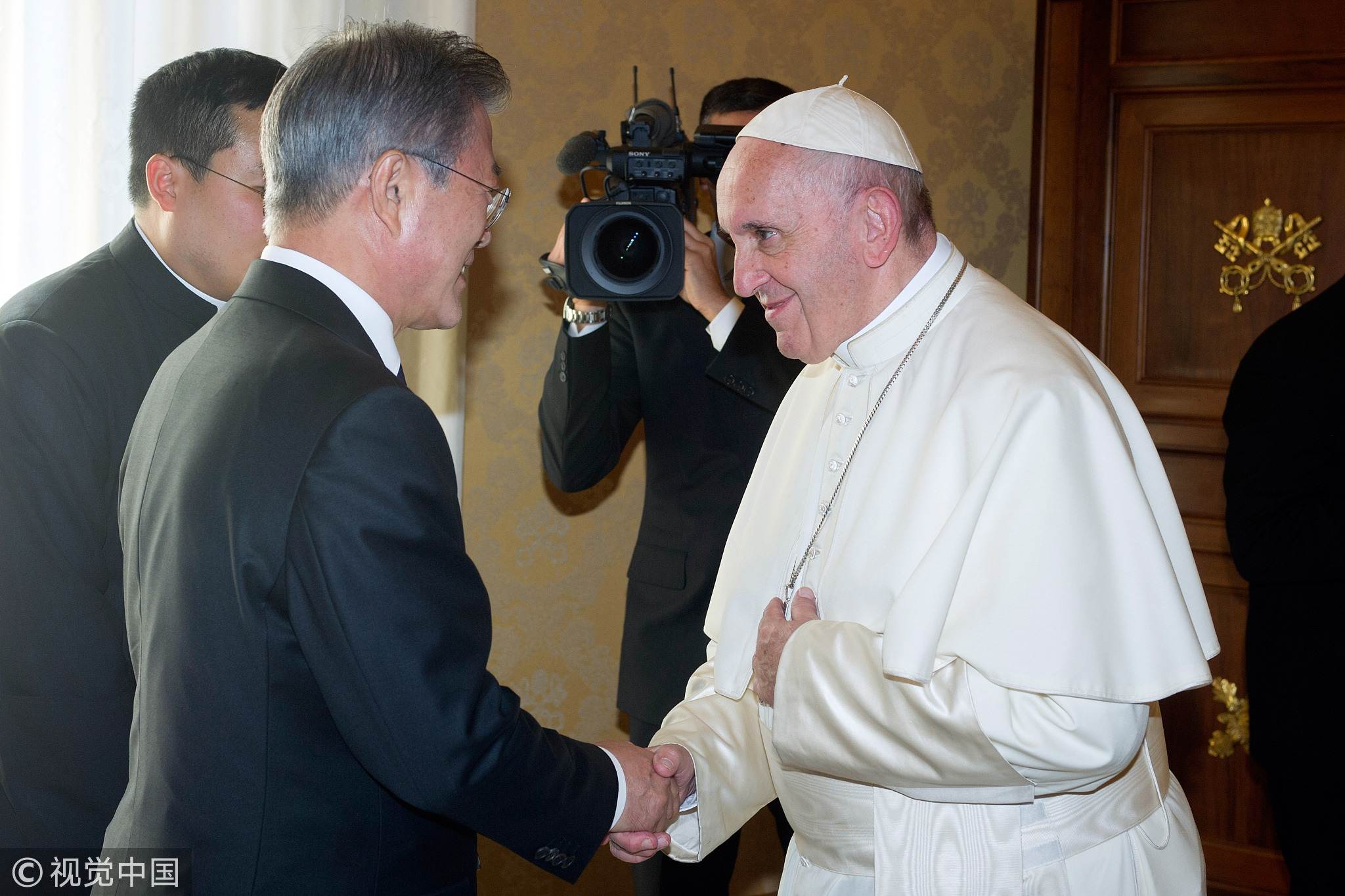
Pope Francis (R) meets ROK President Moon Jae-in during an audience at the Apostolic Palace in the Vatican, October 18, 2018. /VCG Photo
Pope Francis (R) meets ROK President Moon Jae-in during an audience at the Apostolic Palace in the Vatican, October 18, 2018. /VCG Photo
As one part of the "charm diplomacy" of Kim, the reconciliation with the Vatican is predictable, as the DPRK leader is seeking to make more breakthroughs, including another DPRK-US summit and visits to Moscow and Seoul by the end of 2018.
In order to defuse the bomb on the Peninsula, Moon is making great efforts to regional peace and the denuclearization of the Peninsula. That's why he has been working so hard as a "moderator" to harmonize the interests of the involved countries.
Apparently, Seoul won't miss the chance to boost the ROK-EU comprehensive relationship and thus President Moon also chose to visit Brussels, the headquarters of the EU. A supportive EU undoubtedly will be helpful in the final peace progress on the Peninsula.
An open and cooperative Korean Peninsula is a portrait that President Moon has tried to draw to the world. It, of course, would be challenging to keep the current trend and fulfill the goals in the upcoming days.
The trust mechanism between the DPRK and US still needs time to build up while the make-or-break situation the ROK and DPRK have to face leaves them no choice but to seek compromises and cooperation on the way to reduce the risks.
The ROK has already realized that all the achievements acquired from the past dozens of years would be wiped off overnight and millions of Koreans would lose their lives once a massive military conflict erupts in the region. That somehow explains this unprecedented EU visit: Moon is acting as an intermediary between the DPRK and other countries in the world.
(If you want to contribute and have specific expertise, contact us at opinions@cgtn.com.)