
Politics
08:34, 25-Apr-2018
France's Macron urges US not to back out of Iran deal
 ["north america"]
Share






Copied
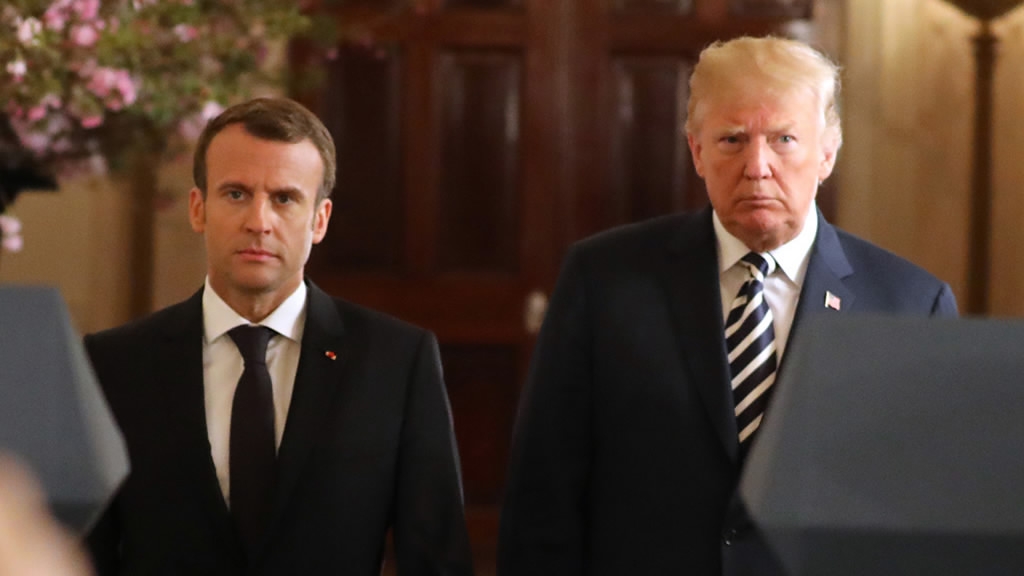
US President Donald Trump has given his strongest indication yet that he will pull out of the Iran nuclear deal, which was signed in 2015 under his predecessor Barack Obama. In Washington on Tuesday, as he hosted French President Emmanuel Macron for a state visit, Trump called the deal "insane" and "ridiculous."
Known as the Joint Comprehensive Plan of Action (JCPOA), the agreement was the culmination of a decade of talks aimed at reining in Iran’s nuclear program. France, Germany, the UK, Russia, and China are also signatories.
Read more: Iran nuclear deal explained
Macron came to the US in part to help convince Trump to stay in the deal. Instead, Trump suggested the US could pull out of the agreement by May 12, the next deadline requiring US recertification.
Trump has been critical of the deal since his campaign days, calling the agreement a "terrible deal."
"It’s bad deal. It's a bad structure," Trump said. "It's falling down (and it) should have never ever been made. I blame Congress. I blame a lot of people for it. But it should have never been made. And we're going to see what happens on the 12th."
Macron admits the agreement is flawed but salvageable. The French leader proposed a separate agreement – part of a four-pillar approach – that would address US and French concerns about Tehran's behavior in the Middle East (including Iran's ballistic missile testing) in exchange for Washington staying in the agreement.
"We have nuclear in the short-term, we have nuclear in the long run," Macron said, referring to two of the pillars his plan would cover. "We have ballistic activity, and we have Iran's regional presence. We want to fix the situation for these four pillars."
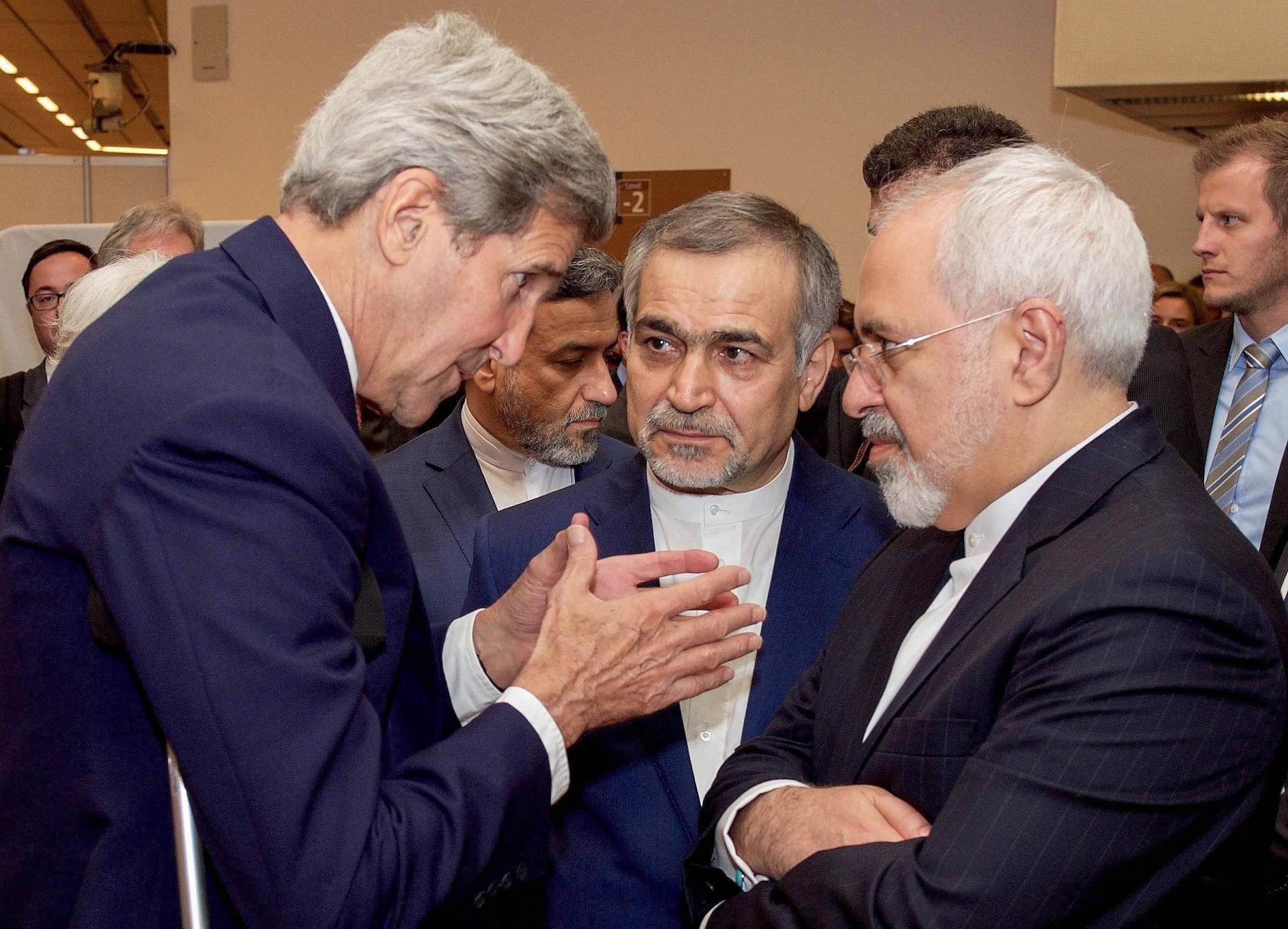
Then US Secretary of State John Kerry (L) speaks with Hossein Fereydoun (C), the brother of Iranian President Hassan Rouhani, and Iranian Foreign Minister Javad Zarif (R) at the Austria Center in Vienna, Austria, July 14, 2015. /VCG Photo
Then US Secretary of State John Kerry (L) speaks with Hossein Fereydoun (C), the brother of Iranian President Hassan Rouhani, and Iranian Foreign Minister Javad Zarif (R) at the Austria Center in Vienna, Austria, July 14, 2015. /VCG Photo
Trump appeared open to Macron’s approach, despite having a difference of opinion.
The current leadership in Washington and Europe have visibly different approaches to Tehran. Trump issued a stern warning.
"If Iran threatens us in any way, they will pay a price like few countries have ever paid," he said.
Macron, however, called for a less confrontational approach, based on the current framework of the Iran agreement. "It's not about intervening, no matter what," Macron said. "Rather, it is about building a stable framework that will contribute to stability and peace building. And I think this is what we've been agreeing upon today. It's not about tearing apart an agreement and have nothing, but it's about building something new that will cover all of our concerns."
Trump referred to his friendship with Macron as a "very special relationship" as he appeared to wipe dandruff off the French leader's shoulder to "make him look perfect." But the two leaders also disagreed on the trade issue.
In 2017, the US had a 15 billion US dollar trade deficit with France and a 150 billion US dollars trade deficit with the EU.
Earlier this year, under Section 232 of the 1962 US Trade Expansion Act, the Trump administration introduced tariffs on imports of steel and aluminum, exempting many US allies from the tariffs, which cite the oversupply of foreign metals as a threat to US national security.
Trump, on Tuesday, offered no relief for France, saying the European Union imposes too many barriers to US exports across the Atlantic. Pinning the blame on China, Macron said he recognized there are global trade problems.
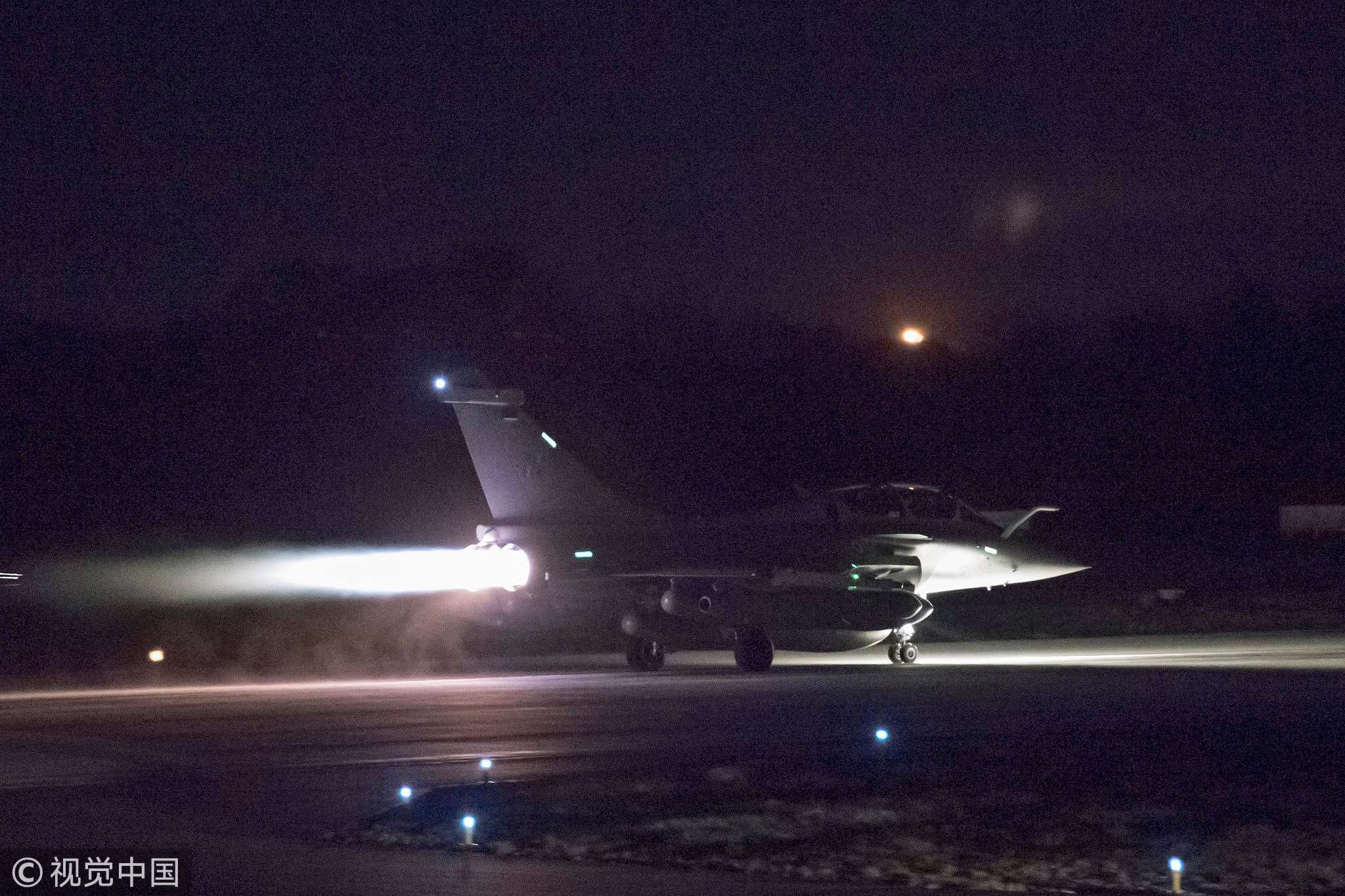
A plane preparing to take off as part of the joint airstrike operation by the British, French and US militaries in Syria, is seen in this picture obtained on April 14, 2018. /VCG Photo
A plane preparing to take off as part of the joint airstrike operation by the British, French and US militaries in Syria, is seen in this picture obtained on April 14, 2018. /VCG Photo
On the issue of Syria, Trump appeared to be a bit more conciliatory.
France and Britain joined the US in striking targets in Syria earlier this month, in response to an alleged gas attack by Syrian forces on the city of Douma. It happened just days after Trump indicated he wanted to pull US troops out of Syria as quickly as possible.
Macron is stepping up French engagement in the region and worries that an American pullout will only strengthen Tehran's foothold in the country.
On Tuesday, he seemed to convince the American leader that US troops should stay at least until there's a regional force set-up.
Trump recognized the force was needed to help prevent the reemergence of ISIL in Syria. "I would love to get out," Trump said. "I would love to bring our incredible warriors back home. But I want to come home also with having accomplished what we have to accomplish."
Macron is the first of two European leaders visiting Washington this week. Trump will host German Chancellor Angela Merkel at the White House on Friday.
11159km