
Opinions
19:48, 09-Jul-2018
Opinion: Trade, regulation and non-tariff barriers
Updated
19:41, 12-Jul-2018
 ["north america"]
Share







Copied
Editor's note: Jose De Lyon is a Research Assistant at the center for economic, Swati Dhingra is a Lecturer in Economics, Department of Economics, LSE. The article is published in the report – “The Brexit white paper: what it must address “ by the think tank- The UK in a changing Europe. The article reflects the author’s opinion, and not necessarily the views of CGTN.
Theresa May has yet to publish the Brexit white paper however, her Brexit Secretary David Davis resigned on July 8. He claims it's due to a row with May over her plans for post-Brexit relations with the EU. Dominic Raab was appointed as the new Brexit Secretary. Theresa May is expected to address parliament to explain her proposal for Britain to adopt EU rules on goods after Brexit later on Monday.
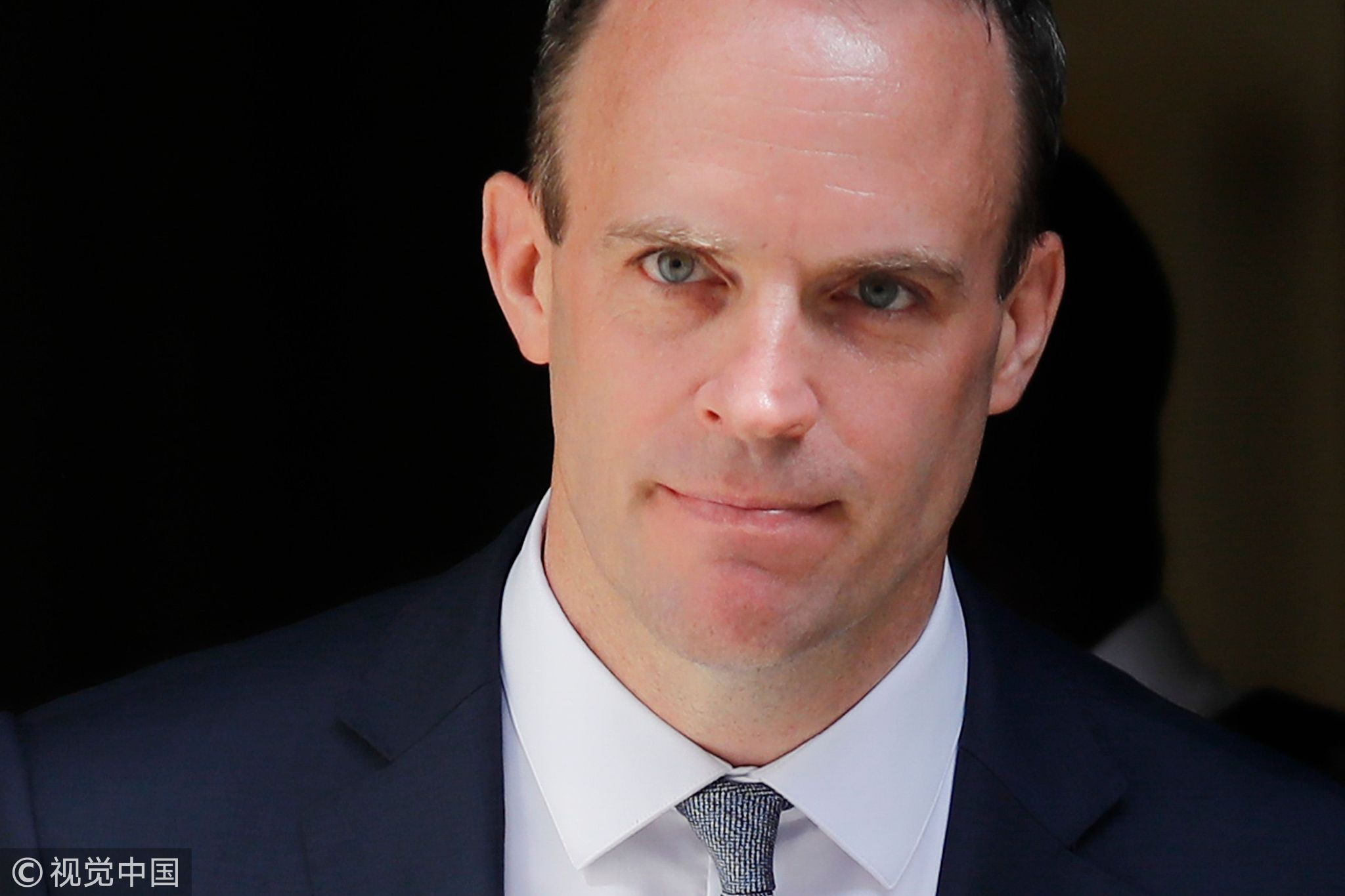
Britain's new Secretary of State for Exiting the European Union (Brexit Minister) Dominic Raab leaves 10 Downing Street in central London on July 9, 2018 /VCG Photo
Britain's new Secretary of State for Exiting the European Union (Brexit Minister) Dominic Raab leaves 10 Downing Street in central London on July 9, 2018 /VCG Photo
The government has set some clear red lines for its post-Brexit trade policy. It will not remain a member of the single market because it is not willing to accept free movement of people and does not want to be under the jurisdiction of the European Court of Justice (ECJ). The UK will also leave the EU customs union, instead of pushing for a bespoke customs arrangement that allows it to negotiate independent trade agreements with non-EU countries, as Meredith Crowley and Oliver Exton explain in this report.
Yet the UK also hopes to maintain a special relationship with the EU. As is a consistent theme throughout this report, the challenge that the white paper must address is how the UK can remain deeply integrated with the EU to minimize trade costs whilst satisfying its own red lines as well as those of the EU—currently, a seemingly impossible conundrum to resolve.
The discussion of trade policy in recent weeks has focused on customs. But customs is just one component of the trade. The bulk of the cost of doing business across borders comes from non-tariff barriers, such as complying with different regulations and standards, obtaining licenses for investing internationally and settling cross-border disputes. These are not covered by the proposed customs arrangements.
Outside the EU, the UK could face high non-tariff barriers to trade. A recent review of studies found the non-tariff costs on all goods between the EU and the US, for example, was around 13-14%, with some sectors such as agricultural products, beverages and tobacco, pharmaceuticals and processed foods being considerably higher. In contrast, the average customs duties between the EU and the US are under 2%. The most important objective for the UK, therefore, is to ensure that non-tariff barriers to trade with the EU27 do not rise after Brexit.
The focus on non-tariff barriers is even more important in the services sector, which makes up 80% of the UK economy. There are no tariffs on services, and it is estimated that non-tariff barriers arising from Brexit could reduce the UK’s services exports by anywhere between 6-13% over a ten-year period. The main constraint for many businesses will be the divergence in regulations and standards that could arise when the UK exits the single market.
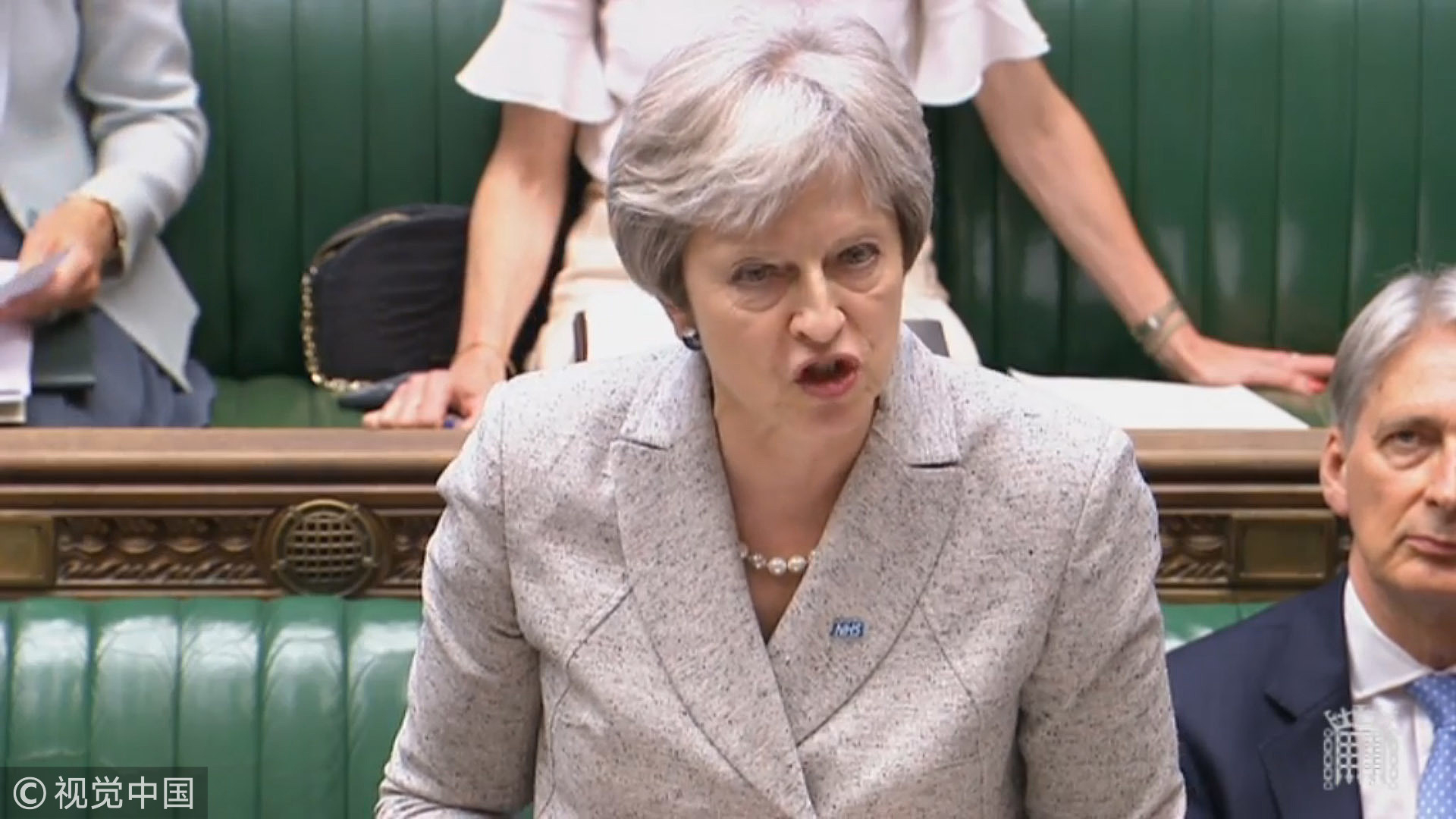
Prime Minister Theresa May makes a statement to the House of Commons regarding the June European Council./ VCG Photo
Prime Minister Theresa May makes a statement to the House of Commons regarding the June European Council./ VCG Photo
For instance, thousands of financial services firms depend on passporting rights for their operations with the EU. Chancellor Philip Hammond acknowledged the importance of agreeing on a bespoke deal on financial services that goes beyond EU equivalence regimes, and more detail is expected in the government’s white paper, as John-Paul Salter explains in this report. However, as with all of the government’s plans, this must be compatible with the position of the EU.
The white paper is expected to include a significant section on preventing regulatory divergence between the UK and the EU, as Hussein Kassim points out below. Prime Minister May’s Mansion House speech indicated that the UK hopes to remain part of some EU regulatory agencies. This is a sensible objective given that businesses would face higher costs of doing business under multiple regulatory regimes. Further, the cost of setting up regulatory agencies can be substantial.
For instance, a UK version of the European Aviation Safety Agency has been estimated at £400 million over a decade and there are around 40 such agencies that would need to be established. The problem for Mrs. May is that it is not clear how regulations can remain aligned in the long run if the UK is not willing to remain under the jurisdiction of the ECJ. The issue will be even more difficult because the solution proposed in the white paper will also need to be accepted by the EU—which to date has been consistent in insisting that the UK cannot selectively opt into certain EU institutions.
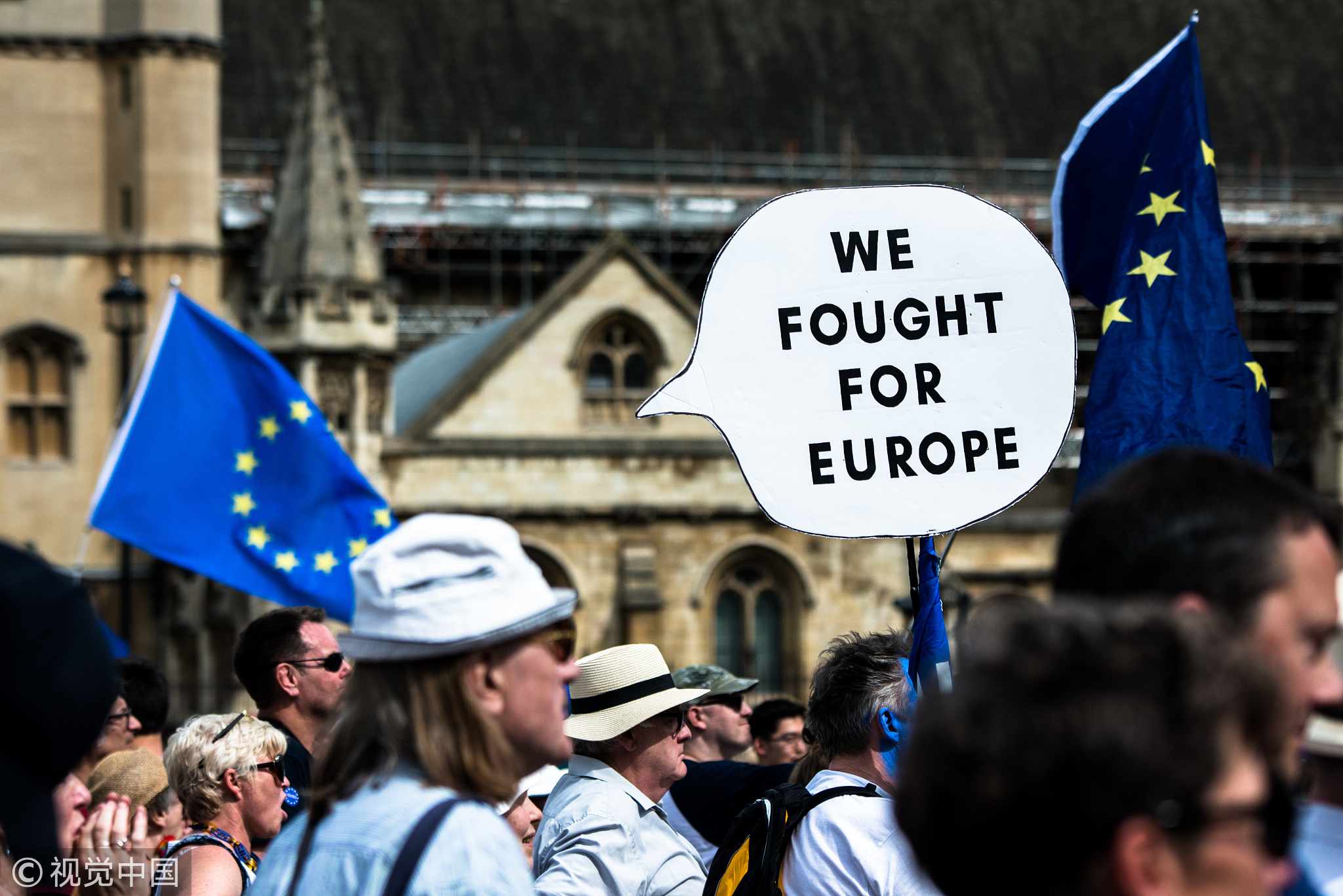
A coalition of pro-EU groups organized a march to parliament to demand a Peoples Vote on Brexit deal and whatever the government proposes on its future relationship with the EU. /VCG
A coalition of pro-EU groups organized a march to parliament to demand a Peoples Vote on Brexit deal and whatever the government proposes on its future relationship with the EU. /VCG
Maintaining low non-tariff barriers means the UK would need to reduce any potential divergence in standards and regulations with the EU. This could potentially tie the hands of the government in undertaking deep commitments with other trade partners. Outside the EU, the UK could benefit from negotiating new trade agreements with non-EU countries such as the US, China or India which are large or growing trade partners.
Lowering tariffs and other trade costs with these trade partners would increase economic activity in the UK. However, the extent of the gains would be limited, as the regulatory structures in the US, China and India are very different from those in the UK. It will, therefore, be difficult for the UK to simultaneously undertake deep commitments on non-tariff barriers with the EU and other trade partners.
The potential gains from new trading arrangements are likely to be much smaller than the costs of losing market access to the EU27. For instance, a UK-China deal would need to raise bilateral trade by over ten times to get to the levels of trade the UK has with the EU. This seems unlikely in light of the recent Swiss-China trade deal. A survey by the Swiss Chamber of Commerce two years after the introduction of the free trade agreement concluded: “it appears the FTA is not very attractive”.
The government, therefore, has an enormous challenge ahead: minimizing the costs of doing business with its largest trade partner while getting enough flexibility to undertake reductions in non-tariff barriers with countries outside the EU. This may be an impossible circle to square. The government must accept the inevitable trade-off between pursuing optimal economic policies, adhering to its red lines and satisfying the EU’s refusal to allow the UK to cherry-pick subsections of its institutions.