
Opinions
21:23, 22-Apr-2018
Opinion: Thumbs-up for Kim Jong Un's choice
 ["other","Asia"]
Share







Copied
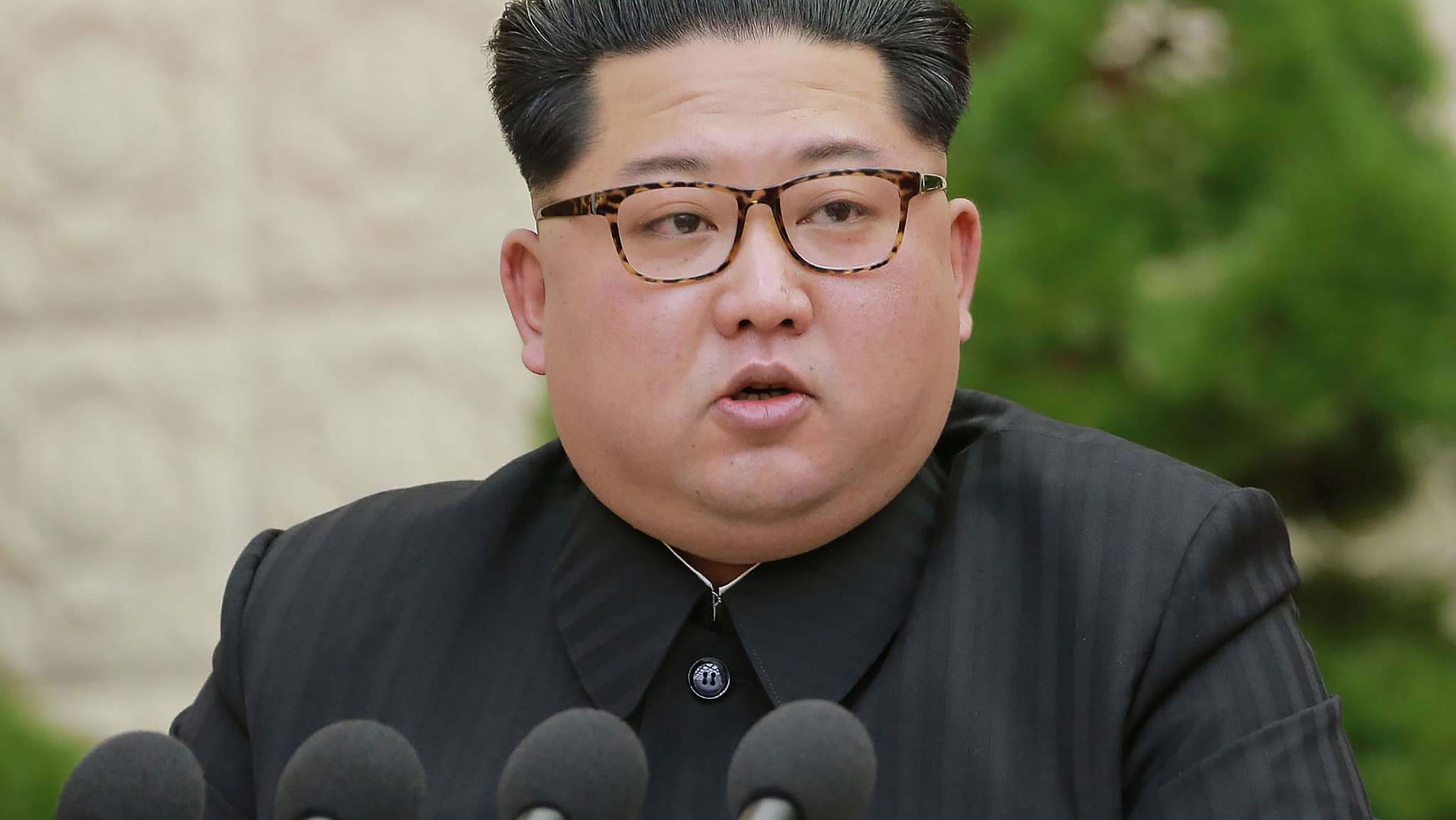
The Democratic People's Republic of Korea (DPRK) surprised the world on Friday when its leader Kim Jong Un offered to end tests of nuclear weapons and intercontinental ballistic missiles. Kim vowed not to use nuclear warheads and transfer nuclear weapons and technology to other countries "unless there is a nuclear threat or nuclear provocation." He also promised to shut down the country's nuclear test site to "ensure transparency" and to concentrate on economic development.
The stunning stance taken by Pyongyang has created a warm atmosphere for the upcoming inter-Korean summit, buoying hopes that a South-North agreement will likely be yielded at the historic meeting. Plus, it also got across a positive signal for the Washington-Pyongyang summit in early June. Kim has shown his resolve to put an end to nuclear development and engage in the denuclearization process.
The international community spoke highly of Pyongyang's resolution to work toward a nuclear-free Korean Peninsula. Welcoming Kim's decision, Beijing hoped that all parties involved would take concrete actions and expressed its willingness to continue playing a positive role in the process. US President Donald Trump hailed in a tweet, "This is very good news for North Korea and the World - big progress!" The Blue House said Kim's decision was of great significance to denuclearization on the Korean Peninsula and that the Republic of Korea (ROK) would make strenuous efforts to achieve lasting peace on the peninsula.
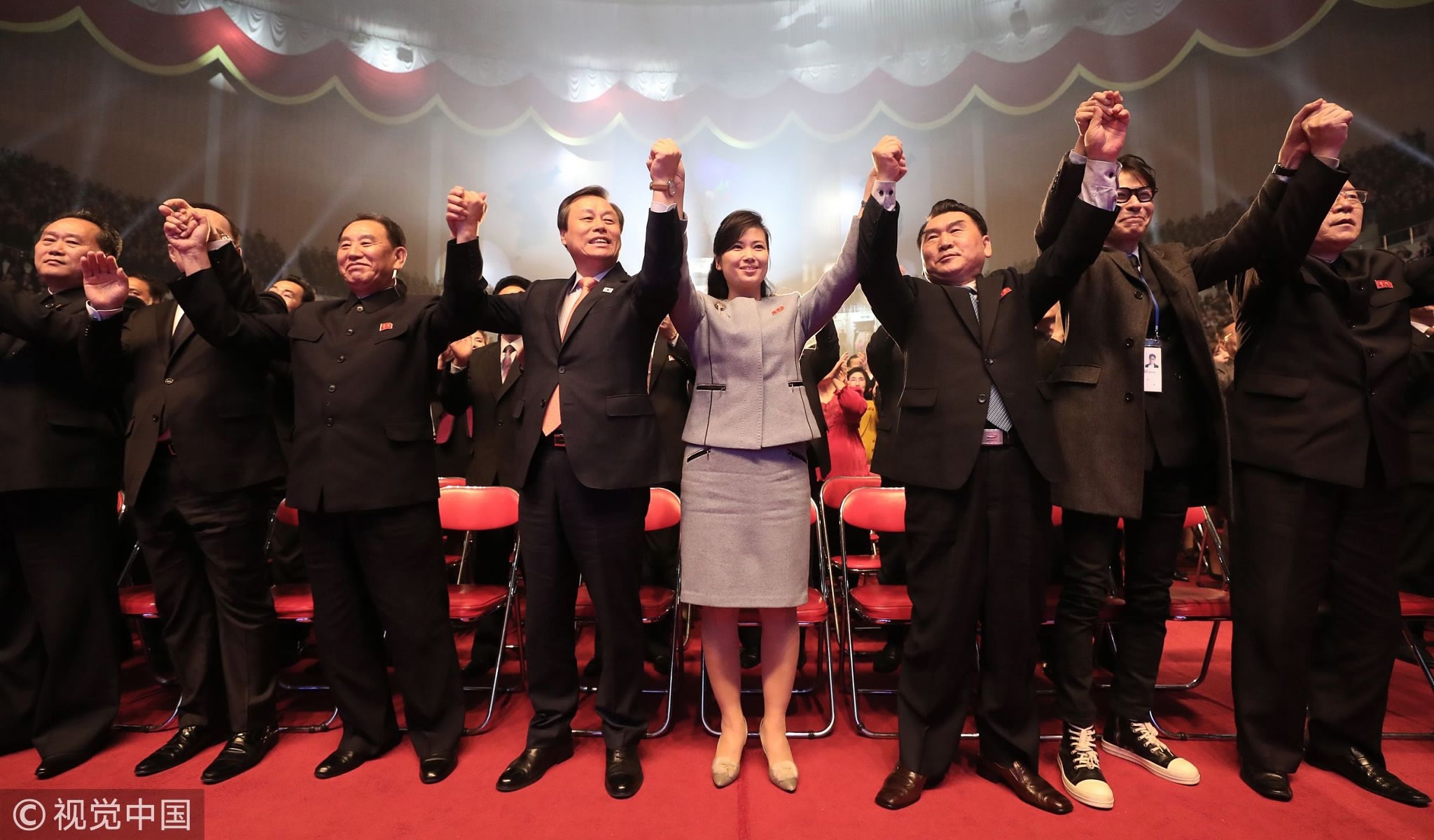
The Culture Minister of the Republic of Korea (ROK) Do Jong-hwan (4th L), DPRK General Kim Yong Chol (3rd L), who is in charge of inter-Korean affairs for the ruling Workers' Party, and Hyon Song-wol (C), founder of the North's popular all-female Moranbong band, react as they watch a joint performance by ROK and DPRK musicians at the 12,000-seat Ryugyong Jong Ju Yong Gymnasium in Pyongyang on April 3, 2018. /VCG Photo
The Culture Minister of the Republic of Korea (ROK) Do Jong-hwan (4th L), DPRK General Kim Yong Chol (3rd L), who is in charge of inter-Korean affairs for the ruling Workers' Party, and Hyon Song-wol (C), founder of the North's popular all-female Moranbong band, react as they watch a joint performance by ROK and DPRK musicians at the 12,000-seat Ryugyong Jong Ju Yong Gymnasium in Pyongyang on April 3, 2018. /VCG Photo
We should give praise to the landmark decision by the DPRK because it lets us see the flush of dawn for a peaceful Korean Peninsula, adds a tint of light to world peace and development, and brings forth the huge possibility for the country to return to the international community and engage in regional cooperation.
Since the beginning of 2018, Pyongyang has released a series of signals of its new diplomatic approach, to which Washington and Seoul have responded in a friendly manner.
Based on traditional friendship and geological intimacy, Beijing has been working in closer collaboration with the northern neighbor, trying to figure out a fresh scenario for the peninsula. In actuality, the exciting news is strong proof that China's "dual-track" approach, aiming to realize parallel progress in denuclearization and the establishment of a peace mechanism on the Korean Peninsula, is effective. We highly appreciate Kim's decision and meanwhile expect to see more efforts coming in a similar vein.
The choice is also conducive to accelerating the pace of the regional peace process. In a six-point list published by the DPRK's Korean Central News Agency, the country said it was an "important process for global nuclear disarmament" and it would "work with the international community to halt nuclear testing worldwide." It also pledged to "intensify close ties and dialogue" with neighboring countries and the international community. We anticipate that it will pave the way for us to march toward a nuclear-free world.
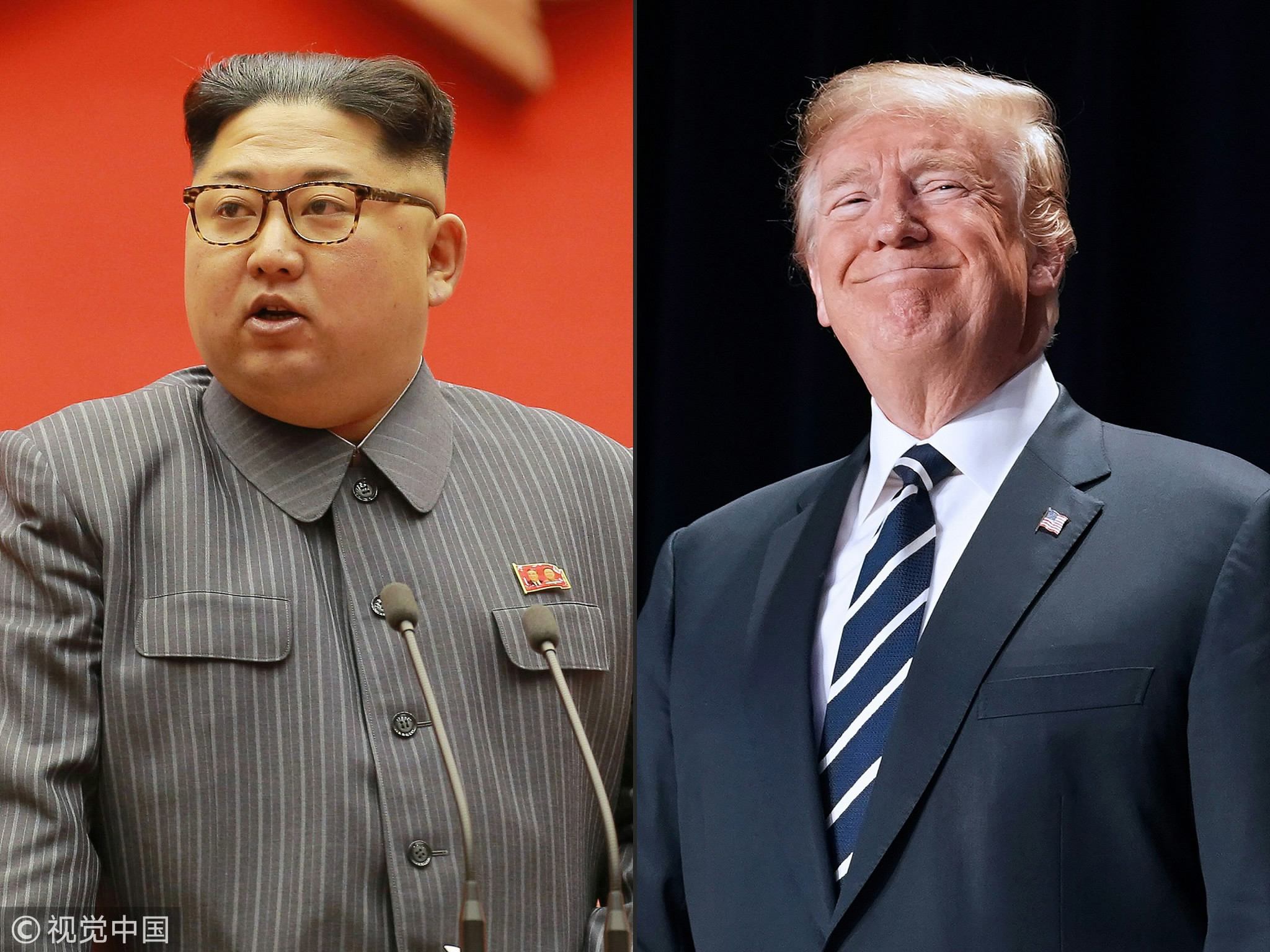
A photo (L) shows DPRK leader Kim Jong Un during the fifth Conference of the Workers' Party of Korea Cell Chairpersons on December 23, 2017, and a picture shows US President Donald Trump during the National Prayer Breakfast at a hotel in Washington, DC, on February 8, 2018. /VCG Photo
A photo (L) shows DPRK leader Kim Jong Un during the fifth Conference of the Workers' Party of Korea Cell Chairpersons on December 23, 2017, and a picture shows US President Donald Trump during the National Prayer Breakfast at a hotel in Washington, DC, on February 8, 2018. /VCG Photo
Moreover, Kim's declaration has also made it not only possible but also feasible for the DPRK to return to the international community. Pyongyang is committed to mobilizing all manpower and resources to "dramatically raise people's lives" and developing a "strong socialist economy." This might be a start for the DPRK to extricate itself from decades-long isolation, launch a new round of domestic reforms, open up to the outside world and blend in regional cooperation based on a trusted mechanism toward peace and stability on the Korean Peninsula. We call for the building of a coordinating institution that can cater to the needs of all stakeholders.
Of course, peace and stability, cooperation and development cannot be realized overnight. There will be a run-in stage for the parties involved to deepen mutual trust and understanding and agree on more practical actions. Washington lacks persuasiveness in demanding Pyongyang to abandon nuclear weapons while insisting on its own nuclear weapons policy, so the two sides need to bridge the gap in both the timetable and roadmap of denuclearization. We also long to see rational reactions from Seoul and Tokyo and a multilateral political process to precipitate the effort. But we have every reason to compliment Pyongyang's resolve and expect to see the bud blossoming.
(Da Zhigang is the director of the Institute of Northeast Asian Studies at the Heilongjiang Academy of Social Sciences. The article reflects the author's opinion, and not necessarily the views of CGTN.)