
Asia Pacific
16:46, 27-May-2019
Trump presses Japan over trade gap, strikes dovish tone on DPRK, Iran
Updated
20:10, 27-May-2019
 ["china"]
Share







Copied
02:01
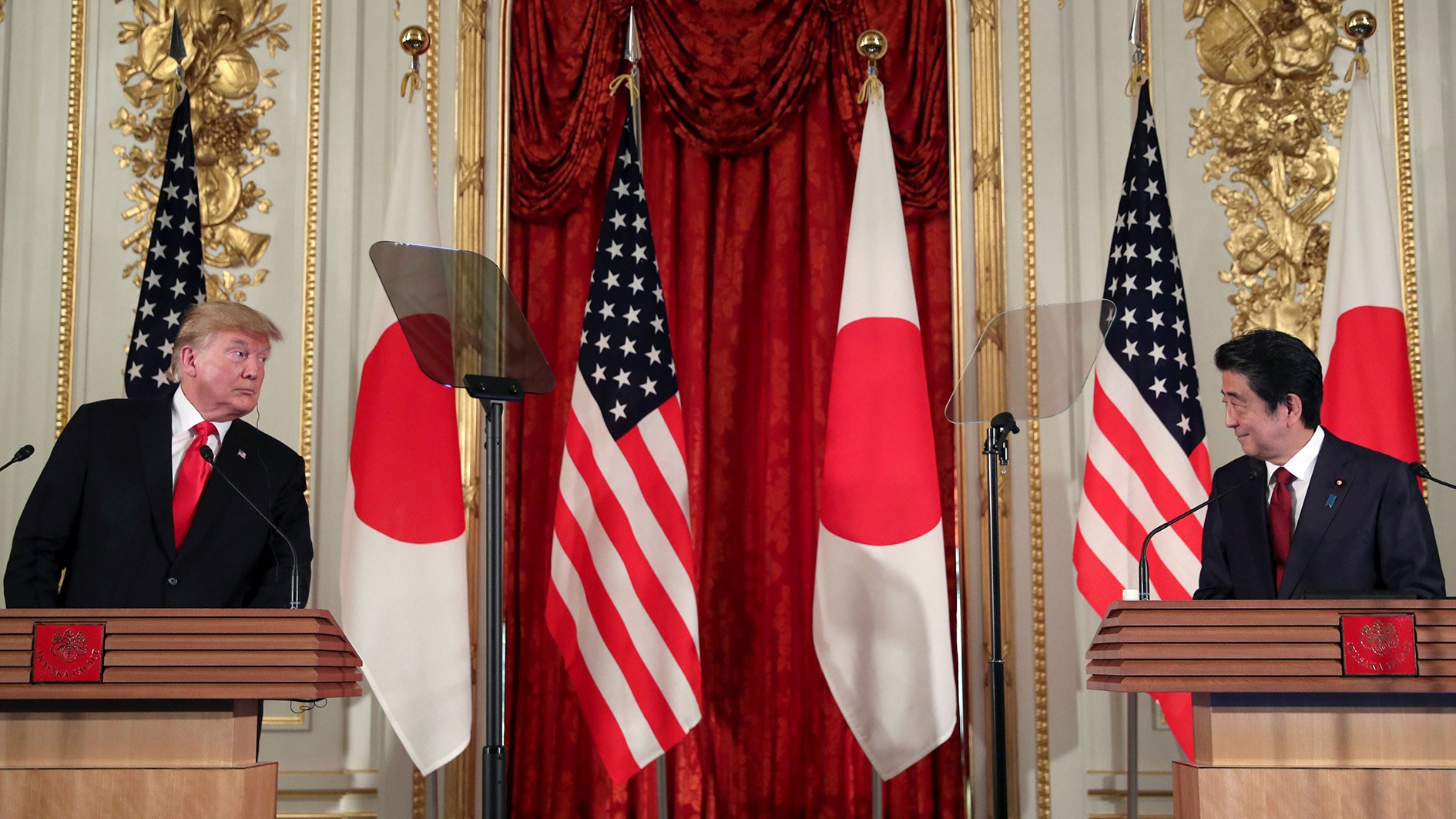
U.S. President Donald Trump pressed Japanese Prime Minister Shinzo Abe on Monday to even out a trade imbalance with the United States, while played a dovish tone on DPRK and Iran.
Trump said at a news conference with Abe after their summit that his goal was to remove trade barriers to put U.S. exports on a fair footing in Japan. He said he hoped to have more to announce on trade very soon and said he and Abe had agreed to expand cooperation in human space exploration.
"We have an unbelievably large imbalance, as you know, trade imbalance with Japan for many, many years, Japan having the big advantage," Trump said.
"They are brilliant business people, brilliant negotiators, and put us in a very tough spot. But I think we will have a deal with Japan," he added.
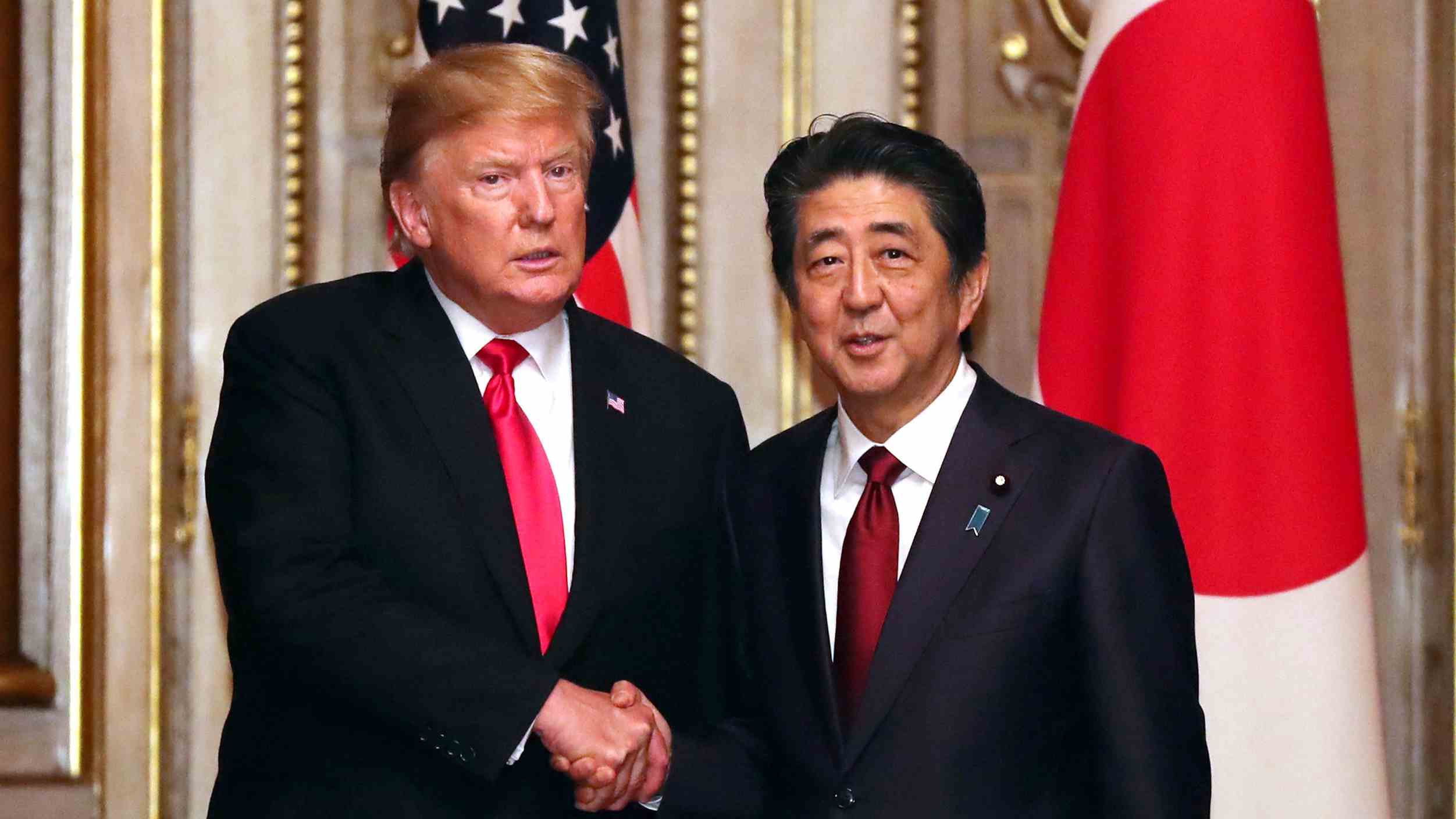
U.S. President Donald Trump (L) shakes hands with Japanese Prime Minister Shinzo Abe prior to their working luncheon at the Akasaka guesthouse in Tokyo, Japan, May 27, 2019. /Reuters Photo
U.S. President Donald Trump (L) shakes hands with Japanese Prime Minister Shinzo Abe prior to their working luncheon at the Akasaka guesthouse in Tokyo, Japan, May 27, 2019. /Reuters Photo
Abe, for his part, said the two leaders had agreed to speed up two-way trade talks, but dodged a question about timing.
Trump, who is on a four-day state visit to Japan meant to showcase the alliance between the allies, said on Twitter on Sunday that he expected big moves on trade would wait until after Japan's upper house election in July.
"Trade-wise, I think we'll be announcing some things, probably in August, that will be very good for both countries," Trump said on Monday at the start of the talks. "We'll get the balance of trade, I think, straightened out rapidly."
Deputy Chief Cabinet Secretary Yasutoshi Nishimura told reporters there was no agreement to reach a trade deal by August.
'Very smart' Kim knows he must give up nukes
Trump also expressed optimism over prospects that the Democratic People's Republic of Korea (DPRK) would give up its nuclear program, and repeated that he was not bothered by its recent missile tests.
"My people think it could have been a violation, as you know. I view it differently – I view it as a man, perhaps he wants to get attention. Perhaps not. Who knows? It doesn't matter. All I know is that there have been no nuclear tests, no ballistic missiles going out, no long-range missiles going out. And I think that someday we'll have a deal," Trump said.
"I'm not in a rush," he added.
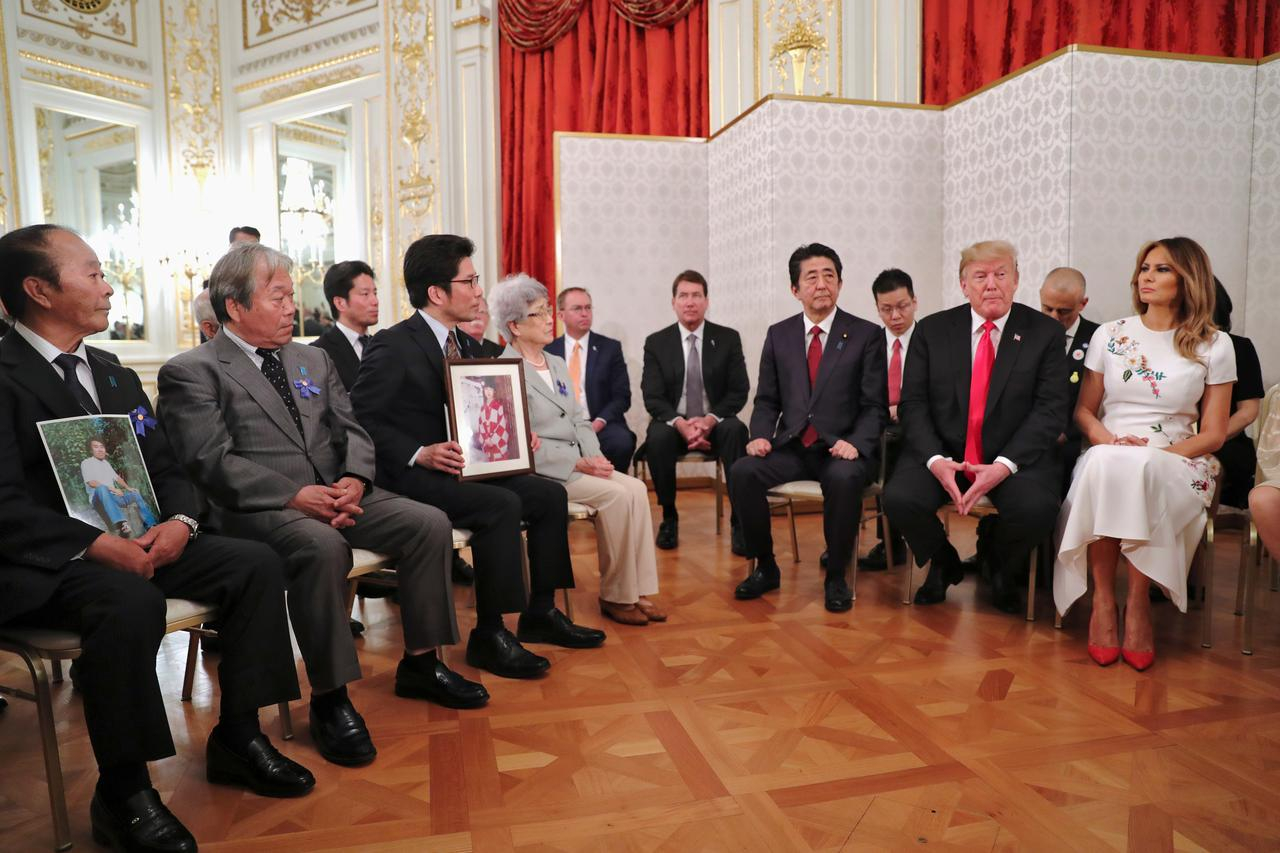
U.S. President Donald Trump, first lady Melania Trump and Japan's Prime Minister Shinzo Abe meet with family members of people abducted by DPRK in Tokyo, Japan, May 27, 2019. /Reuters Photo
U.S. President Donald Trump, first lady Melania Trump and Japan's Prime Minister Shinzo Abe meet with family members of people abducted by DPRK in Tokyo, Japan, May 27, 2019. /Reuters Photo
Abe said he supported Trump's approach to Kim, but repeated Japan's stance that recent short-range missile tests violated U.N. Security Council resolutions.
He also said he had won the backing of Trump for a proposed meeting with DPRK's leader Kim Jong Un. He has said earlier that a face-to-face meeting with Kim is the only way to solve the emotional issue of Japanese people who Tokyo believes were abducted by Pyongyang, but Kim has so far shown little interest in a summit.
After his meeting with Abe, Trump met families of Japanese citizens kidnapped by the DPRK and told the relatives that he would work with Abe to bring the abductees home.
In 2002, DPRK admitted it kidnapped 13 Japanese decades ago. But Japan says 17 of its citizens were abducted, five of whom were repatriated. DPRK has said eight are dead and that another four never entered the country.
'Not looking for regime change in Iran'
The two leaders also discussed Iran. Tensions have risen between Iran and the United States after this month's attack on oil tankers in the Gulf region.
Washington, a firm backer of Tehran's regional rival Saudi Arabia, has blamed the attacks on Iran, which denies the accusations.
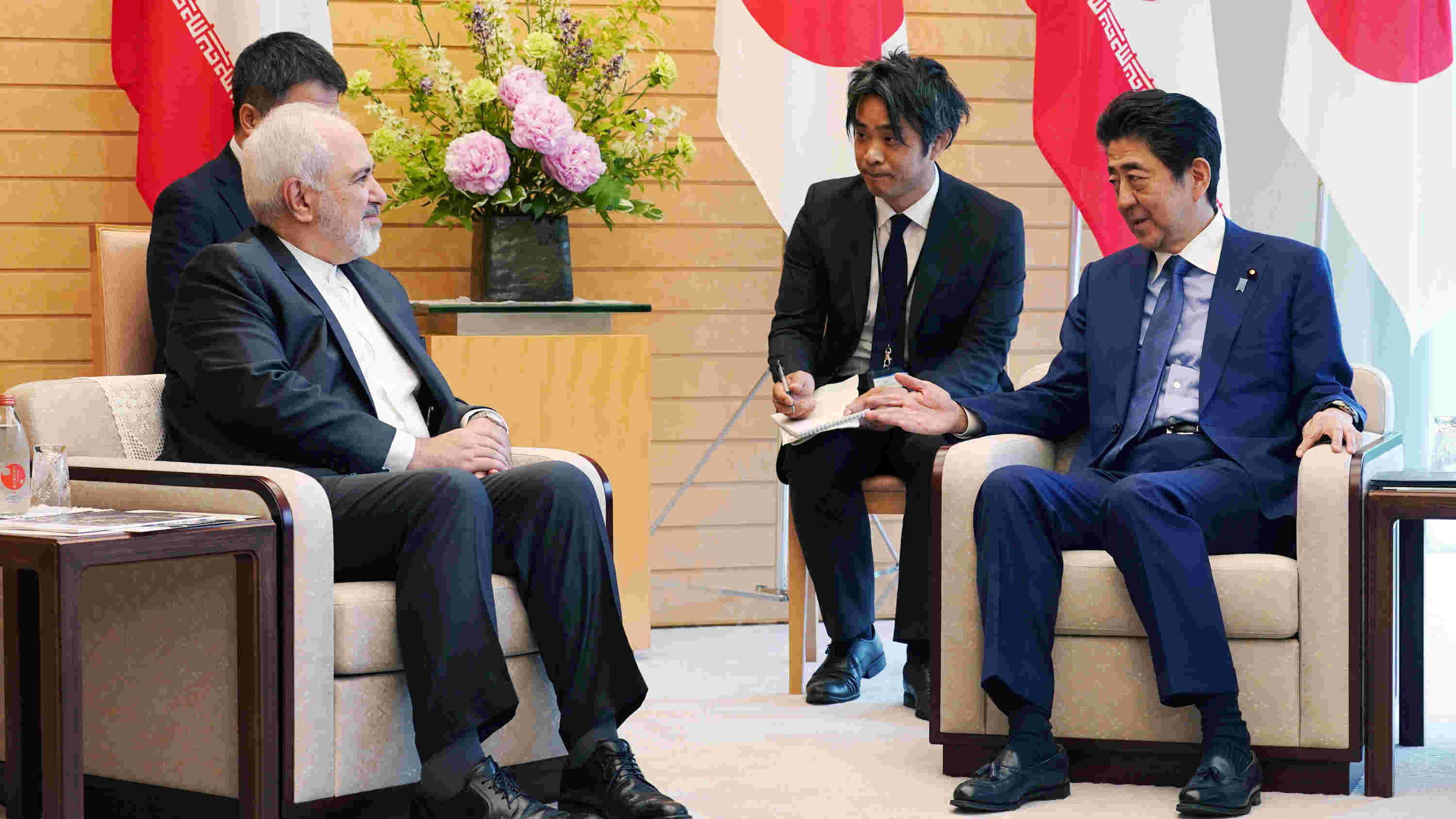
Iranian Foreign Minister Mohammad Javad Zarif (L) and Japanese Prime Minister Shinzo Abe shake hands at Abe's official residence in Tokyo, May 16, 2019. /Reuters Photo
Iranian Foreign Minister Mohammad Javad Zarif (L) and Japanese Prime Minister Shinzo Abe shake hands at Abe's official residence in Tokyo, May 16, 2019. /Reuters Photo
During Monday's news conference, Trump said a deal with Iran on its nuclear program was possible, crediting economic sanctions for curbing activities Washington has said are behind a spate of attacks in the Middle East.
"I really believe that Iran would like to make a deal, and I think that's very smart of them, and I think that's a possibility to happen," Trump told reporters.
"It has a chance to be a great country with the same leadership," Trump said. "We aren't looking for regime change – I just want to make that clear. We are looking for no nuclear weapons."
Japanese broadcaster NHK has said Abe was considering a trip there next month, to try to soothe rising tension between Iran and the United States.
"I know for a fact that the prime minister is very close with the leadership of Iran, and we'll see what happens," Trump said.
During his joint news conference with Trump, Abe said Japan would do what it can on the Iran issue.
"Peace and stability of the Middle East is very important for Japan and the United States and the international community as a whole," Abe said.
Read more:
(With inputs from Reuters and AFP)