
Opinion
14:33, 02-Apr-2019
Turkey's election shows that people want economic solutions
Updated
17:51, 02-Apr-2019
 ["china"]
Share







Copied
Editor's note: Adam Garrie is director of the UK-based global policy and analysis think tank Eurasia Future and co-host of a talk show "The History Boys." The article reflects the author's opinion and not necessarily the views of CGTN.
Turkey's local elections have resulted in an overall victory for the ruling Justice and Development Party (AKP) and its ally the Nationalist Movement Party (MHP), which leads with 51.7 percent of the votes in local elections on Sunday.
But the opposition Republican People's Party (CHP) also showed strong momentum in key cities including the capital Ankara.
When taken in totality, the results mean that Turks remain generally satisfied with the stability of their government but that they are willing to explore new party political options as a means of improving the economy.
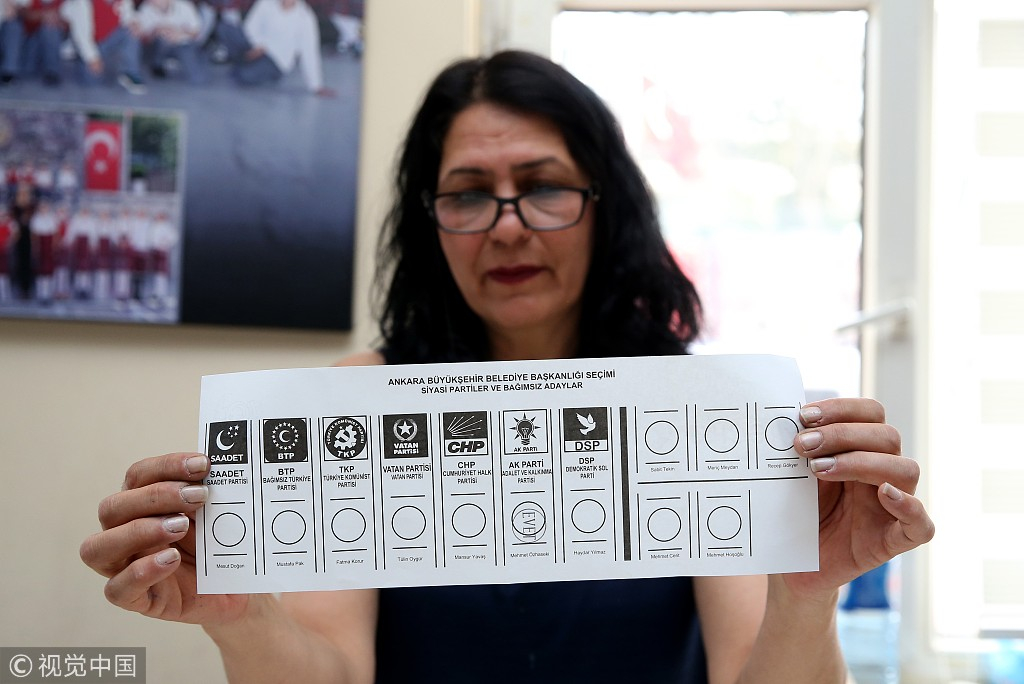
A scrutineer holds a ballot paper after the polls for the local elections closed at a polling station in Ankara, Turkey March 31, 2019. /VCG Photo
A scrutineer holds a ballot paper after the polls for the local elections closed at a polling station in Ankara, Turkey March 31, 2019. /VCG Photo
Turkey's 21st-century economy has tended to be one built around rapid growth powered by a young workforce. Recently, however, growth has slowed while the value of the lira has been hit by aggressive western currency speculators.
Against this background, it is important to remember that Turkey was an early supporter of the Belt and Road initiative (BRI). As Turkey lies on important paths that formed ancient Pacific to Mediterranean trading roads, it is only natural for Turkey's contemporary leadership to seek integration into the modern belts and roads of 21st-century trade.
China continues to invest heavily into major Turkish development projects which will provide long term sustainable benefits to the economy. At the same time, both sides look to expand the 2018 figure of 21.5 billion U.S. dollars' worth of bilateral trade.
According to Daily Sabah, this year, China has pledged to invest 6 billion dollars into the Turkish economy by the year 2021. These are all deeply positive developments that will produce win-win results for the economies of both countries.
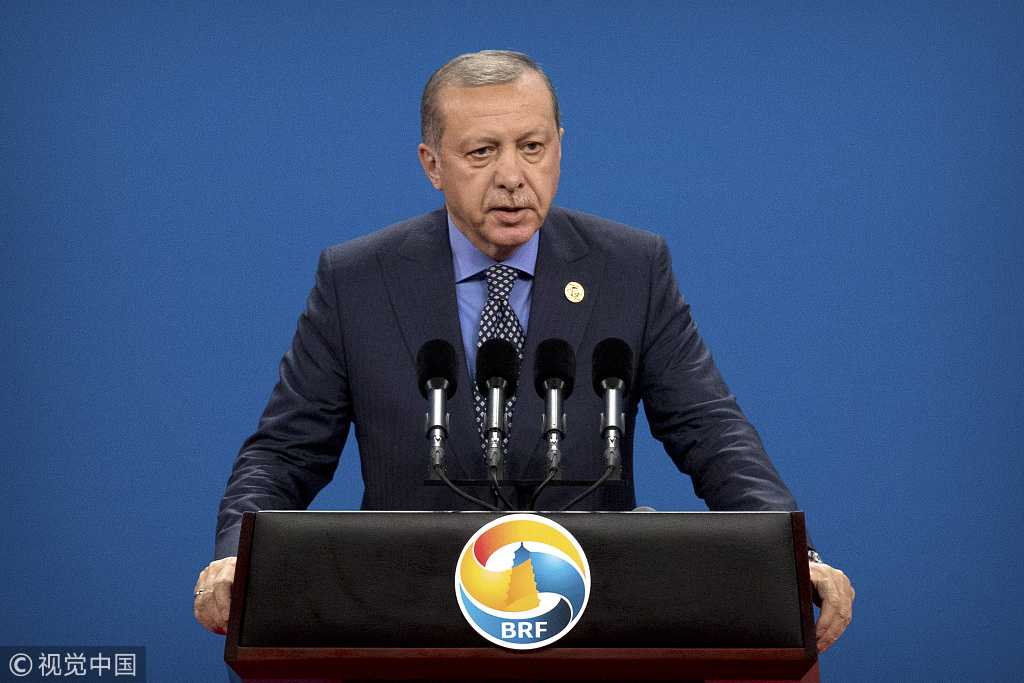
Turkish President Recep Tayyip Erdogan speaks during the opening ceremony of the Belt and Road Forum at the China National Convention Center (CNCC) in Beijing, May 14, 2017. /VCG Photo
Turkish President Recep Tayyip Erdogan speaks during the opening ceremony of the Belt and Road Forum at the China National Convention Center (CNCC) in Beijing, May 14, 2017. /VCG Photo
Unlike many of Turkey's western partners, China does not comment on, nor meddle in the internal affairs of Turkey. This is in sharp contrast to frequent statements from multiple European politicians who go out of their way to antagonize Turkey's leadership based on zero-sum ideological grounds.
Although Turkey has many economic interests throughout the world, recent years have seen Turkey diversify its interests not only to the east but to the south as Turkey seeks greater economic connectivity in Africa. This itself can be a further source of BRI connectivity for Turkey as Africa as a whole looks to consolidate multiple win-win BRI based partnerships.
With all this in mind, it was deeply unhelpful that recent months saw Turkish officials comment negatively on internal Chinese affairs based on falsehoods spread by China's self-described western "rivals".
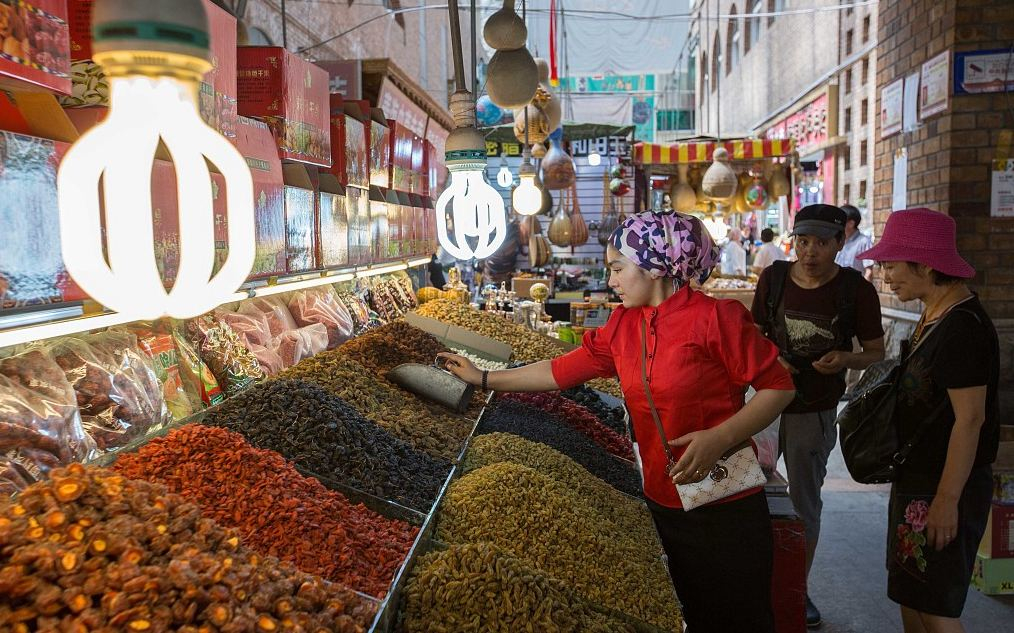
An Uyghur vendor peddles goods in the Xinjiang International Grand Bazaar in Urumqi, capital of northwest China's Xinjiang Uyghur Autonomous Region, July 02, 2017. /VCG Photo
An Uyghur vendor peddles goods in the Xinjiang International Grand Bazaar in Urumqi, capital of northwest China's Xinjiang Uyghur Autonomous Region, July 02, 2017. /VCG Photo
While the Republic of Turkey has strong emotional attachments to Turkic peoples elsewhere, the cultural realities in China's Xinjiang Uygur Autonomous Region should be a building block for positive cultural interaction rather than for completely misguided suspicion. Just as Turkey has developed special relations with many of the central Asian republics and with Azerbaijan, Turkey can do the same with China in respect of the Muslim groups of Xinjiang.
It is of note that in the immediate run-up to elections in Turkey, the main parties ceased provocative statements against China which is indicative of a mature approach to international relations.
The voice of Turkey's public as conveyed in recent elections demonstrates that the people remain focused on economic improvements and are willing to see both government and opposition cooperate to find win-win internal solutions in this respect.
When extrapolated further, as Turkey looks to create new trading opportunities for its people, it is important to strive for ever more win-win opportunities abroad and for this, BRI continues to provide a sustainable vehicle for the kind of economic improvement that Turks seek.
The elections in Turkey were ultimately not dominated by ideological questions or foreign affairs but by fundamental issues of economic improvement after a challenging year. Based on these local results, Turkey's government has an indicative mandate to go forward and make progress with China and other key Asian economic partners.
(If you want to contribute and have specific expertise, please contact us at opinions@cgtn.com.)