
Climate
22:26, 16-Oct-2018
'Year of extremes' for shrinking Swiss glaciers in 2018: study
Updated
22:09, 19-Oct-2018
 ["china"]
Share







Copied
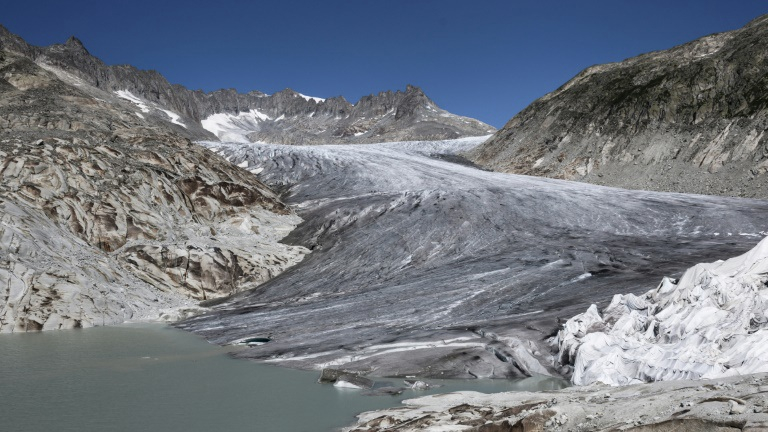
Despite an exceptionally snow-filled winter, Swiss glaciers have lost 2.5 percent of their volume this year, according to a report Tuesday which dubbed 2018 "a year of extremes."
This year's record-breaking temperatures have greatly contributed to the loss of "a fifth of (the glaciers') volume over the past decade", according to the annual study on the state of the glaciers, published by the Swiss Academies of Science.
And that happened despite the piles and piles of snow that fell during the 2017-18 winter season in the Alpine country.
Snow acts like a protective covering that prevents glaciers from melting.
"Up until the end of March, there was still more than twice as much snow as usual above an altitude of 2,000 meters," the report authors said.
But the exceptional snowfall at the start of the year was matched by soaring temperatures and little to no precipitation after March.
According to the Swiss Office of Meteorology, the period between June and August ranked among the hottest on record after 2003 and 2015.
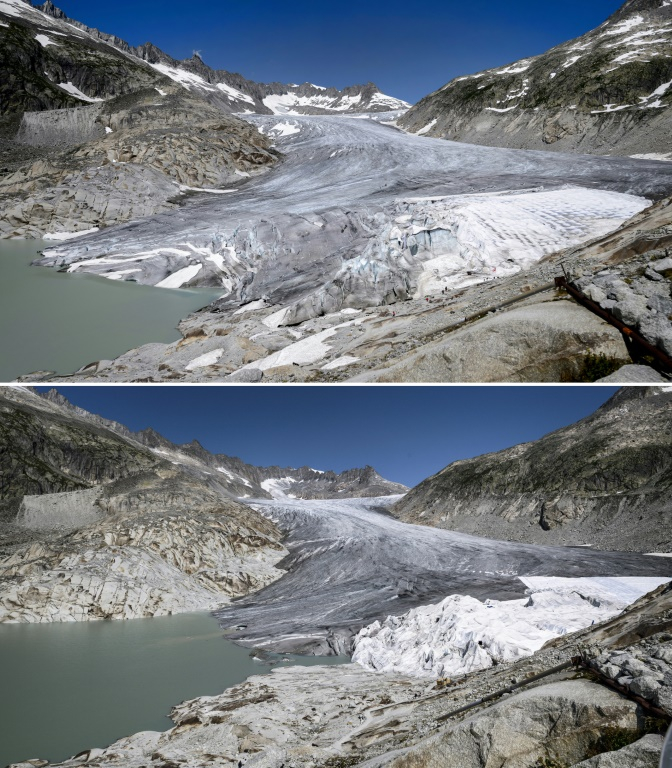
This combination created on October 8, 2018, shows (Top) the Rhone Glacier, near Gletsch in Switzerland on July 14, 2015 and (Bottom) the same location on August 16, 2018. From the comparison, it can be noticed that the glacier is melting. /AFP Photo
This combination created on October 8, 2018, shows (Top) the Rhone Glacier, near Gletsch in Switzerland on July 14, 2015 and (Bottom) the same location on August 16, 2018. From the comparison, it can be noticed that the glacier is melting. /AFP Photo
'Hottest ever recorded'
And the period from April to September was "by far the hottest ever recorded" in Switzerland, the report said.
It pointed to the case of Weissfluhjoch peak (2,540 meters), which hosts the Swiss Institute for Snow and Avalanche Research.
The peak saw no snowfall of more than one centimeter between May 17 and September 4 – a first in the 81 years of record-keeping, the report said.
The heat and lack of precipitation "not only melted large quantities of winter snow (up to five meters on some glaciers), but also melted the ice," Matthias Huss, in charge of the Glacier Monitoring Network (GLAMOS), said.
The Swiss glaciers have rarely experienced such a melt, with the exception of when Europe was hit by a massive heatwave 15 years ago, he said.
"2003 remains the worst year for the glaciers, but 2018 is clearly in the Top 10 over the past century; and the top three for some glaciers," he said.
"If there had been the same low level of snowfall as in 2017, 2018 would definitely have broken the overall record," he added.
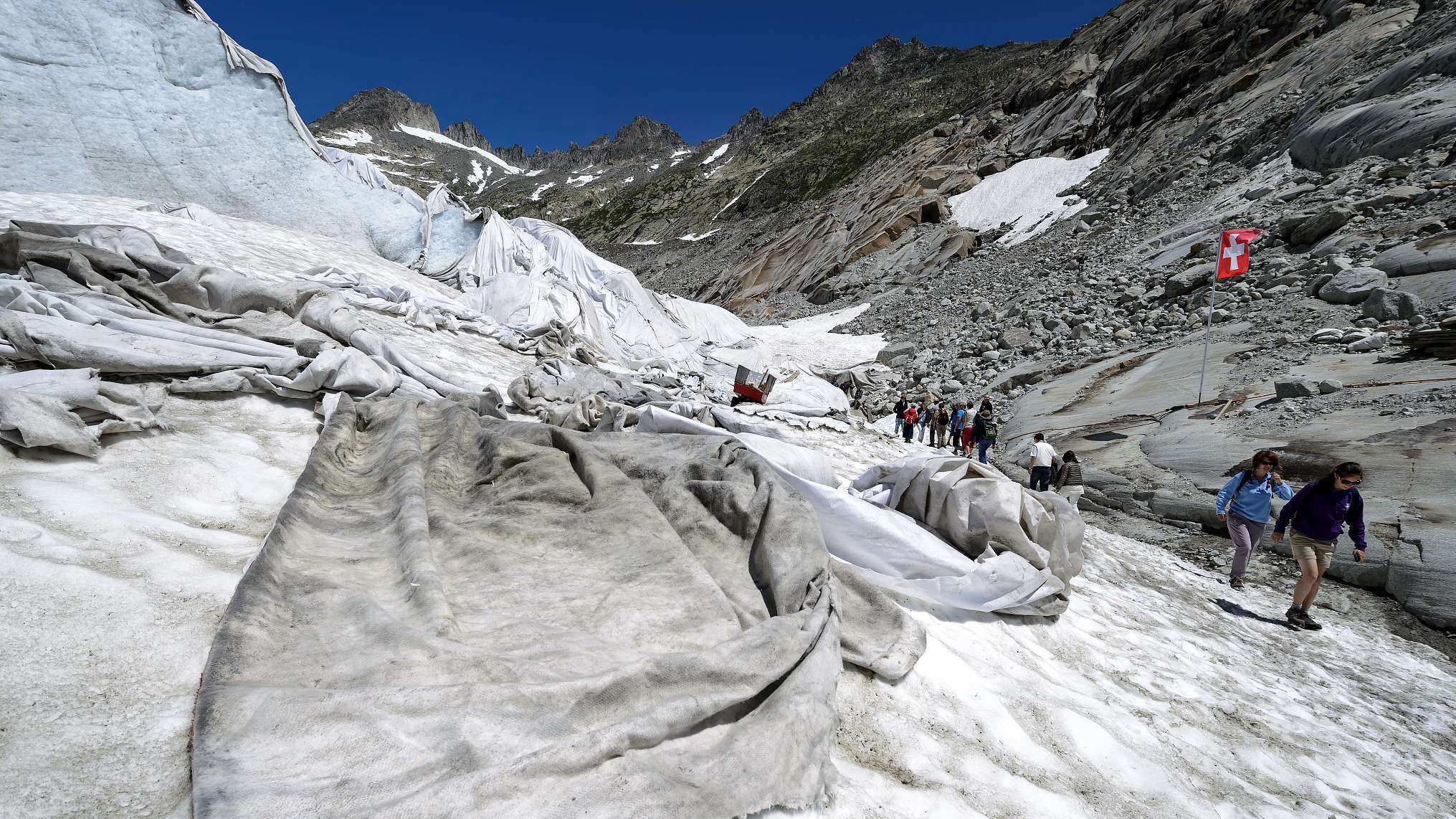
Tourists walk to visit an ice cave next to insulating foams wrapping up the Rhone Glacier, which has been shrinking under the summer sun, near Gletsch in Switzerland, July 14, 2015. /VCG Photo
Tourists walk to visit an ice cave next to insulating foams wrapping up the Rhone Glacier, which has been shrinking under the summer sun, near Gletsch in Switzerland, July 14, 2015. /VCG Photo
Last week, a landmark UN climate report warned drastic action was needed to prevent Earth from hurtling towards an unbearable rise in temperature.
"The shrinking of the glaciers is directly linked to climate change," Huss said.
If the planet continues warming at the same pace as today, he warned that "many of Switzerland's smaller glaciers will completely disappear."
(Cover: A picture shows the Rhone Glacier and its glacial lake near Gletsch in Switzerland on August 28, 2018 – a year is dubbed a 'year of extremes' for shrinking Swiss glaciers by the Swiss Academies of Science. /AFP Photo)
Source(s): AFP