
Politics
10:35, 07-Oct-2018
Brazil's polarized election 2018, left or right?
Updated
10:35, 10-Oct-2018
 ["china"]
Share







Copied
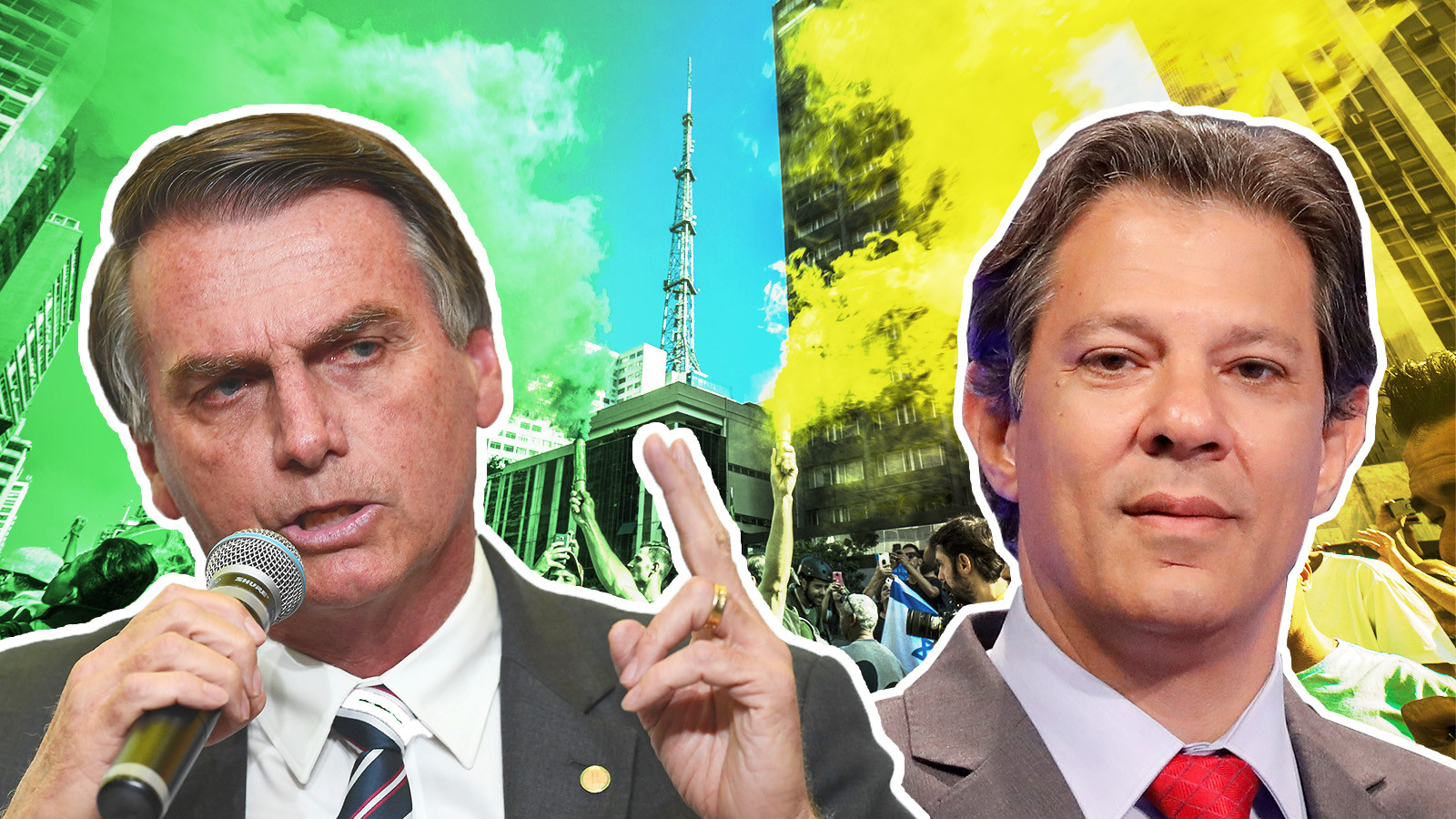
The most unpredictable, polarized and crucial presidential election in Brazil's recent history will kick off as the polls open on Sunday.
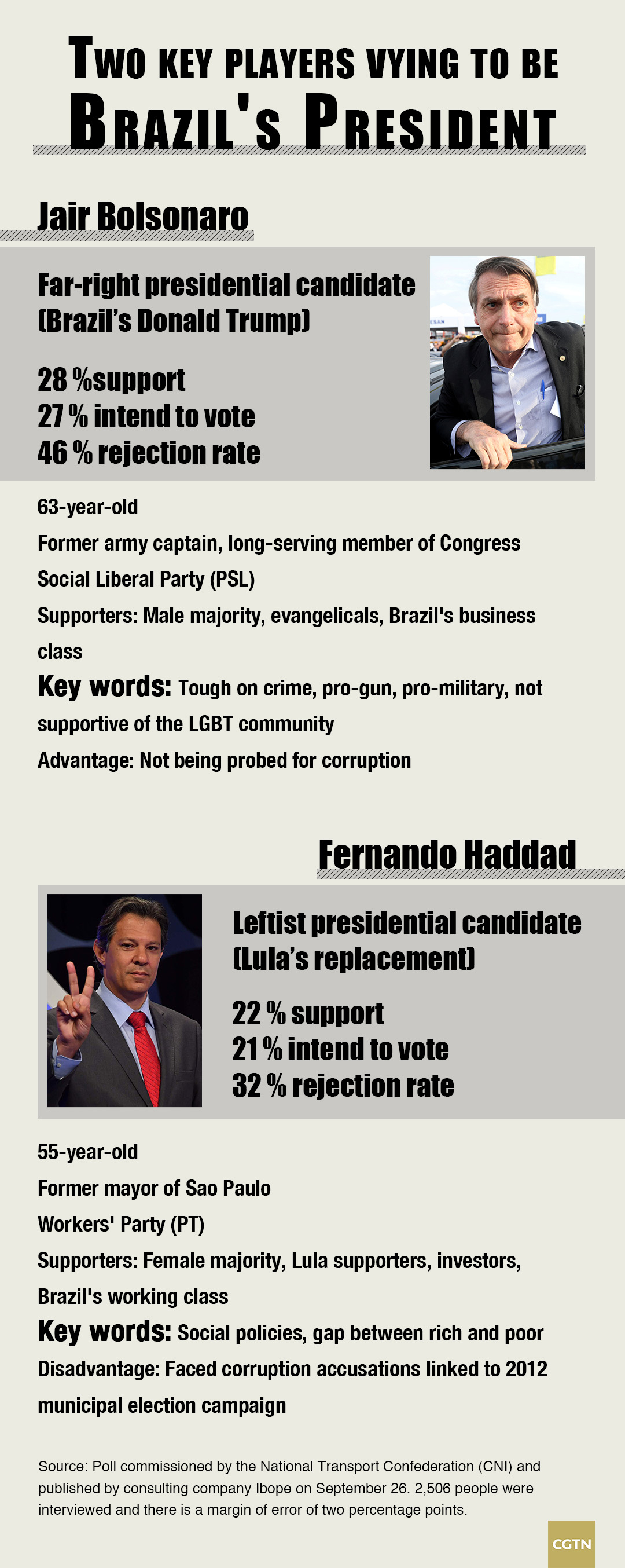
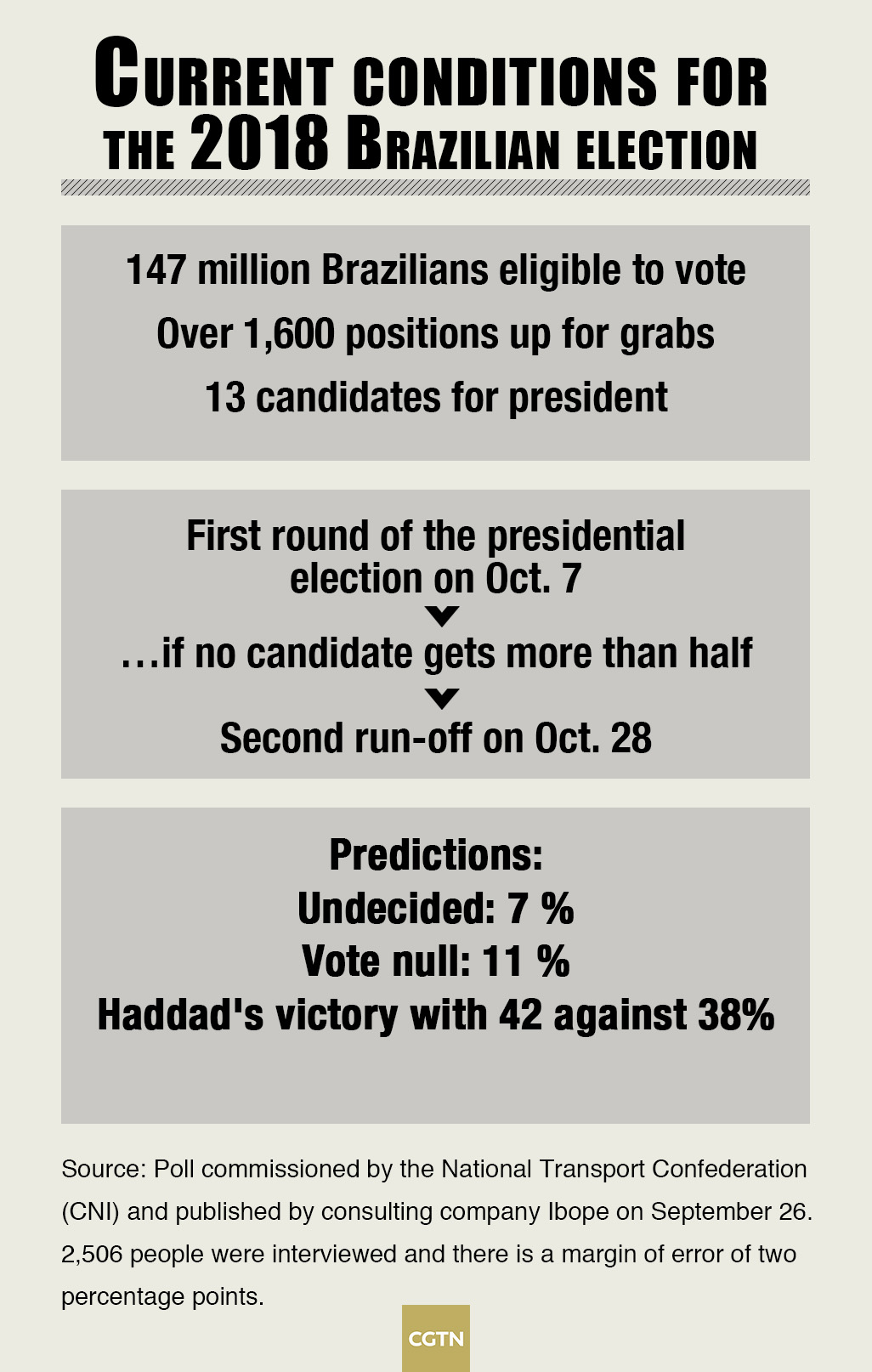
The current polls show that the votes of the top two presidential candidates are very statistically tied, which may lead to a second-round run-off on October 28.
Fernando Haddad, the substitute candidate for Brazil's jailed ex-leader Luiz Inacio Lula da Silva, or Jair Bolsonaro, an outspoken controversial conservative? It is time for Brazilians to choose the direction of the country's future in the coming four years at least.
A possible head-to-head second round?
Aside from Haddad and Bolsonaro, no other participant is predicted to win more than 11 percent of the vote on October 7, though there are 13 candidates vying to become country's 38th president.
input words
input words
Besides the two key players, the Democratic Labor Party's (PDT) Ciro Gomes comes third, with 12 percent, up from 11 percent in the previous poll. Geraldo Alckmin from the Brazilian Social Democracy Party (PSDB) remains stable at eight percent, followed by Sustainability Network's (REDE) Marina Silva, with six percent, up from five percent in the previous poll.
Polling stations will open at 8:00 a.m. (1100 GMT) and close at 5:00 p.m. (2000 GMT). Voting is compulsory and entered electronically, with results expected within a couple of hours of the closing time.
Though the polls show the votes of the top two candidates are very close, the styles of the two are entirely different.
Devil or angel?
With his hardline stance on crime comments widely considered sexist, misogynist, and homophobic, Bolsonaro is a controversial leader.
He has voted repeatedly to preserve state-owned monopolies and against reforming Brazil's bloated public pension system.
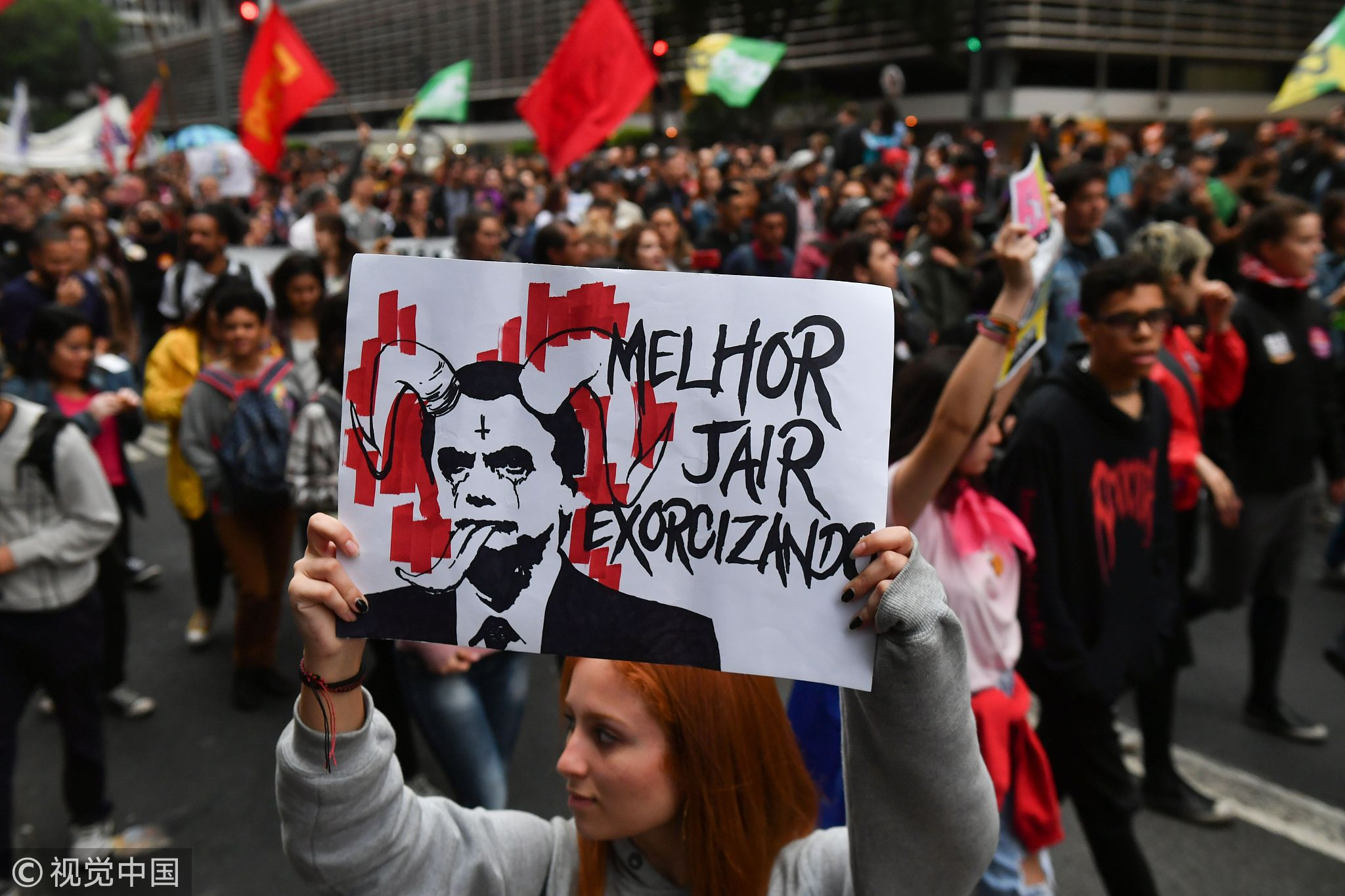
Demonstrators with a sign depicting Brazilian right-wing presidential candidate Jair Bolsonaro as the exorcist take part in a women's protest called by a social media campaign under the hashtag #EleNao (Not Him) in Sao Paulo, Brazil, October 6, 2018. /VCG Photo
Demonstrators with a sign depicting Brazilian right-wing presidential candidate Jair Bolsonaro as the exorcist take part in a women's protest called by a social media campaign under the hashtag #EleNao (Not Him) in Sao Paulo, Brazil, October 6, 2018. /VCG Photo
Read more:
He also pledged to combine the Agriculture and Environment Ministries, which he said would solve many of the farm sector's problems, without elaborating after a Congressional farm caucus endorsement on Wednesday.
Fernando Haddad, the "new Lula", though quite a stranger to most Brazilians, is usually described by the media as a "cultured, articulate and moderate" politician.
The former professor at the University of Sao Paulo and scholar of Marxist theory has been often criticized for being aloof and lacking the popular touch.
His ideas inherit the concepts of Lula, which is to pursue social policies, reduce the gap between rich and poor and strengthen cooperation with developing countries.
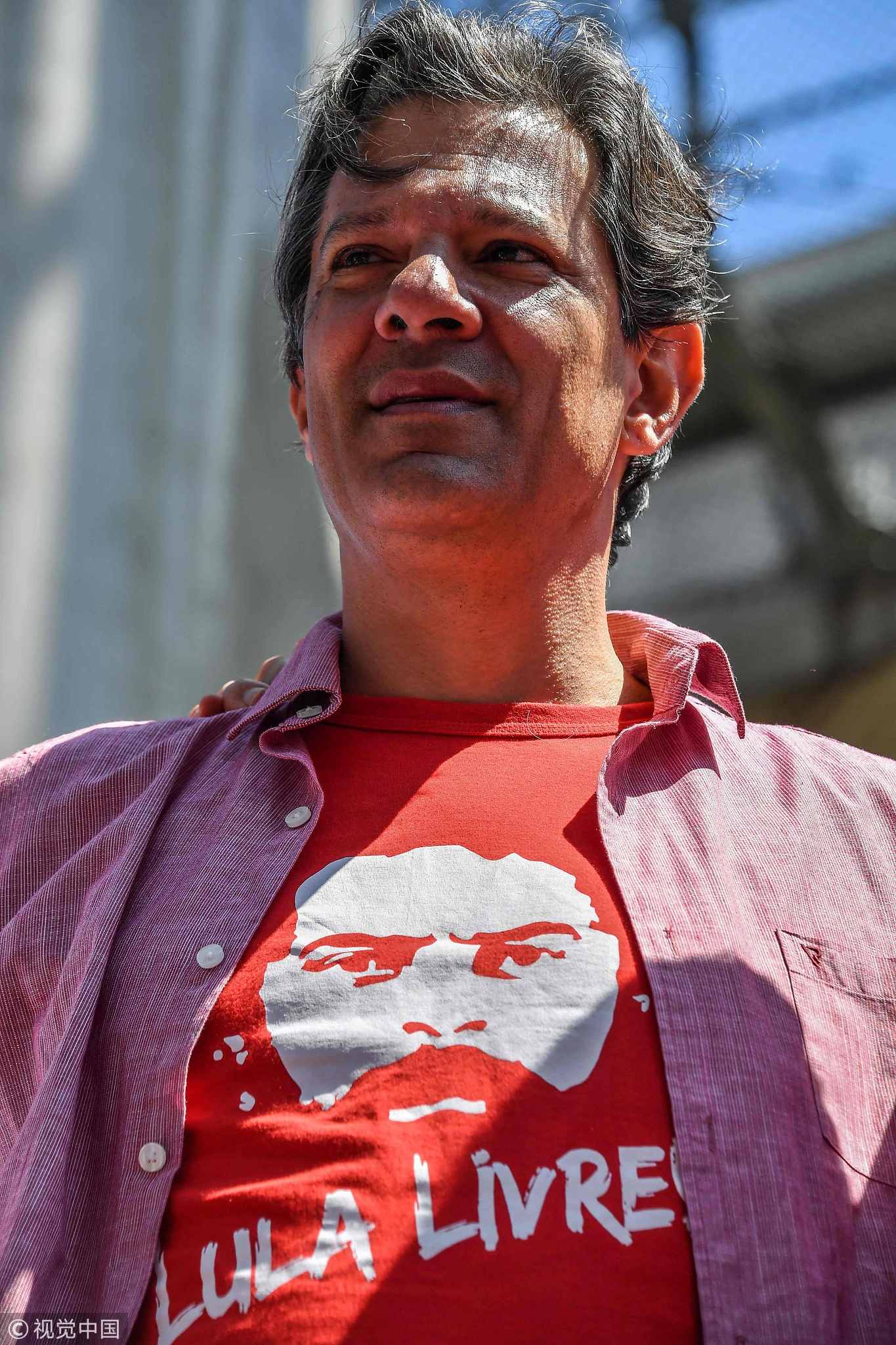
The presidential candidate for Brazil's Workers' Party (PT), Fernando Haddad, looks on as he campaigns in Sao Miguel Paulista, on the outskirts of Sao Paulo, Brazil, September 19, 2018, ahead of the October 7 national election. /VCG Photo
The presidential candidate for Brazil's Workers' Party (PT), Fernando Haddad, looks on as he campaigns in Sao Miguel Paulista, on the outskirts of Sao Paulo, Brazil, September 19, 2018, ahead of the October 7 national election. /VCG Photo
He said Wednesday he would strengthen ties with countries that make up the BRICS and the Southern Common Market (Mercosur) should he win in the country's upcoming election.
"Brazil is timid, closed in foreign policy. The first thing we have to consider is the BRICS countries, which are very important markets for Brazil, and we need to strengthen bilateral and multilateral agreements with those partners in order to create jobs," Haddad of the Workers' Party said.
Haddad also added that he would seek closer ties with Mexico and make progress in the relationship with the European Union.
People believe that the future of Brazil is at risk and that these elections will either consolidate democracy or facilitate authoritarianism.
Whoever takes the baton will face massive tasks to lead an angry and troublesome Brazil back to the right track.
Corruption, violence, unemployment
Corruption is viewed as the biggest and most obvious tumor in Brazil.
Corruption probes that began in 2014 have reached the highest levels of the Brazilian government and corporate elite, implicating President Michel Temer, former presidents, and dozens of cabinet officials and senators.
Operacao Lava Jato (Operation Car Wash) and overlapping investigations have led to prison sentences for top executives and politicians, mass layoffs, and billions of dollars paid in fines.
Not only corruption, unemployment violence, and economic issues also plague the country.
Read more:
Nearly 13 million Brazilians are unemployed, while homicides rose to a record high figure of 63,880 nationwide last year, according to the Brazilian Forum of Public Security.
As for the economy, much of Brazil did very well economically under the 2003-2010 rule of former president Lula and yearns for that heyday after suffering through a subsequent 2014-2016 recession, which was Brazil's worst ever.
However, the market once again reduced the Gross Domestic Product (GDP) forecast for 2018, from 1.36 percent to 1.35 percent according to Brazil's Central Bank (BC).
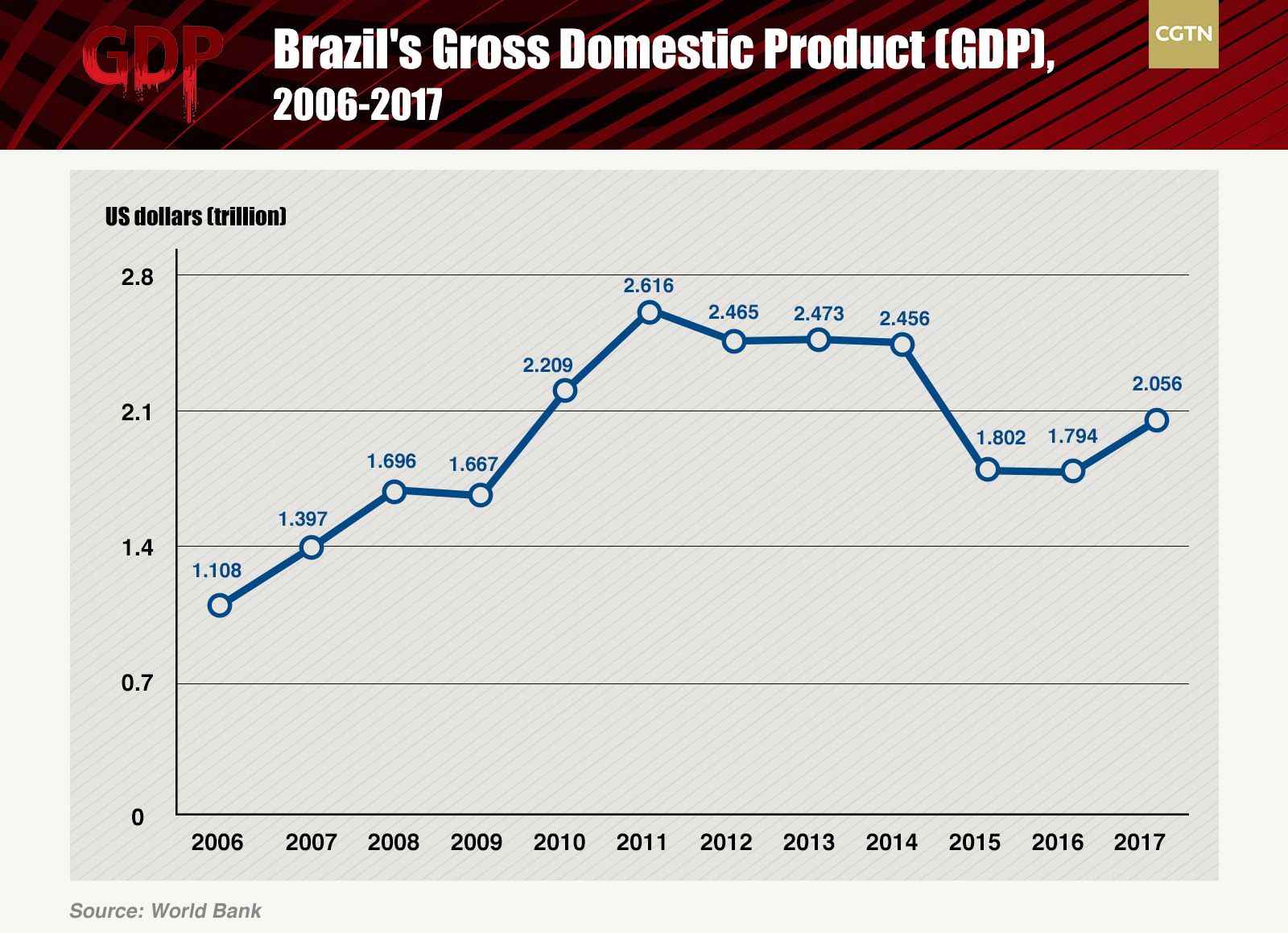
Brazil's growth rate slowed from 7.5 percent in 2010 to 3.6 percent in 2016 and a mere 0.9 percent in 2017. Its growth estimates for 2018 and 2019 have been constantly downgraded.
The country witnesses 155 murders every day, adding up to 30,000 so far in 2018 (2017 ended up with a record of 63,880 assassinations), as openDemocracy reported.
Among the factors worsening the situation in Brazil is the uncertainty looming over the outcome of the general elections on October 7.
The majority of Brazilian voters, especially young people, are pessimistic about the country's present situation, according to a poll released Wednesday by polling firm Datafolha.
Asked how they felt about Brazil today, calm or angry, 68 percent of those polled said they felt angry, compared to 27 percent who felt a sense of calm.
(With inputs from agencies)
16954km