
Opinions
22:52, 12-Oct-2018
Opinion: Is China an engine of global development or 'economic aggressor'?
Updated
22:39, 15-Oct-2018
 ["china"]
Share







Copied

Editor's note: Zhong Xuanli is a columnist at People's Daily. This article is translated from an opinion piece originally published in People's Daily.
What has China's development brought to the world? This should not be a difficult question to answer.
Recently, however, some strange talk in the United States has seemed to be a "standardized answer" to that question. For example, there is a saying that China's rise is actually to practice "economic aggression," to implement "geopolitical expansion," and to breach "international rules."
Such claims are not new in the US and have been around for a long time. They were simply innuendoes before, but now have become the government's rhetoric.
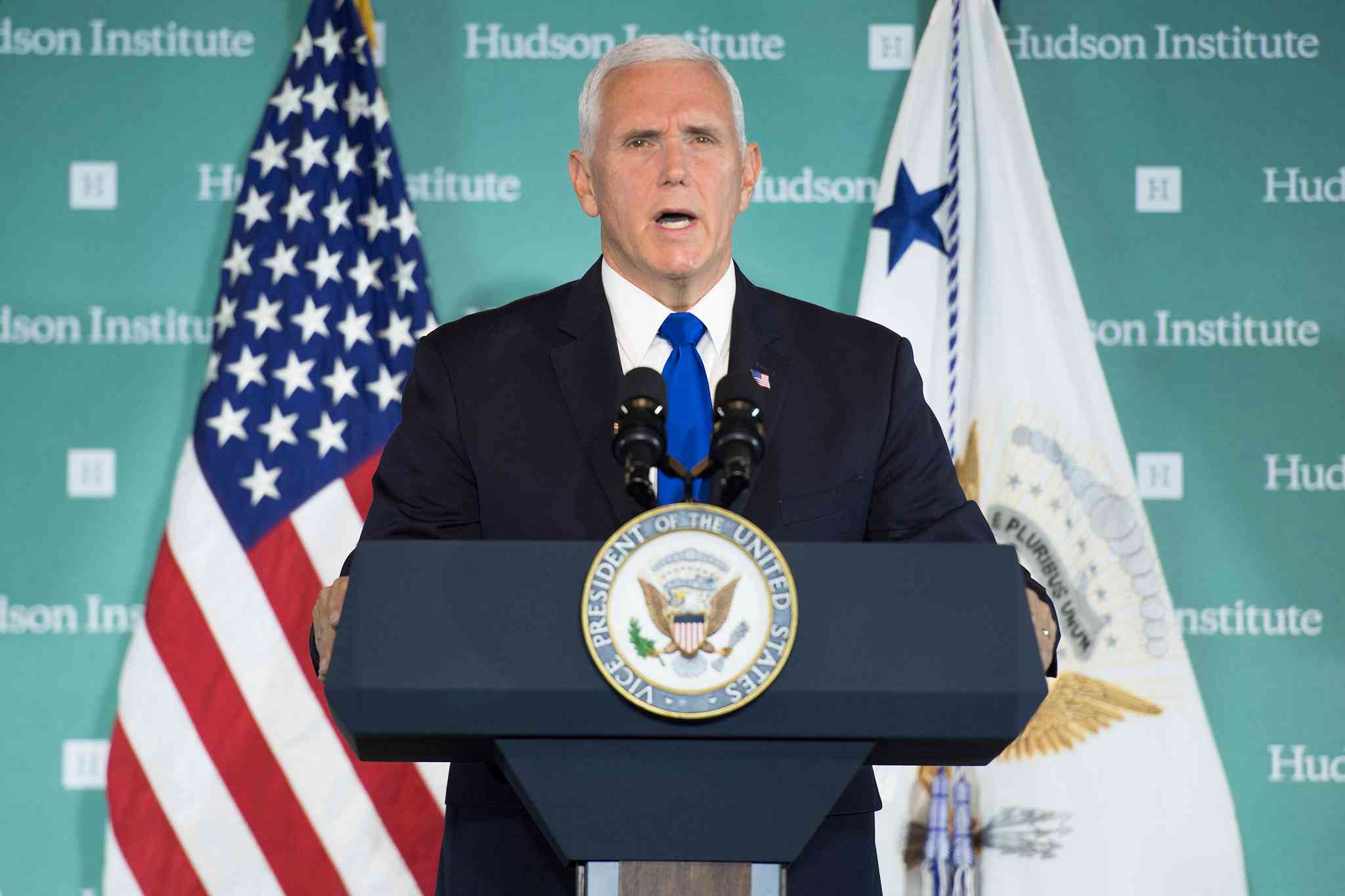
US Vice President Mike Pence addresses the Hudson Institute in Washington, DC, October 4, 2018. /AFP
US Vice President Mike Pence addresses the Hudson Institute in Washington, DC, October 4, 2018. /AFP
On September 17, President Trump accused China of "constituting a grave threat to the long-term health and prosperity of the United States economy" in his statement.
What's more, in a speech on October 4, Vice President Mike Pence falsely declared that China's "success was largely driven by American investment in China" and that the US "rebuilt China over the last 25 years."
What a hilarious joke! That being the case, we have to reason things out and make a good account of everything.
Pence accused China of engaging in "economic aggression" in the world and regarded the US as a victim. He also claimed that China has "used an arsenal of policies inconsistent with free and fair trade....These policies have built Beijing's manufacturing base, at the expense of its competitors – especially the United States of America" and that "China's actions have contributed to a trade deficit with the United States."
As a result, in the speech he said the US "will demand" China to "fulfill its obligations." America even started a trade war for that purpose. What about the losses to the world? It is worth close consideration.
The US thinks that its trade deficit with China is a "loss" and that America suffers from "economic aggression," claiming that its trade deficit is 200 billion US dollars. Trade numbers should not be counted like this.
We need to understand that trade as a mutual act, with both sides taking what they need. It is a voluntary process. China never sells by force nor seeks a surplus.
The US has a huge demand for the Chinese market, in terms of both buying and selling. UN statistics indicate that in 2017 US exports to China amounted to 129.89 billion US dollars, a 577 percent increase from 19.18 billion US dollars in 2001, and far higher than the 112 percent increase in its exports to other countries over the same period.
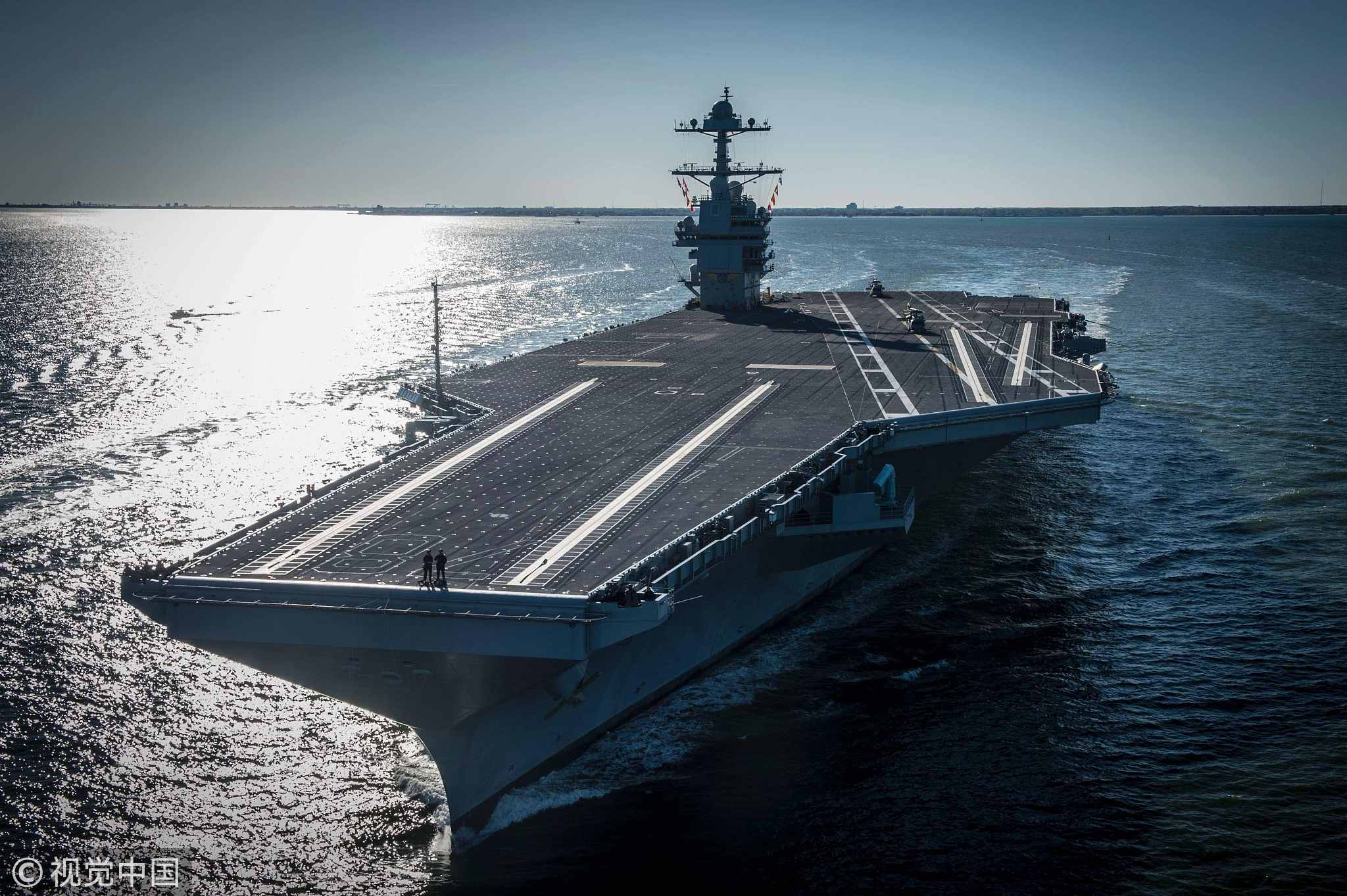
The USS Gerald R. Ford is seen underway on its own power for the first time in Newport News, Virginia, April 8, 2017. /VCG Photo
The USS Gerald R. Ford is seen underway on its own power for the first time in Newport News, Virginia, April 8, 2017. /VCG Photo
This was achieved when the US strictly limited its exports to China, and anything that contained some technological content was forbidden from being sold. If the US was willing to sell high-tech products, would there be such a big deficit?
Will the US Ford-class aircraft carrier, for example, be sold? One aircraft carrier is worth 15 billion US dollars and four carriers could fill the gap of the 60-billion-US-dollar deficit immediately if they were sold to China.
If the US could ease restrictions on exports to China a little bit, the trade deficit would not be what it is today, not to mention selling aircraft carriers.
According to a report by the Carnegie Endowment for International Peace in April 2017, if US export controls on China were relaxed to the level of those on Brazil, its deficit could be cut by 24 percent, and 35 percent if relaxed to the level of France.
Evidently, the key point is not "China does not buy" but "the US does not sell."
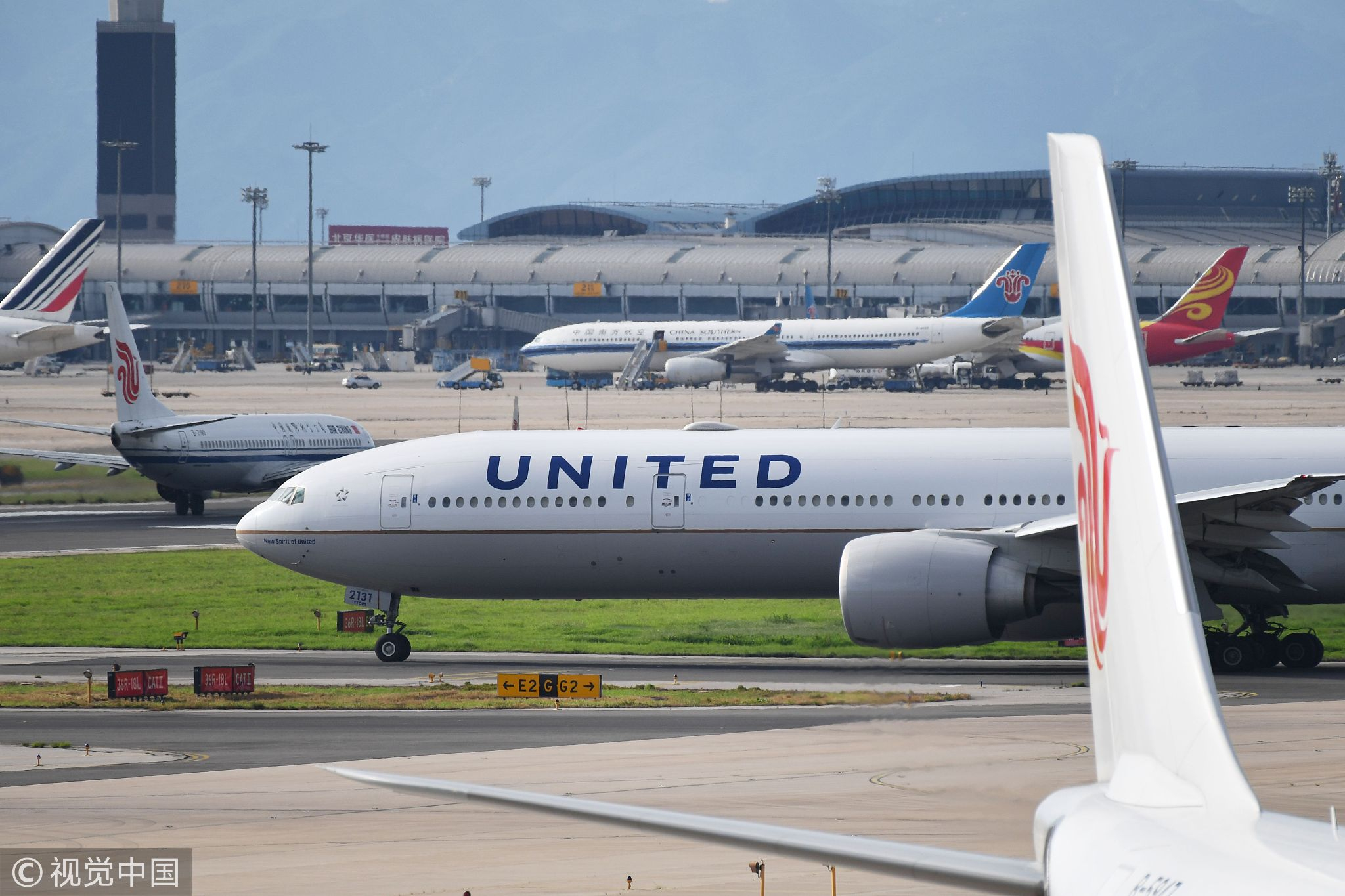
A United Airlines Boeing 777 aircraft waits to take off at Beijing airport, July 25, 2018. /VCG Photo
A United Airlines Boeing 777 aircraft waits to take off at Beijing airport, July 25, 2018. /VCG Photo
Beyond that, we should also consider trade in services. US data shows that its service exports to China increased 3.4 times from 13.14 billion US dollars in 2007 to 57.63 billion US dollars in 2017, while its service exports to other countries and regions increased only 1.8 times. Eventually, the US achieved a surplus of 40.2 billion US dollars in its trade in services with China in 2017, 30 times higher than in 2007.
In fact, because of globalization, it would be one-sided to calculate the profit and losses of China-US trade just based on the two countries.
For decades, manufacturing in the US, such as processing and assembling, has shifted to the world. The US has retained design and marketing services, while China has become the largest recipient of global industrial transfers, where many goods are manufactured and then exported to America and other countries.
The sale of these goods is calculated as an export from China. In the value chain of products, multinational enterprises get the lion's share, while Chinese enterprises get a small margin. It is apparently unfair to conclude that China takes all the profit in this situation.
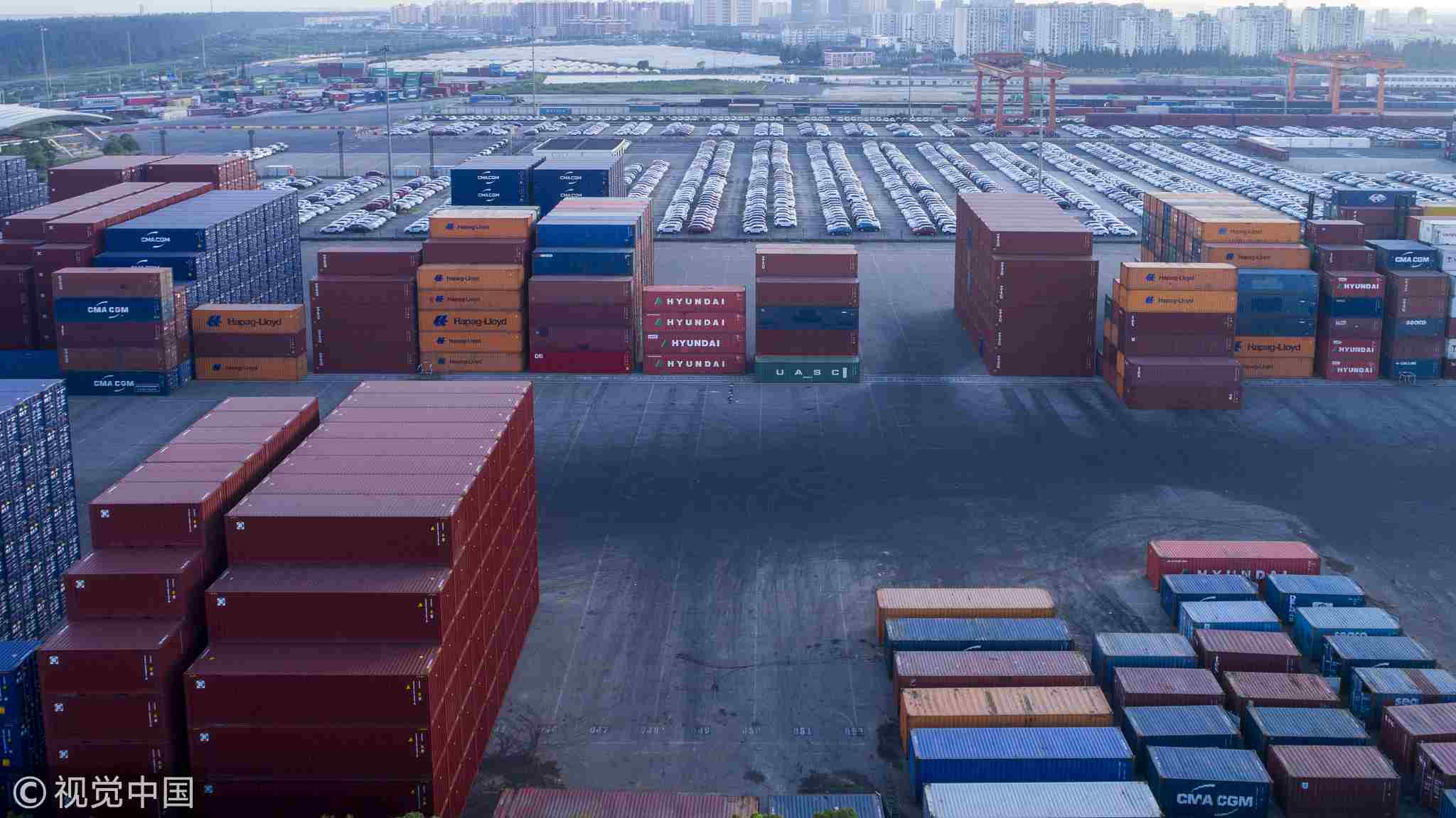
Container boxes are seen at the Yangshan Deep Water Port, part of the Shanghai Free Trade Zone, in Shanghai, China, July 20, 2017. /VCG Photo
Container boxes are seen at the Yangshan Deep Water Port, part of the Shanghai Free Trade Zone, in Shanghai, China, July 20, 2017. /VCG Photo
The development of China is an important boost, rather than an "economic aggression," to world economic growth. China's contribution to world economic growth has stayed at around 30 percent since 2013 and China always ranks as the largest contributor. In 2017, China's contribution reached 34.6 percent, about twice that of the US.
China's development has also created a bigger market for the world. From 2001 to 2017, China's imports grew at an average rate of 13.5 percent, or twice the world average. China's service imports grew at an average of 16.7 percent over the same period, 2.7 times the world average.
From 2011 to 2017, China's total share of imports and services increased by 1.7 percentage points, from 8.4 percent to 10.1 percent, while the US share declined by 0.5 percentage points over the same period.
China is also playing an important role in job creation for the world economy. China has established more than 80 overseas economic and trade cooperation zones with countries along the Belt and Road, adding 244,000 jobs.
According to data from Ernst & Young, one of the big four international accounting firms, China created more than 130,000 jobs in Africa between 2005 and 2016, more than three times that of the US.
In addition, China created 1.8 million jobs in Latin America and the Caribbean from 1990 to 2016, according to the International Labor Organization's report entitled "Effects of China on the quantity and quality of jobs in Latin America and the Caribbean."
The US says that China has "taken" American jobs as some American factories have moved to China, which is a one-sided opinion and untenable. The US-China Business Council's 2017 report noted that the China-US business relationship supported about 2.6 million US jobs.
A study by Ball State University showed that compared with the peak in manufacturing jobs in the US in 1979, the US has lost about 7 million manufacturing jobs. However, 88 percent of the lost jobs were caused by improved industrial automation.
This has nothing to do with China. In the final analysis, where US companies assign their factories is motivated by profit, and no one can control their decision.
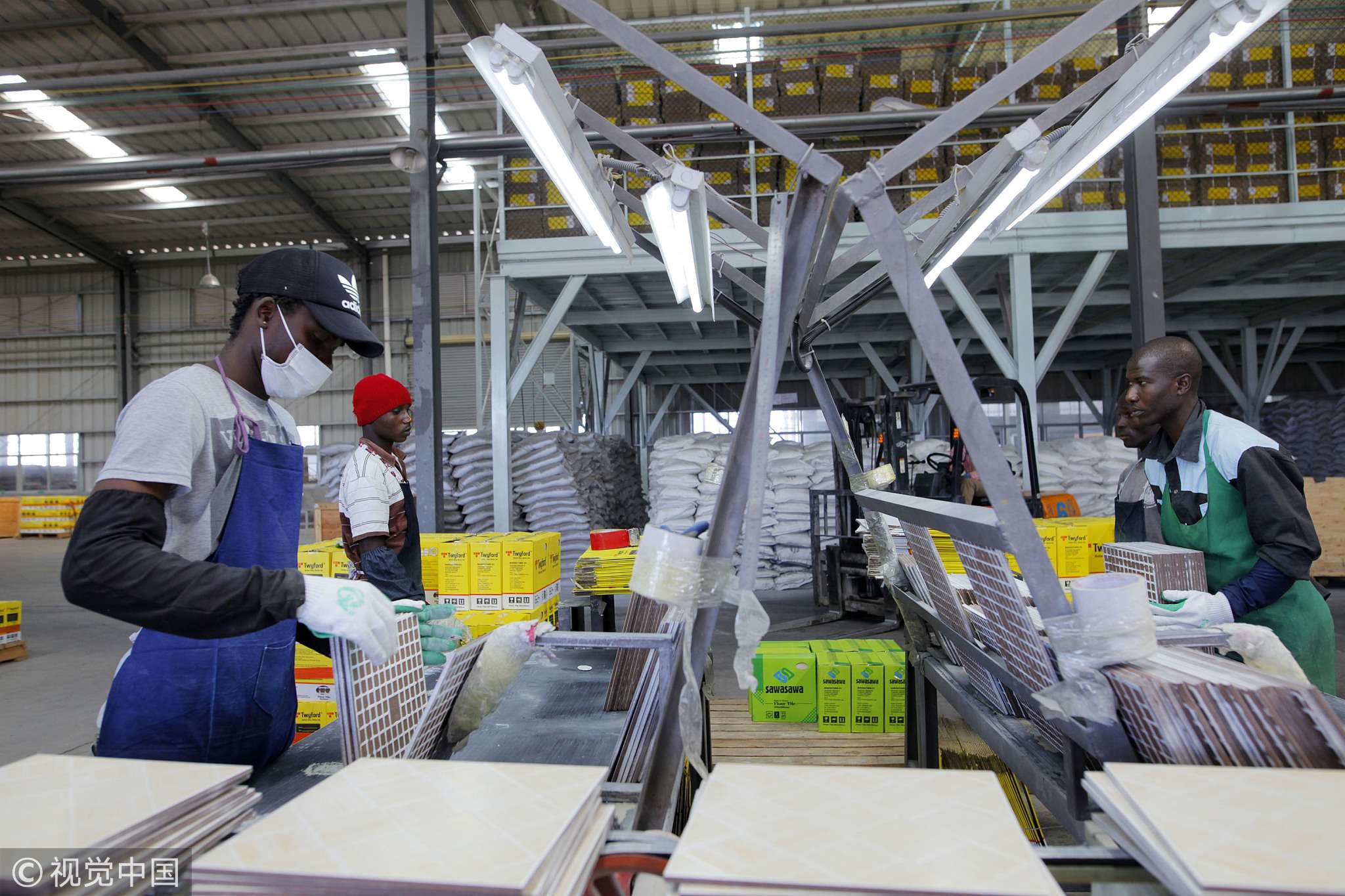
Locals work at a Chinese company in Kenya, December 12, 2017. /VCG Photo
Locals work at a Chinese company in Kenya, December 12, 2017. /VCG Photo
Instead of "economic aggression," China's development has promoted the development of the world by expanding its market, creating employment and contributing wisdom. It strongly supports the UN Millennium Development Goals and the 2030 Agenda for Sustainable Development.
China's development has led the way for developing countries in the world, whose population accounts for more than 80 percent of the world's total population, to modernize, and has provided new choices to countries and nations who want to accelerate their development and maintain their independence at the same time.
Raphael Tuju, the secretary general of Kenya's ruling Jubilee Party, said: "China's achievements have no precedent in history. It brings African people hope and gives them light at the end of the tunnel."
China's development is by no means "driven by US investment in China," as some US politicians claim. It has been achieved by more than a billion Chinese people who have worked hard.
Even when it comes to investing in China, the US does not have the most capital flow or capital deposited, not even mentioning talk about "rebuilding China." Data shows that since the 1980s, US investments in China only account for 7 percent to 10 percent of foreign investment. However, the United States has made huge profits from investing in China.
(If you want to contribute and have specific expertise, please contact us at at opinions@cgtn.com)