
Technology
18:02, 01-May-2019
Facebook proclaims 'The future is private'
Updated
09:43, 02-May-2019
 ["china"]
Share







Copied
01:03

As I attended Facebook's developer conference this year known as F8, one thing was clear: Facebook CEO Mark Zuckerberg was intent on showing that Facebook will build products embedded with privacy features from the start.
The F8 was held from April 30 to May 1 in San Jose, U.S.
Zuckerberg's emphasis on privacy stands in stark contrast to the way the social media giant used to operate when it had posters adorned to its office walls saying "Move Fast and break things. Unless you are breaking stuff, you are not moving fast enough."
This past year Facebook discovered what the company had broken was the people's trust in them.
This year's F8 is all about winning that back.
As the keynote event kicked off, Zuckerberg set the stage by saying in his opening line: "We are going to talk about building a privacy-focused platform."
He attempted to strike a tone of humility.
"I get that a lot of people aren't sure we are serious about this. I know that we don't exactly have the strongest reputation on privacy right now to put it lightly," said Zuckerberg on stage as he chuckled. "But I'm committed to doing this well and starting a new chapter for our products."
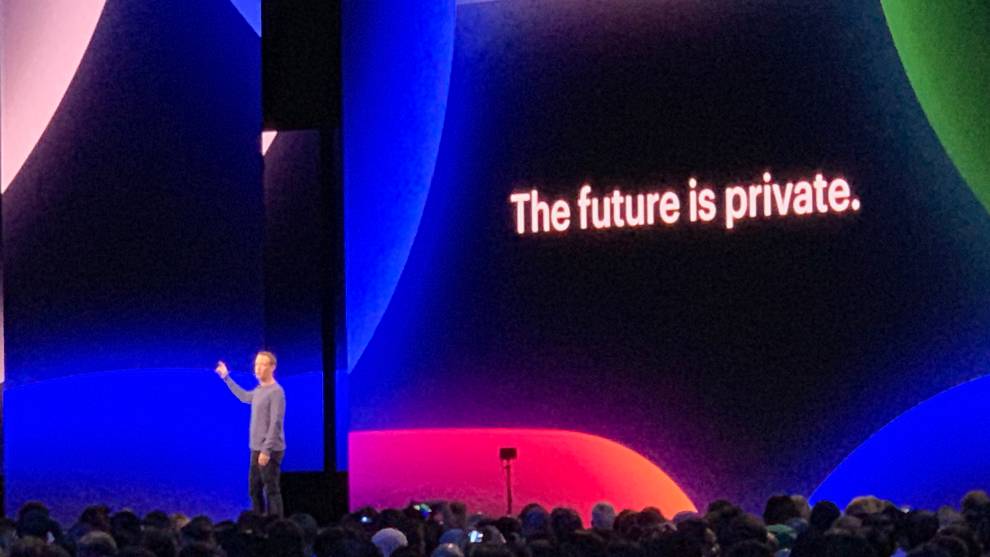
As the keynote event kicked off, Zuckerberg set the stage by saying in his opening line: "We are going to talk about building a privacy-focused platform." /CGTN Photo
As the keynote event kicked off, Zuckerberg set the stage by saying in his opening line: "We are going to talk about building a privacy-focused platform." /CGTN Photo
Zuckerberg laid out some of the core principles in his privacy vision – end-to-end encryption, secure data storage, and reducing the permanency of messages – so what you say on social media won't come back to haunt you later.
"It's no surprise that the fastest ways we are all communicating online are private messaging, in small groups, and stories," said Zuckerberg. "As the world gets bigger and more connected, we need that sense of intimacy more than ever. So that's why I believe that the future is private."
"That's totally up in the air," Karsten Weide, program vice president of Media and Entertainment at the International Data Corporation, told CGTN. "They said they would redesign the service around these items but how exactly they are going to do that is another question."
As Facebook rolled out a redesigned look called FB5, Zuckerberg admitted years ago they would have figured out how to adjust to problems as they came up after the launch of the new look.
But now he says his company is taking a more open and consultative approach.
That means taking a year to work with experts, law enforcement, and governments around the world to discuss how to build the right safety features.
But still, hits to Facebook's reputation on privacy have hardly made a dent in Facebook's business.

Facebook's annual developer conference, or F8, held in San Jose, California, from April 30 to 2, 2019. /CGTN Photo
Facebook's annual developer conference, or F8, held in San Jose, California, from April 30 to 2, 2019. /CGTN Photo
"If there is a significant defection of users or reduced usage times, it doesn't really show in the numbers. Not in a dramatic way anyway. Revenues are still increasing," said Weide.
Facebook also revealed it's making a deeper push into payments and shopping through its Messenger app and its popular Instagram app, looking to emulate what WeChat has done in China.
Other new features will challenge Zuckerberg's commitment to privacy.
The company announced the expansion of Facebook Dating, which seeks to help people that have never met before find romance.
Facebook Dating rolled out to a limited audience last year, but will finally hit the U.S. along with at least 14 other countries, including ones in Asia and South America.
It'll be taking on apps and dating sites like Tinder and Match.com.

Facebook will also offer a new feature called Secret Crush. /CGTN Photo
Facebook will also offer a new feature called Secret Crush. /CGTN Photo
Facebook will also provide a new feature called Secret Crush. Users can select friends they are secretly interested in. If those friends feel the same way, Secret Crush will reveal the match.
The question now becomes whether those new features mesh with Zuckerberg's emphasis on privacy since all that data and all those likes it has collected on its users are an excellent way to find a match.
That's the dilemma Facebook is always facing, how far to go in making use of personal data.