
Opinion
19:50, 25-Feb-2019
Oscars: A slight diversity overkill
Updated
18:15, 26-Feb-2019
 ["china"]
Share







Copied
Editor's Note: Bo An is a film producer based in Los Angeles, and the chief operating officer of the China Lion Entertainment Production. She holds an M.A degree in Cinema Studies from the Tisch School of Arts, New York University. The article reflects the author's views, and not necessarily those of CGTN.
It was after a typical Hollywood packaging meeting between a big Hollywood producer, whose work just achieved huge global success, and a Chinese production company that has been developing China-U.S. co-productions for a couple of years in Hollywood.
When the producer mentioned the 91st Oscars that took place on Sunday, the Chinese company executive expressed an interesting opinion. "I'm not sure if I would watch it on Sunday," she noted. "After all, Black Panther is nominated (for Best Picture)."
One of the reasons why she made such a comment is, of course, because Black Panther is a so-called blockbuster. And it's a common notion among Chinese audiences and filmmakers, that blockbusters, although successful business-wise, are usually criticized for its artistic and critical value.
More importantly, as a film company executive who's been working in Hollywood, let's just call her an "insider" for the moment, her reaction toward the fact that the blockbuster was nominated in the Best Picture category also represents her opinion about Hollywood's slight "overkill" on its route toward diversification.
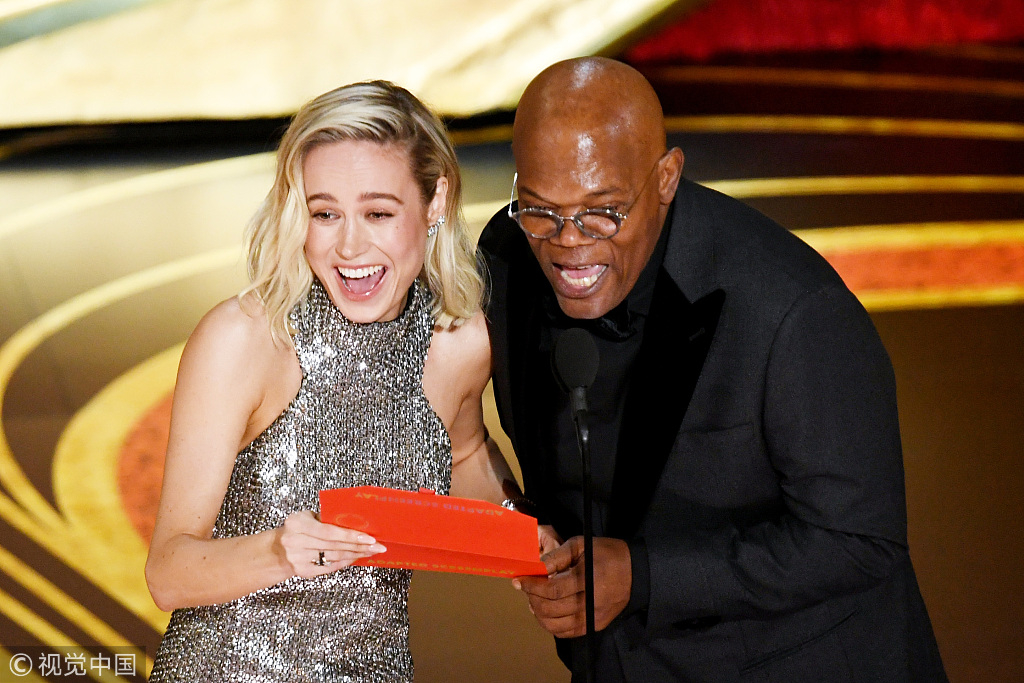
Brie Larson and Samuel L. Jackson during the 91st Annual Academy Awards at Dolby Theater in Los Angeles, California, February 24, 2019. /VCG Photo
Brie Larson and Samuel L. Jackson during the 91st Annual Academy Awards at Dolby Theater in Los Angeles, California, February 24, 2019. /VCG Photo
Before diving into the movement of Hollywood's diversification, let's take a quick look at this year's Best Picture Nominees: "Bohemian Rhapsody," "The Favourite," "Black Panther," "BlackKklansman," "Green Book," "Vice," "A Star Is Born," and "Roma." Among all eight of them, only one-and-a-half titles are about straight white male human beings, a type of character that earlier used to be the hero for most Oscar Best Picture nominees, if not all of them.
And beyond those motion pictures, the very same group of people also make up the majority of the Academy of Motion Picture Arts and Sciences, the entity and decision maker behind the Oscars.
However, in today's Hollywood, if a movie wants to win in the competition for Best Picture, it'd better have a hero that's not straight ("Bohemian Rhapsody"), or not white ("Black Panther," "BlackKklansman," "Green Book"), or not male ("The Favourite," "A Star Is Born," "Roma").
Sometimes, it's even not a human being! We did not see such an extreme nominee in this year's competition, but don't forget "The Shape of Water," which indeed was the Best Picture of last year's Oscars and some joked that the motif of that movie, and what the Oscars tries to tell us these days, was "everyone but straight white male human beings could triumph."
The phenomenon reflects its will and struggle of keeping up with today's social and political developments of the Oscars, the 91-year-old entity that's facing all kinds of challenges in today's media and entertainment industry. And before the movement, there was indeed a lack of diversity and a long-existing problem of stereotypes in the portrayal of minorities and females.
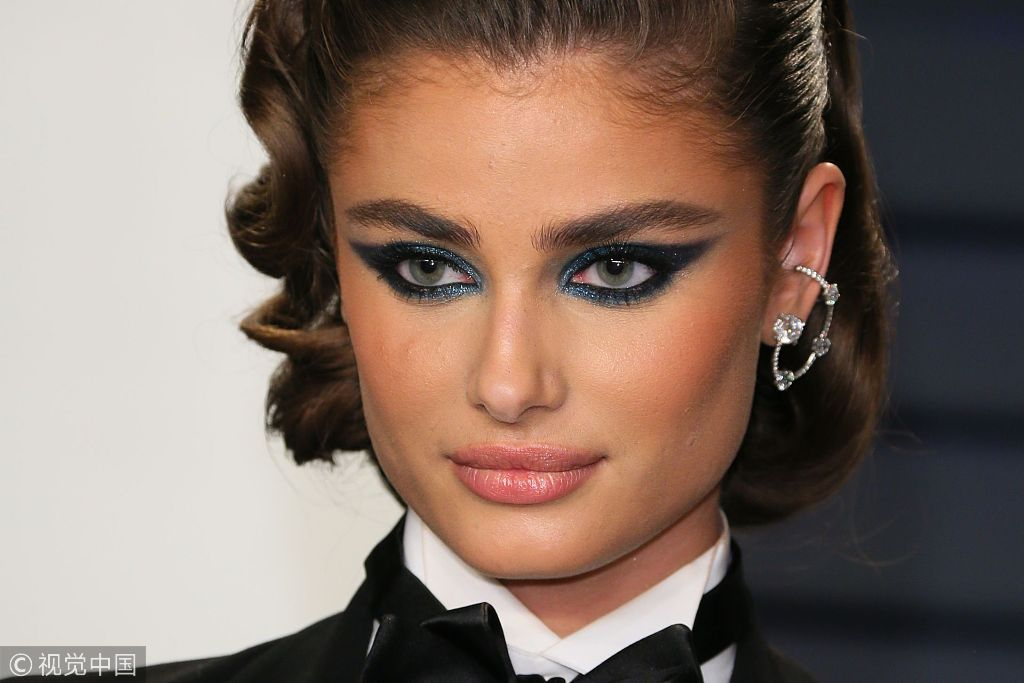
Model Taylor Hill attends the 2019 Vanity Fair Oscar Party following the 91st Academy Awards at The Wallis Annenberg Center for the Performing Arts in Beverly Hills, February 21, 2019. /VCG Photo
Model Taylor Hill attends the 2019 Vanity Fair Oscar Party following the 91st Academy Awards at The Wallis Annenberg Center for the Performing Arts in Beverly Hills, February 21, 2019. /VCG Photo
It all started at the ceremony of the 2016 Oscars, when black comedian Chris Rock brought three Asian children to the stage, posing as "bankers" from finance firm PricewaterhouseCoopers.
The joke soon upset many people because of its stereotypical depiction of Asians and child labor. The Oscars soon apologized for the joke and from that day on, to prove its determination to be as diverse as possible, the movement rages on.
In the following year, among the nominees of the 89th Oscars, out of nine titles, three of them told the stories of African-Americans. "Moonlight," the one that has a hero who's not only African-American, but also gay, won the award for Best Picture. "Lion" told a story of an Indian boy and "Arrival" has a female lead. In that year, the ratio of titles with straight white male protagonists and other titles are still about half and half.
In 2018, the situation progressed. Among all nine titles, only three of them were about straight white males. And as mentioned above, the extremist "Shape Of Water" won the Best Picture award. And even before the ceremony, it was almost certain for many who work in the industry and who were aware of this movement of diversity that "Shape of Water" would win!
It's definitely a good thing that Hollywood and the Academy has started to realize the importance of diversity and such a movement does open up opportunities for minorities' stories to be told, and for more minority filmmakers in Hollywood. Yet some are also wondering whether the Oscars' current struggle toward diversity is a bit of an overkill, to the degree that the Best Picture nominees are more like flags for some political statements than great pieces of art in accordance with the classic criteria of motion pictures?
(If you want to contribute and have specific expertise, contact us at opinions@cgtn.com.)