
Business
13:43, 22-Sep-2018
Harvest day arrives for Chinese fishermen on Xiyang island
Updated
13:10, 25-Sep-2018
 ["china"]
Share







Copied
02:54
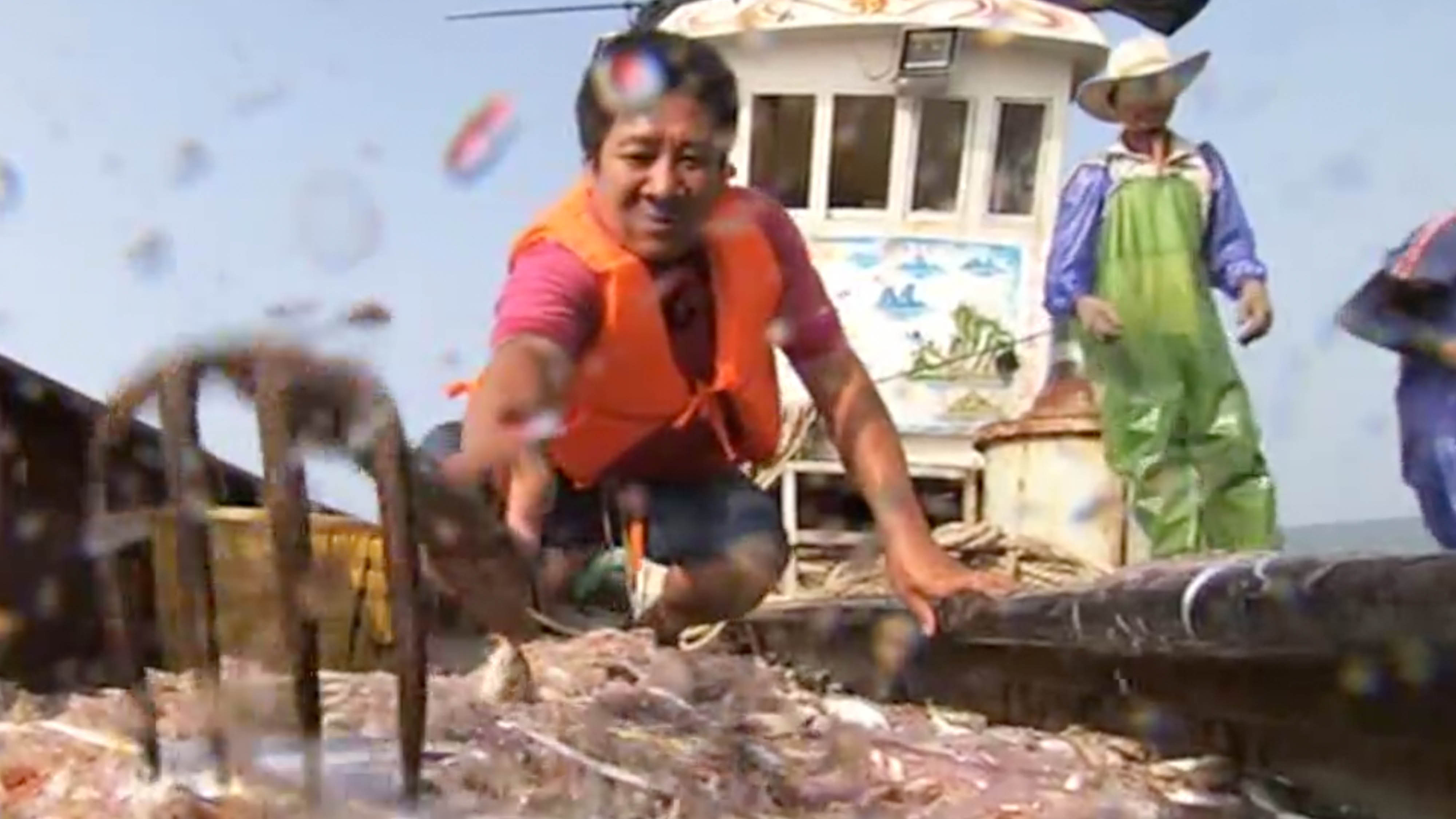
September 23 has been designated as China's inaugural national Harvest Day for farmers. This year, fishermen on Xiyang Island, east China's Fujian Province, are ready to embrace a big harvest.
When the glory of the morning was mirrored in the sea at around 4:00 am, Wang Jiaxing and thousands of fellow fishermen were already rolling up their sleeves on the ships, and waiting for the first rising tide of the day.
For decades, fishing has been the only industry in Xiyang island, about ten kilometers east off Chinese mainland. Almost all of the local islanders, some 12,000, live on fishing.
In fall, the morning rush hour takes place in the sea near this small island.
"The time we get up depends on when the tide starts to rise," Wang said. "It could be two o'clock, three o'clock or four o'clock."
The ups and downs of the tide bring wild fish to the top of the water, but it takes back-breaking labor for fishermen like Wang to pull them onto the ship.
In the net, there are usually all kinds of fish, shrimps and crabs. But before the ship returns to the shore, Wang had already sorted them for sale.
"There are plenty of people waiting to buy the fish fresh from the sea. Most of them are middlemen who will then sell them by retail," Wang said.
China now tops the world in the amount of wild fish harvested. For most outsiders, this fishing life may be a pleasant escape from the urban hustle and bustle, but for local villagers, there is still another side of the life. Working in the sea is not easy.
As one of the easternmost islands in China, Xiyang often takes the first hit when typhoons approach in summer. Waves are punishing, and crash into the buildings on the shore.
A massive 1,000-meter-long dam is being built in the middle of the sea to minimize the hazard.
Huang Luocheng, who works for state-owned China Communication Construction Company, is in charge of the project.
He said, "We are working fast to complete the main structure of the dam by next summer. We hope that 2018 will be the last year which the islanders have to suffer from the tsunami-like waves during typhoons."
Huang added that the dam costs 60 millions US dollars and aims to reduce the waves for the 12,000 islanders.
The next step of the construction is to ship the heavy trucks and cranes onto the island. The shallow water around the island only allows small ships to carry the heavy equipment, one piece at a time.
It was again a fresh morning. The rising sun began to climb up above the horizon, painting the sky with red and orange hues. Wang boated out of the sea as usual.
"We feel a much stronger sense of security now. We are not forgotten by a fast growing country," Wang smiled and said, looking far away into the sea.