
05:13, 16-Aug-2017
Okunoshima Poison Gas Plant: A history of making chemical weapons
 []
[]
Share







Copied
The 1925 Geneva Protocol prohibited the usage of chemical weaponry against humans. Despite Japan being a signatory of the protocol, its military used millions of gas bombs on the Chinese battlefield. And most of these chemical weapons were from a small island in the beautiful Inland Sea. CGTN's Ma Ke has more.
Only three kilometers from Japan's main island, Honshu, surrounded by the the Inland Sea, is the tiny island of Okunoshima. Amid the picturesque scenery and peaceful environment is the site of a poison gas factory.
From 1929 to 1945, the Japanese military used over seven million gas bombs on the Chinese battlefield. 80 percent of them were from Okunoshima. Workers were attracted by good salaries, only to find out later what they were making. 91-year-old Yasuma Fujimoto was recruited when he was a teenager.
YASUMA FUJIMOTO FORMER EMPLOYEE OF POISON GAS PLANT "As soon as I set foot on the island, I was hit by this smell that made my eyes and nose hurt. I realized at once this was no ordinary military plant. It was a gas plant."
According to a file released by US researchers in 1984, the plant made two kinds of poison: mustard gas--lethal at half a milligram, and Lewisite, as known as "the Dew of Death". Even masks could not prevent damage to workers' skin, eyes and lungs.
YASUMA FUJIMOTO FORMER EMPLOYEE OF POISON GAS PLANT "The working area was filled with poisonous dust. We breathed it every day! Every day!"
After the war, most of the plant was demolished, and the original location went into lock-down. The soil was so contaminated that no plant has ever grown on it since.
MASAYUKI YAMAUCHI, DIRECTOR TAKEHARA POISON GAS RESEARCH INSTITUTE "The foundation of the plant was one meter below. (Is the soil still poisonous?) Yes it is still dangerous." Fujimoto's experience left him with bronchitis and damage to his central nervous system. But he stills holds himself responsible for the bombs he made. He's been visiting China for twenty years, telling the truth about Okunoshima. Okunoshima residents and other Japanese peace lovers have also fought to keep the evidence of the past.
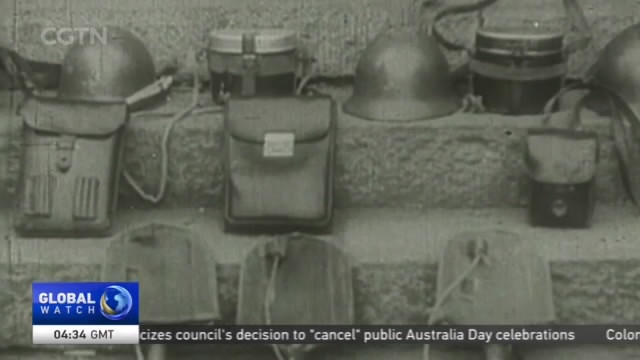
Here in the Okunoshima Poison Gas Museum, gas tanks and masks stand silent witness of a grim history. They even wrote "the Song of Okunoshima" for their grandchildren so that no one will ever forget.