
Opinions
23:35, 30-Jun-2018
Opinion: The success of the CPC is definitely no myth
Updated
22:59, 03-Jul-2018
 ["china"]
Share







Copied
Editor's note: Dr. Xia Lu is an Assistant Professor of Political Science at the School of Marxism Studies, Renmin University of China. The article reflects the author's opinion, and not necessarily the views of CGTN.
The year of 2018 marks the 97th anniversary of the founding of the Communist Party of China (CPC). During its uneasy nearly-a-century long history, the CPC has grown from an intellectual-dominated Marxism study group with just over 50 members in 1921 to the largest political party on this planet leading the second biggest economy in the world, which has been attracting people from all over the world to probe into the myth of its success.
Among all the explaining factors offered by both Chinese and foreign scholars and statesmen, the Party building --- the disciplinary inspection of its own organizations and members at different ranks with strict and rigorous criteria --- probably should take more credit.
Admittedly, at different times, the CPC adopts various policy lines and principles to tackle the major paradox in a certain era. Yet the Party still holds the essence of its governing philosophy --- never forget its initial mindset and the original mission, declared solemnly by General Secretary Xi Jinping at the 19th Party National Congress.
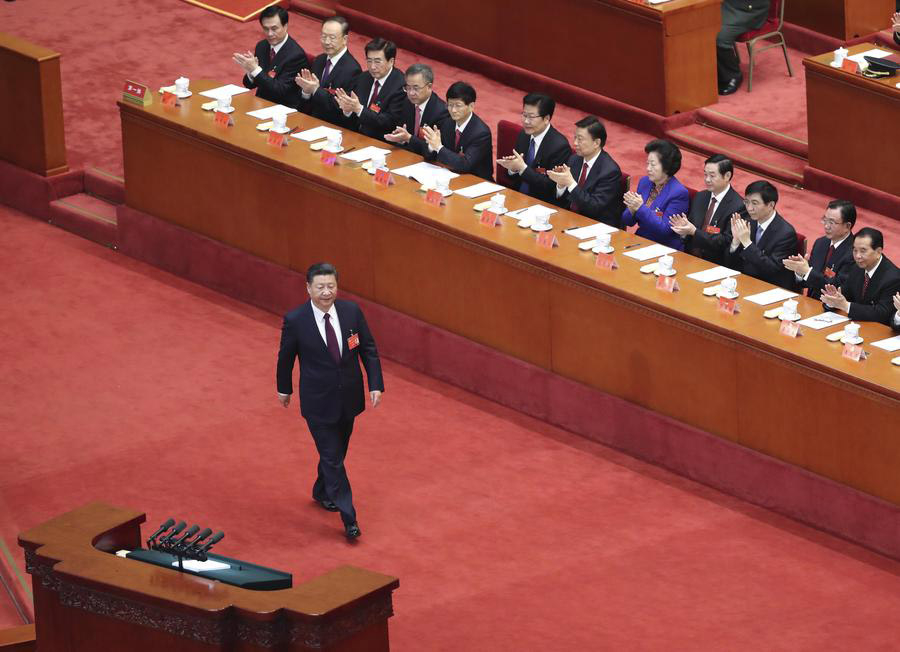
Xi Jinping, general secretary of the Communist Party of China (CPC) Central Committee, walks to deliver a report to the 19th CPC National Congress at the Great Hall of the People in Beijing, Oct 18, 2017. /Xinhua Photo
Xi Jinping, general secretary of the Communist Party of China (CPC) Central Committee, walks to deliver a report to the 19th CPC National Congress at the Great Hall of the People in Beijing, Oct 18, 2017. /Xinhua Photo
This is also the historical responsibility of the Party since its inception. Had it not been kept in the minds by generations of Party leadership, Chinese revolution and the socialist construction would not have achieved success.
What is more, Chinese governing bodies always call for a core, either an organization or a person. Centralization is one of the great features of Chinese politics, whereas de-centralization is that of the West. In terms of booming national economy, integrating social forces, and creating and consolidating national identity, one could argue with more confidence that centralization is much more effective to a developing country like China. Therefore, prosperity calls for a strong governing body, and the latter in turn calls for a wise leading core.
Having been instructing that the Party shall “see its self-governance exercised fully and with rigor”, President Xi Jinping seeks to forge the CPC organizations into battle fortresses and pioneer models.
Among the achievements that have been made in this process, the unification and strengthening of thoughts and organization are the most obvious ones. In addition, continuous theoretical endeavor and practical exploration, always daring to sail in the uncharted water with courage and wisdom, are also noteworthy.
From a historical and comparative perspective, to promote the Party-building is not merely for the sake of the Party itself; rather, it would be doing so in order to achieve state-building, one of the great goals of modernization.
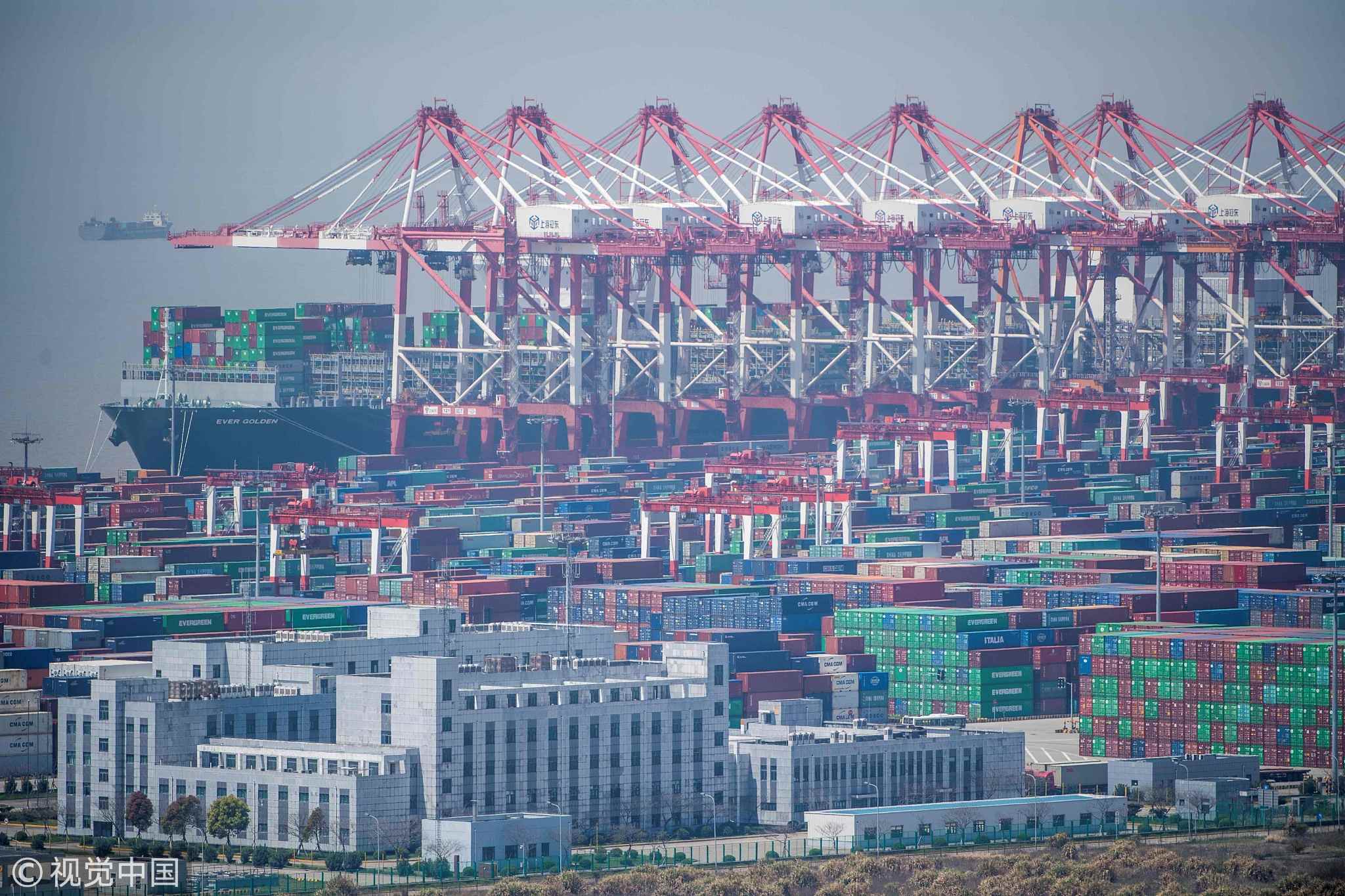
A general view of the Yangshan Deep-Water Port, an automated cargo wharf, in Shanghai on April 9, 2018. /VCG Photo
A general view of the Yangshan Deep-Water Port, an automated cargo wharf, in Shanghai on April 9, 2018. /VCG Photo
An abundance of theoretical and empirical literature has been devoted to understanding the process of nation-state building in modern China since it was forced open by imperialist powers, and it has been argued that China’s state-building task has yet to be finished. I find this argument ungrounded, since few of the studies (mostly conducted by Western scholars) have even attempted to incorporate Party building into the process of state building. Therefore, they often produce the biased understanding of the Party and Chinese politics.
The emergence and spread of the international communist and socialist movements in both theory and practice could be marked as one of the greatest historical phenomena in the 21st century. So is its sudden and dramatic ending.
The CPC was part of it at first, and the success of the Chinese revolution could largely be attributed to the movement. Yet the CPC had never for a bit set behind itself the initial mindset and the original mission --- that is, always serving the nation of China and its people. And thus we have the sinicization of Marxism-Leninism with the real Chinese situation.
Another reason still lies in the periodical purification of the Party organization with discipline and regulation in order to keep up with the mindset and carry on the mission. With continuous and down-to-earth theoretical endeavor and everlasting people-centered practice, the success of the CPC is absolutely understandable.