
Politics
11:26, 11-May-2018
Why was Singapore chosen to host the Trump-Kim summit?
 ["china"]
Share







Copied
02:27
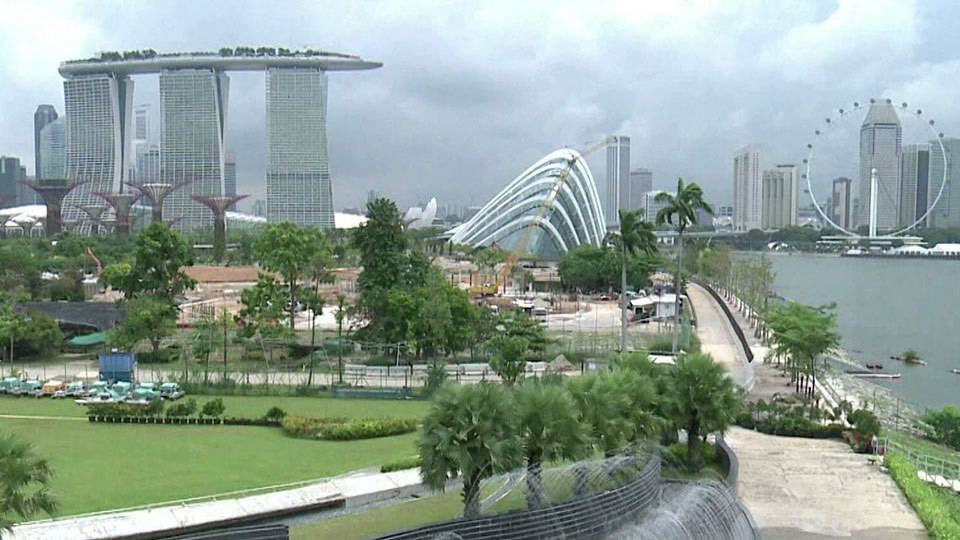
The date and time have been announced for the highly anticipated Trump-Kim summit: June 12th in Singapore. Now the question on everyone’s mind is why?
Read more:
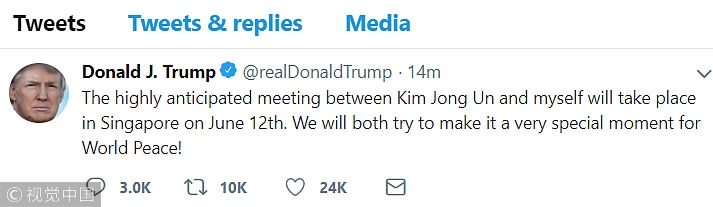
Screenshot of US President Donald Trump's Twitter /VCG Photo
Screenshot of US President Donald Trump's Twitter /VCG Photo
First, security advantage
The Southeast Asian financial hub was likely chosen for its neutrality, security advantages and track record of hosting international summits, observers say.
The ultramodern city-state has a robust security infrastructure and is widely considered one of the safest cities in Asia. It has tight restrictions over media and public gatherings, which will allow for a controlled environment likely to be preferred by Pyongyang.
Second, 'no baggage'
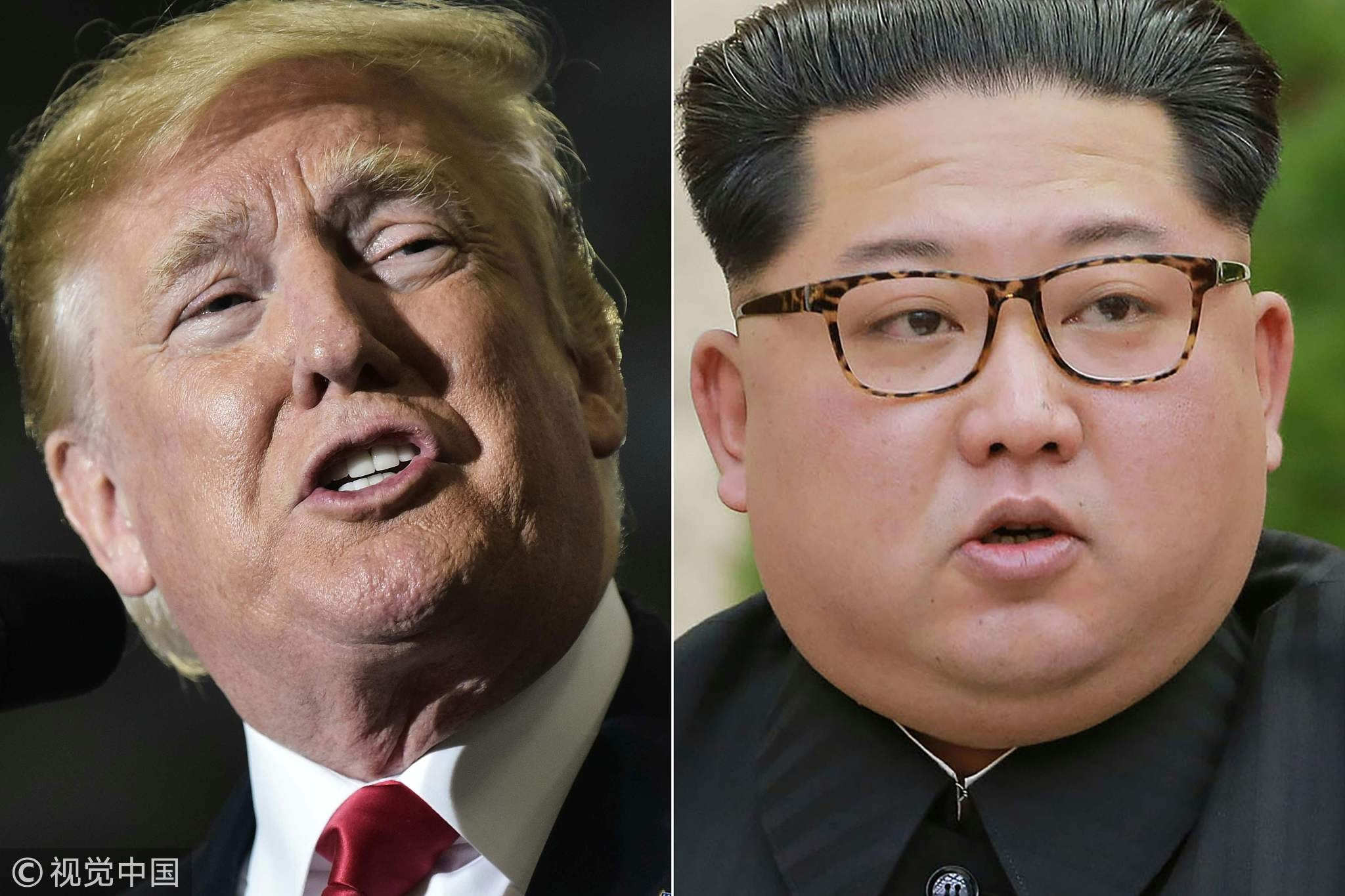
Photos of US President Donald Trump and DPRK top leader Kim Jong Un /VCG Photo
Photos of US President Donald Trump and DPRK top leader Kim Jong Un /VCG Photo
Singapore is also in the rare position of having friendly diplomatic ties with both Washington and Pyongyang.
It considers the United States a close partner, while the Democratic People's Republic of Korea (DPRK) maintains a fully functioning embassy in the city-state.
Singapore and the DPRK have a long history of cooperation – the first law firm and fast food restaurant in Pyongyang were both set up by Singaporeans – even if relations hit a snag last year when Singapore enforced new UN sanctions on trade.
"As a neutral, and objective country with much-admired consistent foreign policy principles and a small state with no desire or capacity to harm other states and their interests, Singapore fits that bill well," said Lim Tai Wei, adjunct research fellow at the National University of Singapore's East Asia Institute.
Trump had previously suggested that the demilitarized zone between the two Koreas could be a venue for his meeting with Kim, before ruling it out on Wednesday. Nearby Mongolia was also ruled out as a possible neutral third-country venue, reportedly for security reasons.
For Trump and Kim, Singapore is a convenient venue precisely because it "doesn't have the historical or political baggage," said Sarah Teo, an associate research fellow at RSIS's regional security architecture program.
Third, 'Asia's Switzerland'

Tourists take photos along the Marina Bay in the backdrop of the financial district of Singapore, March 9, 2015. /VCG Photo
Tourists take photos along the Marina Bay in the backdrop of the financial district of Singapore, March 9, 2015. /VCG Photo
Singapore has a track record for hosting international summits.
The city-state has been accustomed to hosting many meetings for the Association of Southeast Asian Nations (ASEAN). It’s also been dubbed "Asia’s Switzerland" for being neutral, and having tight friendships with many countries around the world.
Back in 2015, Chinese President Xi Jinping chose Singapore for his landmark meeting with then Taiwan leader Ma Ying-jeou. Those historic talks were seen as a success, with high levels of secrecy and tight security all done on short notice.
It also hosts the annual Shangri-La Dialogue, a defense forum regularly attended by heads of state, defense ministers and high-level military officials.
Now that the venue and date have been chosen, it only remains to be seen if Singapore will play host to a meeting that truly builds on hopes for the complete denuclearization of the Korean Peninsula and a formal peace treaty to end the 1950-53 Korean War.
(CGTN's Audrey Siek also contributed to the story.)
Source(s): AFP