
China
20:26, 20-Jul-2018
Who’s responsible for young woman's death from snakebite?
Updated
20:27, 23-Jul-2018
 ["china"]
Share







Copied
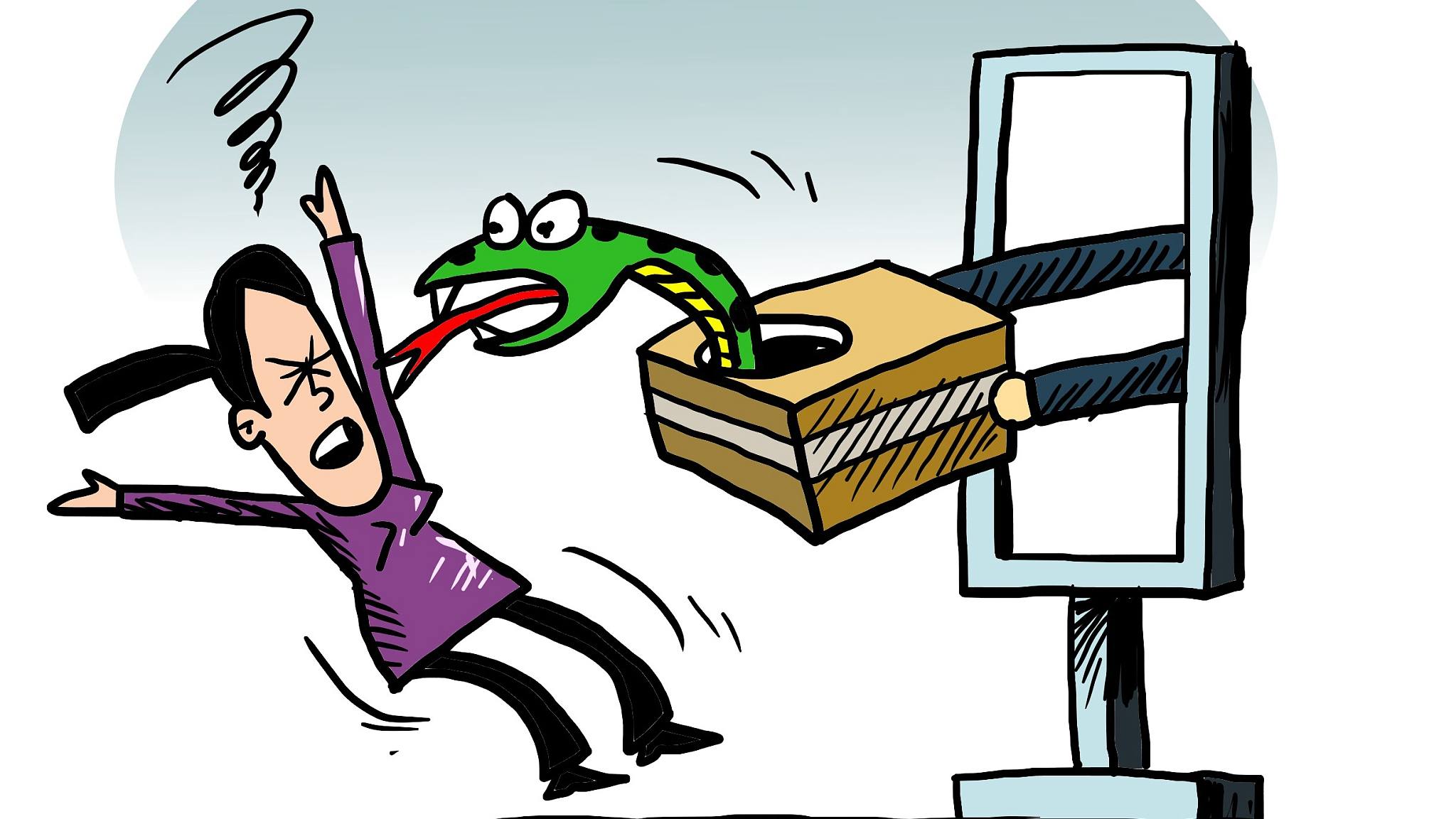
A 21-year-old woman, who was bitten by a poisonous snake on July 9, was pronounced brain-dead on Tuesday after being hospitalized in a coma on life support for over a week.
The snake, which was bought online by the woman from northwestern China known as Xiaofang, was a many-banded krait, one the world's most toxic snakes, prompting authorities to warn in the past that it could be lethal if kept as a pet.
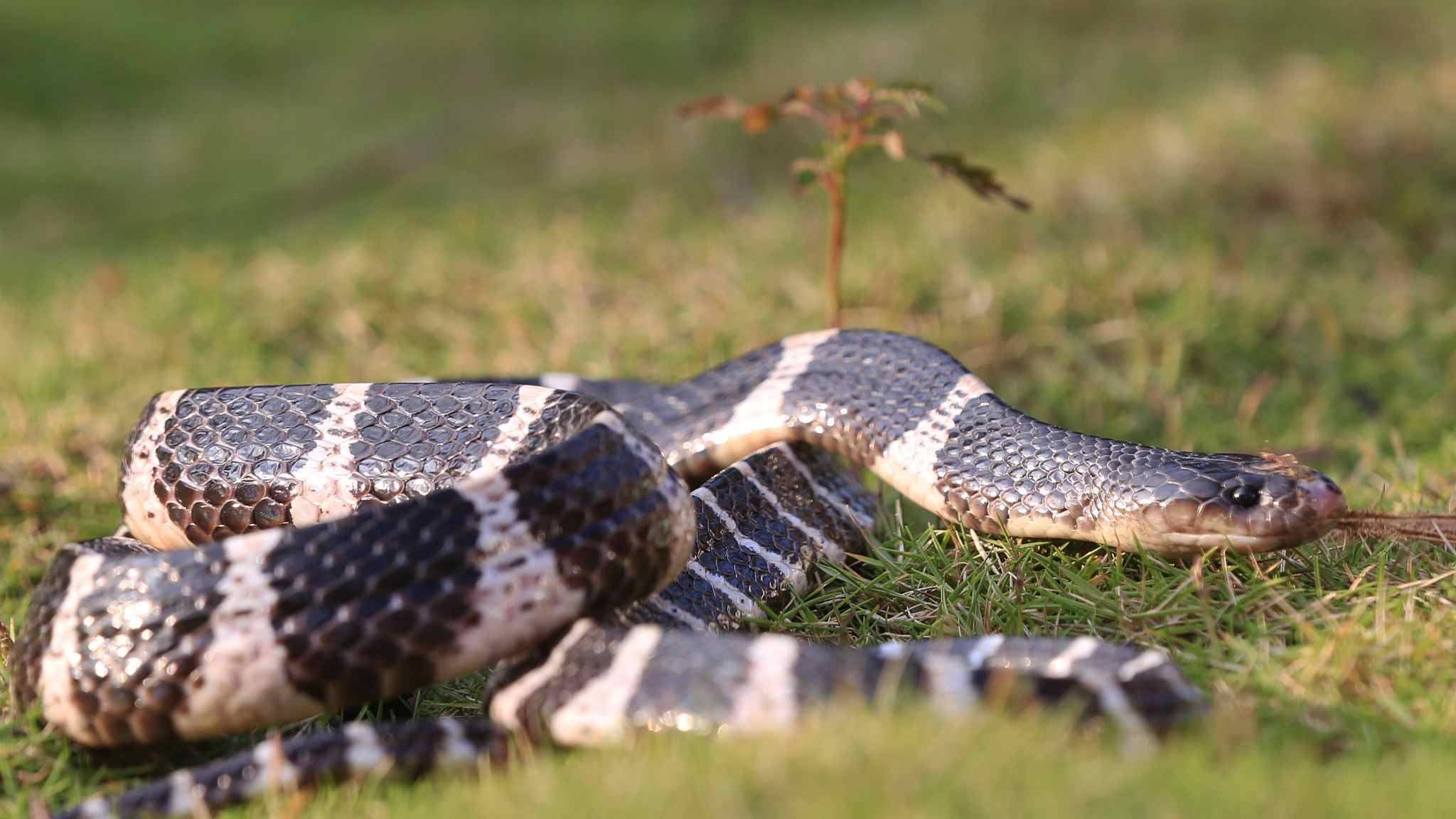
A many-banded krait. /VCG Photo.
A many-banded krait. /VCG Photo.
“Mom, I was bitten by a snake, please take me to the hospital,” Xiaofang’s mother, Mrs Qi, recalled her daughter as saying in what were actually her last words.
Qi said she was not aware of the snake until the terrible incident. After she checked her daughter’s phone, she found out that the snake had been bought several days earlier through an online thrift shop platform from a seller in Guangdong Province, southern China.
“How could a live venomous snake be sold online and transported across half the country to my daughter’s place in Shannxi Province?” Qi asked.
“Who is responsible for my daughter’s death?”
Xiaofang's doubtful motives
Xiaofang’s family said chat logs from her phone suggested the seller had warned Xiaofang that the creature was venomous.
When asked what she planned to do with the snake, she is said to have answered that she wanted to make “snake wine,” a traditional Chinese medicine made by leaving the animals to ferment in alcohol.
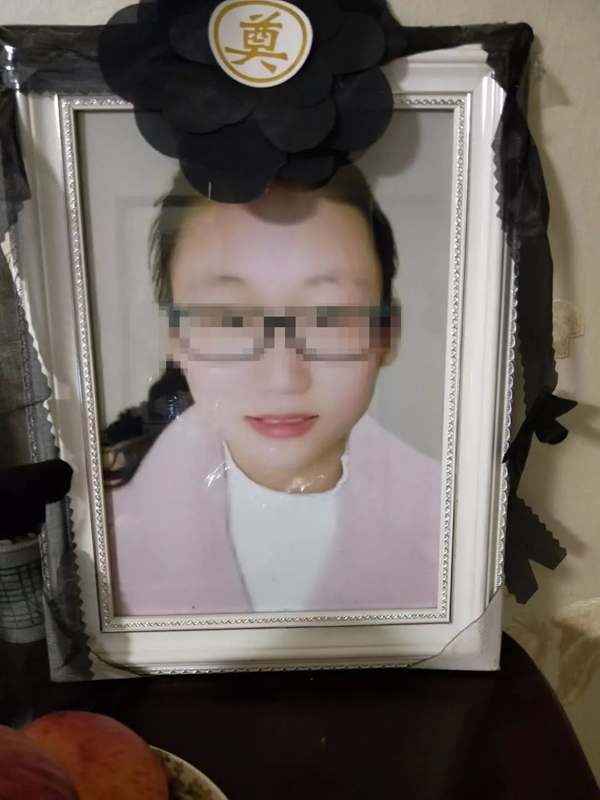
Xiaofang, who is now brain-dead. /Photo via the Chengdu Economic Daily.
Xiaofang, who is now brain-dead. /Photo via the Chengdu Economic Daily.
But her family believe she later decided to keep it as a pet. The snake was reported missing after Xiaofang fell into unconsciousness and was later found dead near a trash can in the neighborhood.
Even though she had been bitten on her finger, Xiaofang did not seek help immediately, but only wrapped the bite with a bandage.
Doctors have said that victims of bites by the many-banded krait usually feel neither swelling nor pain at first. But it is critical for them to get the antidote within a one-hour period as serious symptoms can occur after that.
Xiaofang called her mother more than one hour after the bite. The antidote was therefore administered too late to save her.
In fact, she did not get the antivenin until the following evening after an emergency batch arrived from Shanghai at a provincial hospital where she had been transferred.
The denial from suspected seller
Xiaofang’s family said the seller, surnamed Wang, found in Xiaofang’s chat log has denied having sold the reptile to her, even though his shipping information appeared to coincide with Xiaofang’s order history.
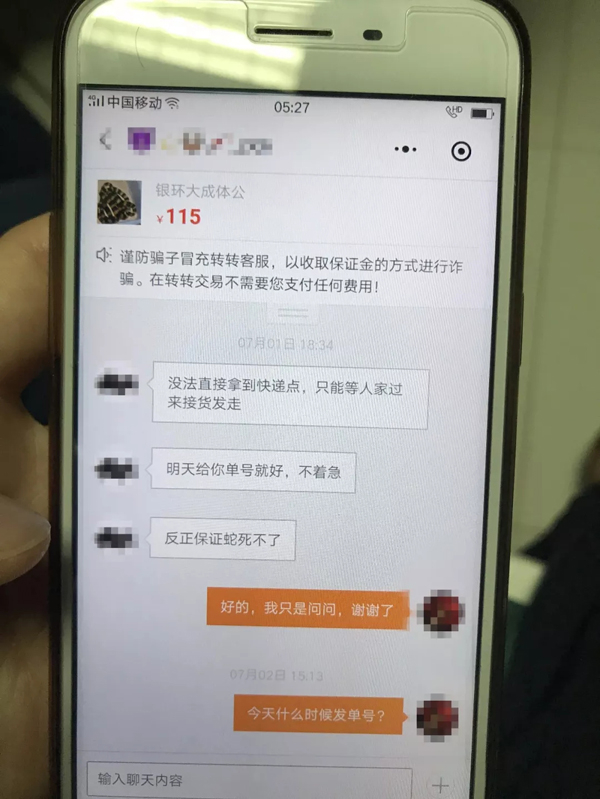
Chat log shows Xiaofang was asking about the shipping order from the seller. /Photo via the Chengdu Economic Daily.
Chat log shows Xiaofang was asking about the shipping order from the seller. /Photo via the Chengdu Economic Daily.
Wang admitted to selling live animals online illegally and delivering them through express courier services. But he insisted he sold only hamsters and groundhogs through the internet.
However, a post found on his social media platform quotes him as saying, “A woman who lied to me that she was buying the many-banded krait for making snake wine turned out to be critically ill after she kept it a pet and got bitten.”
He also warned against buying venomous snakes from him for shipping by post.
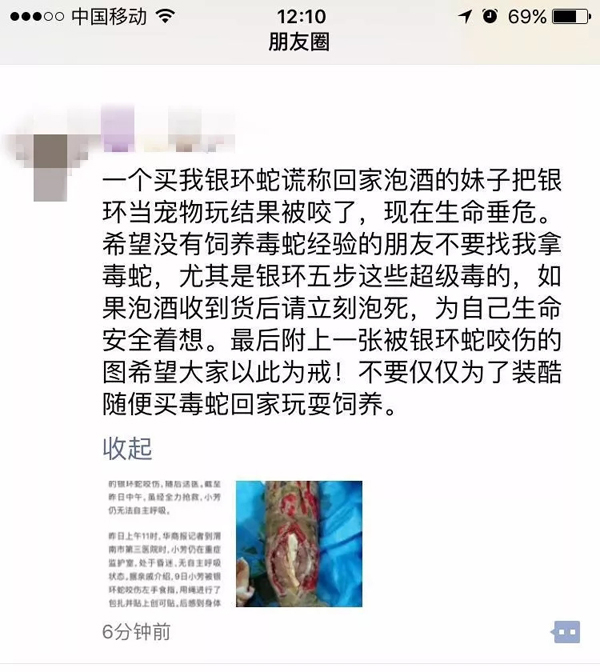
The seller's post on WeChat Circle. /Photo via the Chengdu Economic Daily.
The seller's post on WeChat Circle. /Photo via the Chengdu Economic Daily.
Role of courier company
Xiaofang’s order was verified as taken by an express company named the Best Express in China.
The deliveryman was reported to have delivered the many-banded krait without knowing a snake was inside the delivery box.
“If I had noticed, I would have refused him without hesitation,” said the deliveryman. “I deliver hundreds of packages every day. I don’t even know what's inside the box.”
The courier company has yet to comment publicly on the incident, which is being investigated by police.
Who’s responsible for Xiaofang’s death?
The safety of online shopping and delivery systems was brought into the spotlight as a result of the sad event, with the public urging relevant parties to take responsibility for regulating the trade, “or one day we can buy nuclear weapons online,” as one irate commentator @Dongdong wrote on the Chengdu Economic Daily’s Weibo page.
Over 10,000 comments and 30,000 likes were generated by publication's story, with netizens divided on who should be held responsible for Xiaofang’s death.
Online users sympathized with the deliveryman. “The job can be too dangerous if people deliver bombs, shit, and snakes,” wrote @Putaopupu.
Some argued that the tragedy was caused by the victim in the first place, with @Luluju saying, “The woman was died out of her own ignorance. She should not blame others.”
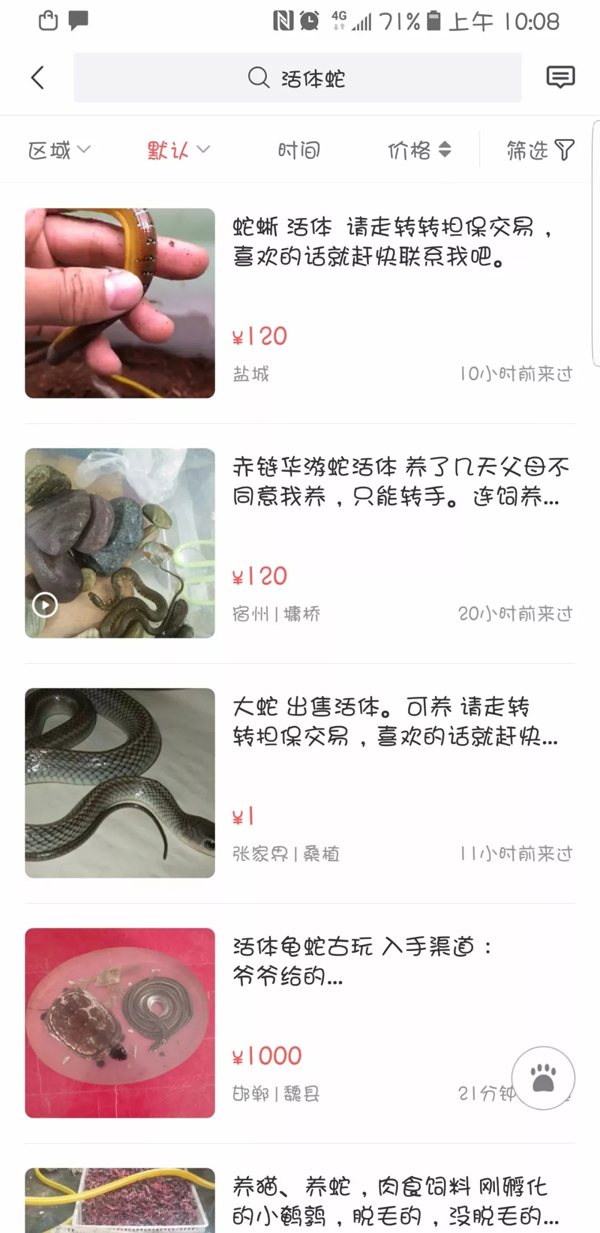
Online shops are selling live animals. /Photo via the Chengdu Economic Daily.
Online shops are selling live animals. /Photo via the Chengdu Economic Daily.
In China, selling live animals online or delivering them through express services are both illegal. But live animals and even venomous species can easily be bought through online platforms, reported the Chengdu Economic Daily.