
Opinions
15:30, 05-Sep-2018
Opinion: The third Moon-Kim summit: An uphill battle
Updated
15:19, 08-Sep-2018
 ["china"]
Share







Copied

Editor's note: Cheng Xiaohe is an Associate Professor at the School of International Studies under the Renmin University of China, and he is also a senior researcher with Pangoal Institute. The article reflects the author's opinion, and not necessarily the views of CGTN.
Summit diplomacy in Northeast Asia is now in full swing.
Special envoys from the Republic of Korea (ROK) left Seoul on Wednesday for a one-day trip to the Democratic People's Republic of Korea (DPRK) to pass on President Moon Jae-in's personal letter to DPRK leader Kim Jong Un.
During the one-day trip, the envoys will discuss plans to improve the relationship between Seoul and Pyongyang based on the Panmunjom Declaration. It is believed that the visit aims to lay the foundation for the third summit to be held this month between Moon Jae-in and Kim Jong Un in an effort to reach agreements.
The upcoming summit will render additional momentum to the diplomacy. The highly anticipated meeting will take place at a critical juncture when talks between Washington and Pyongyang have gone astray.
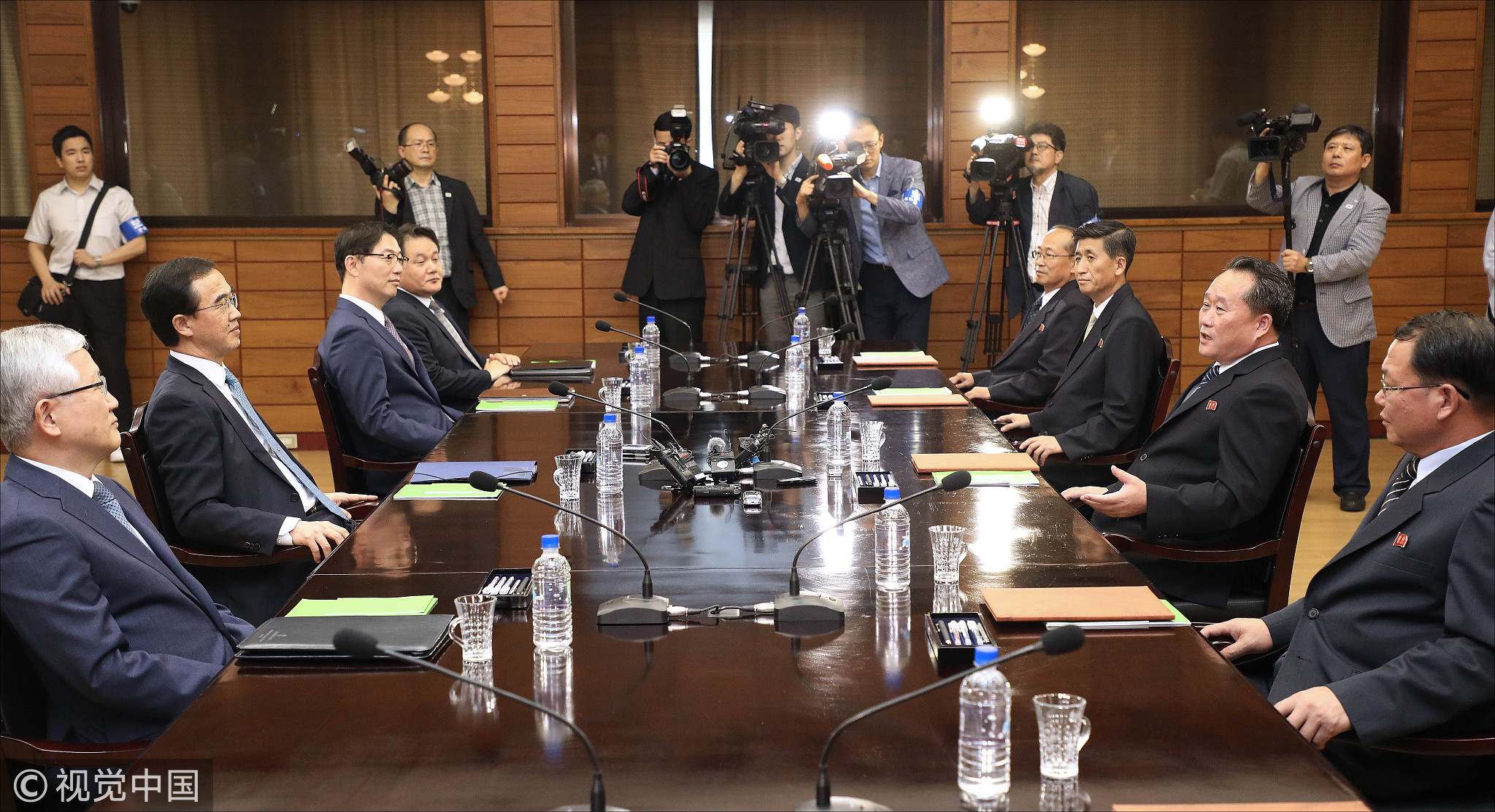
Delegates of DPRK and ROK attend a meeting to discuss preparation for a planned summit between Kim Jong Un and Moon Jae-in in the Demilitarized Zone in Paju, ROK, on August 13, 2018. /VCG Photo.
Delegates of DPRK and ROK attend a meeting to discuss preparation for a planned summit between Kim Jong Un and Moon Jae-in in the Demilitarized Zone in Paju, ROK, on August 13, 2018. /VCG Photo.
The third summit will evaluate the implementations of agreements made at the previous two meetings. Following the first summit, both countries moved quickly to conduct extensive talks and put their newly-forged consensus into practice, including the reestablishment of suspended military communication, inter-Korean sports exchanges, family reunions and more.
The accelerating interactions between the two countries are not free of problems. The DPRK accused ROK of only being satisfied with talks, rather than putting real money into their joined cooperative projects and using sanctions as an excuse to drag its feet on economic cooperation.
Against the DPRK's repeated requests, ROK is reluctant to resume the suspended tour of Mt. Kumgang and reopen the Kaesong Industrial Complex, which was shut down more than two years ago. Therefore, if DPRK and ROK can not further their economic cooperation, the inter-Korean rapprochement may run out of steam.
Another issue on the negotiating table may be the possibility of higher inter-Korean economic cooperation. Frankly speaking, without Kim Jong Un's reciprocal action in denuclearization, it is difficult for Moon to further inter-Korean economic cooperation.
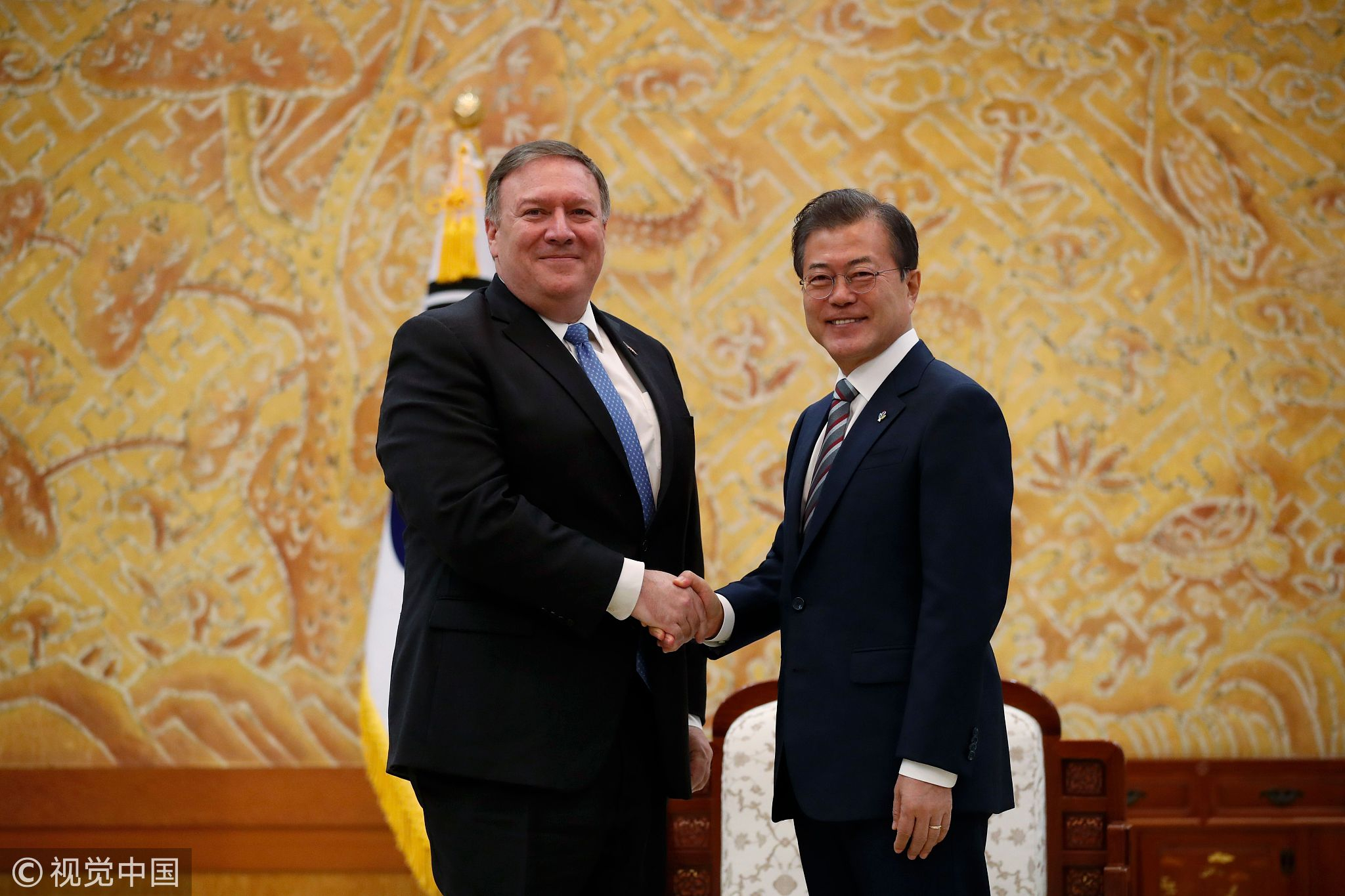
US Secretary of State Mike Pompeo shakes hands with ROK's President Moon Jae-in during a bilateral meeting at the presidential Blue House in Seoul, ROK, on June 14, 2018. /VCG Photo.
US Secretary of State Mike Pompeo shakes hands with ROK's President Moon Jae-in during a bilateral meeting at the presidential Blue House in Seoul, ROK, on June 14, 2018. /VCG Photo.
The restraints come from three directions: first, the current sanctions against DPRK still remain effective and prevent ROK from expanding economic ties with DPRK.
Some of the sanctions are unilaterally imposed by individual countries such as the US, Japan and ROK itself, others are enforced by the United Nations Security Council. It is a daunting challenge for ROK to break the legal restrictions.
Second, domestic conservatives have serious reservations about the DPRK's commitment to complete denuclearization. They are afraid that any major breakthrough on denuclearization will further strengthen the democratic party's position and diminish their chance of gaining power in the next presidential election. They oppose the lifting of the "5.24 measure" against the DPRK adopted in 2010.
Third, the United States also is not supportive. The US government does not want to lift sanctions before the DPRK takes substantive steps to denuclearize. The US government insists that "progress on inter-Korean relations must happen in lockstep with progress on denuclearization."
US officials privately complain that ROK has gone too fast and too far in its relations with DPRK. Given the above restraints, President Moon needs to find a way to overcome the legal and political obstacles to keep inter-Korean rapprochement alive.
If Kim shows flexibility in denuclearization, Moon may be willing to explore the possibility of resuming ROK's tour to Mt. Kumgang.
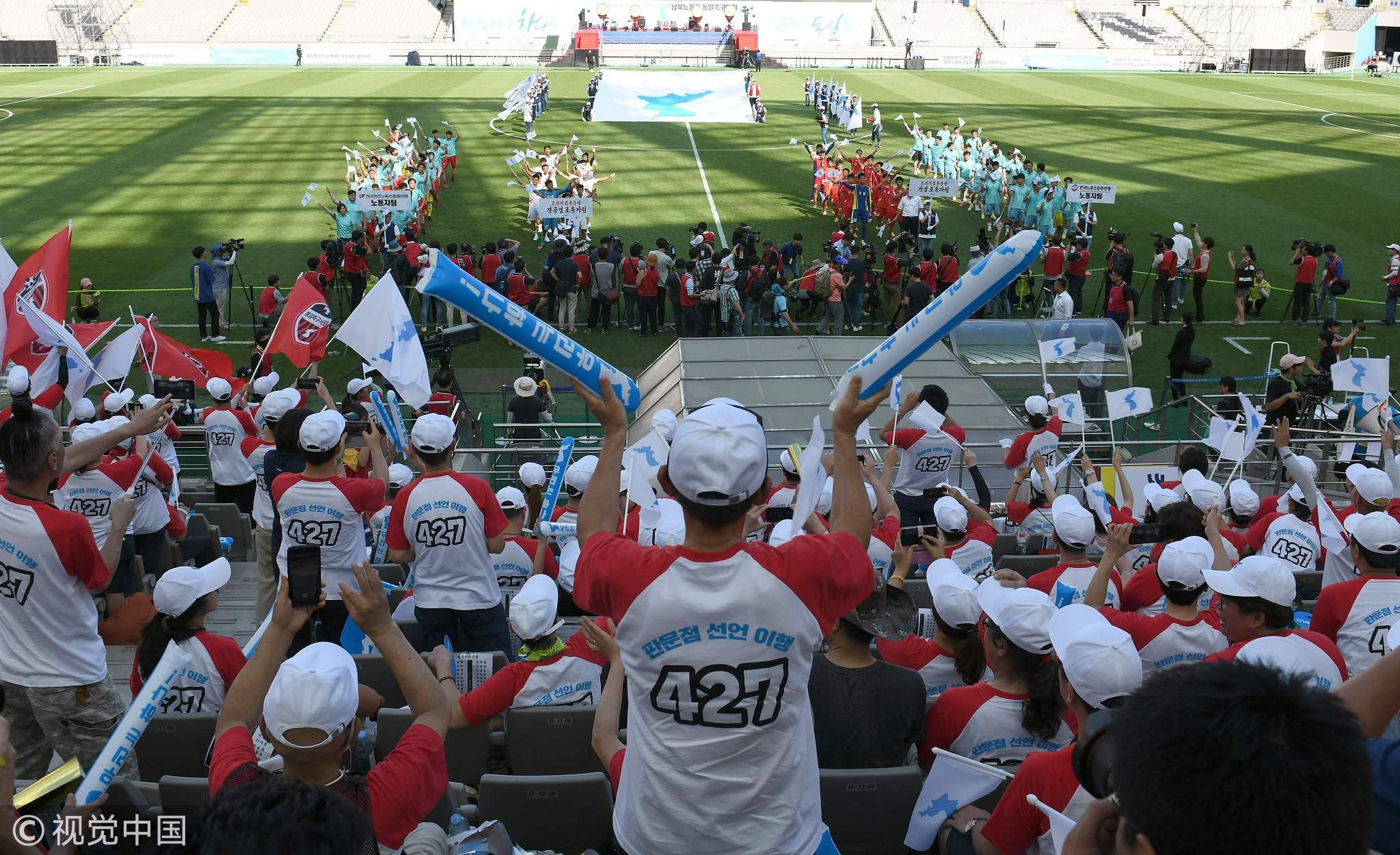
ROK's supporters cheer during the inter-Korean workers' football match in Seoul on August 11, 2018. /VCG Photo.
ROK's supporters cheer during the inter-Korean workers' football match in Seoul on August 11, 2018. /VCG Photo.
Moon also may manage to convince Kim that regularizing and facilitating future family reunions will best serve the interests of the separated families, whose elderly members cannot afford to wait any longer. It is also interesting to see if Moon could find time to pay a visit to his parents' hometown, Hungnam, Hamgyong-namdo.
In addition to addressing some prominent bilateral issues, Moon Jae-in carries an additional but more important mission in bridging the gap between DPRK and the US, whose negotiations have stalled.
Since the Singapore Summit, talks between the US and DPRK have not gone well, with both sides blaming each other for the lack of the progress. The DPRK refuses to take the first step without significant rewards from the US, and the US does not want to make major concessions before DPRK declares its nuclear weapons and materials.
On the surface, the DPRK and US are at odds over a variety of interconnected issues, at the core of their dispute is the question of ongoing sanctions against DPRK and if they'll be removed at the beginning of the denuclearization process.
As Trump canceled Secretary of State Pompeo's scheduled visit to Pyongyang, the voice from the US government became increasingly tough. Defense Minister Mattis weighed in, claiming that "We have no plans at this time to suspend any more exercises."

The reunion meeting for separated families at the Mount Kumgang resort, ROK, on August 24, 2018. /VCG Photo
The reunion meeting for separated families at the Mount Kumgang resort, ROK, on August 24, 2018. /VCG Photo
DPRK shows no sign of weakness, accusing the US government of double-dealing and hatching a criminal plot against it. Seemingly, without the third party's mediation, the detente between the US and DPRK will fall apart and the security situation on the Korean Peninsula will be driven into the old mode of confrontation.
Undoubtedly, Moon Jae-in will be more than happy to play the role of pulling the US and DPRK to the negotiating table, but it will likely be an uphill battle for Moon to do so since he does not have the key to the deadlock and both the US and DPRK, who have the keys, show increasingly thin patience toward each other and the time for Moon to do so is short.
If the first summit between Moon and Kim could be characterized as "ice-breaking," and the second as "facilitating," we have reasons to expect that the third summit should help to salvage the hardly-earned rapprochement on the Korean Peninsula and break the deadlock on DPRK-US relations. The issues Moon and Kim need to cope with are old, and it's still uncertain if they can come up with new ideas or solutions.
If you want to contribute and have a specific expertise, please contact us at opinions@cgtn.com.