
Opinions
17:08, 06-Jul-2018
The Hunger Games: China's trade story
Updated
16:39, 09-Jul-2018
 ["china"]
Share







Copied
06:32
Many say China's hunger for world trade started in 1421 with this man: Admiral Zheng He, a mariner during the Ming Dynasty. But actually what he did was not trade. It was basically Chinese emperors sending out gifts and receiving adulation in return.
The old way of doing business was self-centered and self-defeating. And China paid a huge price before realizing it was the wrong way.
It finally got it right in 2001 when it joined the WTO.
The WTO was a blind date at first. Back in 2000, China was more afraid of global trade than the US is right now. The organization was considered a club of the rich and it took 15 years of negotiations for China to get in. China had a much weaker economy, and it saw a very uncertain future.
It was like Katniss Everdeen in The Hunger Games trilogy – an underestimated novice joining the game in trepidation. But still, China was in, becoming a “player at the table” as then US Deputy Secretary of State Robert Zoellick said.
What Zoellick failed to see was that China not only played the game, it excelled in it.
In 2016, China’s GDP accounted for 15 percent of the world's total. Twenty years ago, it was merely four percent. China is now a 12-trillion-dollar economy growing at around seven percent annually. That means it is giving birth to a new Australia, economically speaking, every year. Since 2002, China has contributed 30 cents for every dollar of growth in the world.
But not everyone appreciates the change. Advanced economies complain about the Chinese taking away their jobs. They forget they are not only producers, they are consumers as well. In Chinese, we call it: 得鱼忘筌 – the more one gets, the more he forgets. The cheap Chinese goods have served consumers in an unimaginable way. Take a look at the inflation chart of OECD countries in 10 years, it has been unusually flat. Why? Because goods from China came at a discounted price in stores from Toronto to Turin, and from Seoul to Sydney.
Yes, trade with China has harmed some, but it helped many more. Free trade is not charity, it is simply a good deal. China's accession to the WTO has not only strengthened global trade infrastructure, improved the quantity of goods and quality of lives, but also refashioned the world economy.
Numbers speak for themselves:
Since joining the WTO, China has sold 216 trillion dollars of goods, but it also bought 198 trillion dollars of commodities; that's 9,400 times the economy of the African continent.
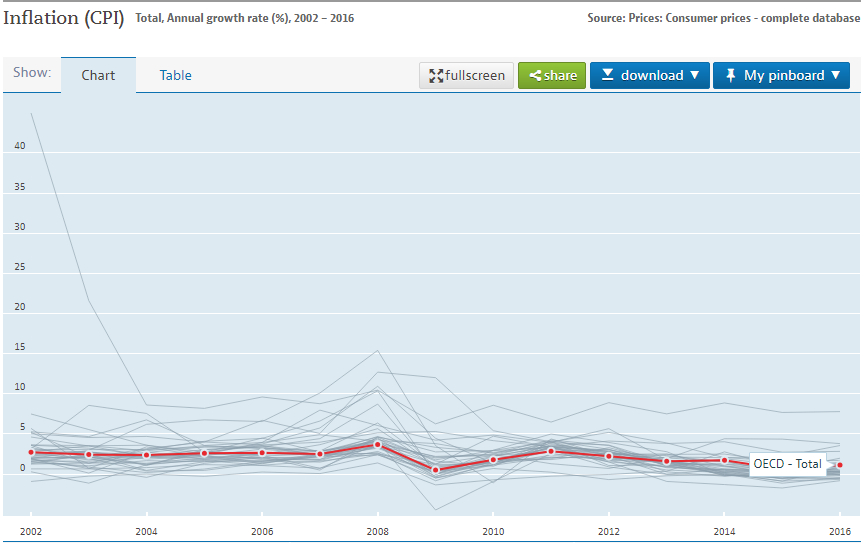
Inflation chart of OCED countries from 2002 to 2016 from OCED.org.
Inflation chart of OCED countries from 2002 to 2016 from OCED.org.
And China has invested 1.1 trillion dollars around the world, giving jobs to 15 million people in every corner of the globe.
If the Chinese economy was a sapling in the late 20th century, it gradually grew and branched out in the 21st century to provide fruits and shade for more people coming by.
In The Hunger Games, Katniss wasn't a simple player, she was a diligent and disciplined player. So was China. In the history of China and the WTO, China has been obedient, not rebellious.
Even America would agree. In 15 years, the United States has filed 12 WTO complaints that resulted in rulings against China. In all of the cases, China has complied. However the US is not only whining about the global trade framework, it plans to abandon the WTO ship altogether.
But of course, China’s role in the WTO has been faulted, especially by some advanced economies. Complaints have targeted fairness issues like the government’s role or IPR protection.
There is truth in some of the complaints, and China needs constant upgrades of its operating system. But what some Americans and Europeans don’t seem to get is that the market economy that Adam Smith conceptualized has many incarnations. The Chinese economic governance is a feature, not a bug. It has helped China to enrich its citizens and empower its economy. As long as the government’s hand is legal and reasonable, it will be there. And you can blame your partner's behaviors, but you can't blame its identity.
The critics are having problems with China because it defies their ingrained belief that only Western democracies can deliver growth. In The Hunger Games, Katniss was not only undervalued, she was misunderstood and mistrusted.
American political scientist Samuel Huntington once said: "The belief in the universality of Western culture has three problems: it is false; it is immoral, and it is dangerous."
But there are larger forces in the world than all of us. Despite misunderstandings and disbelief, China has not only taken the lead, it has changed the game the same way Katniss eventually did in The Hunger Games. It is negotiating new regional trade deals, it is building connectivity projects and it is setting up financial vehicles for borrowers and lenders from everywhere and for everyone.
All people hunger for wealth and opportunities. The WTO truly became a world trade organization the day China joined, and the world of trade is getting bigger and hopefully better every day.
Script Writing: Zou Yue
Animation: Fu Lei, Pan Yufei, Zhang Tao, Ran Boqiang
Videographer & Editing: Wan Bao