
Opinions
07:43, 21-Aug-2018
Opinion: China-Malaysia Ties: Cooperation brings mutual prosperity
Updated
07:39, 24-Aug-2018
 ["china"]
Share







Copied
00:34
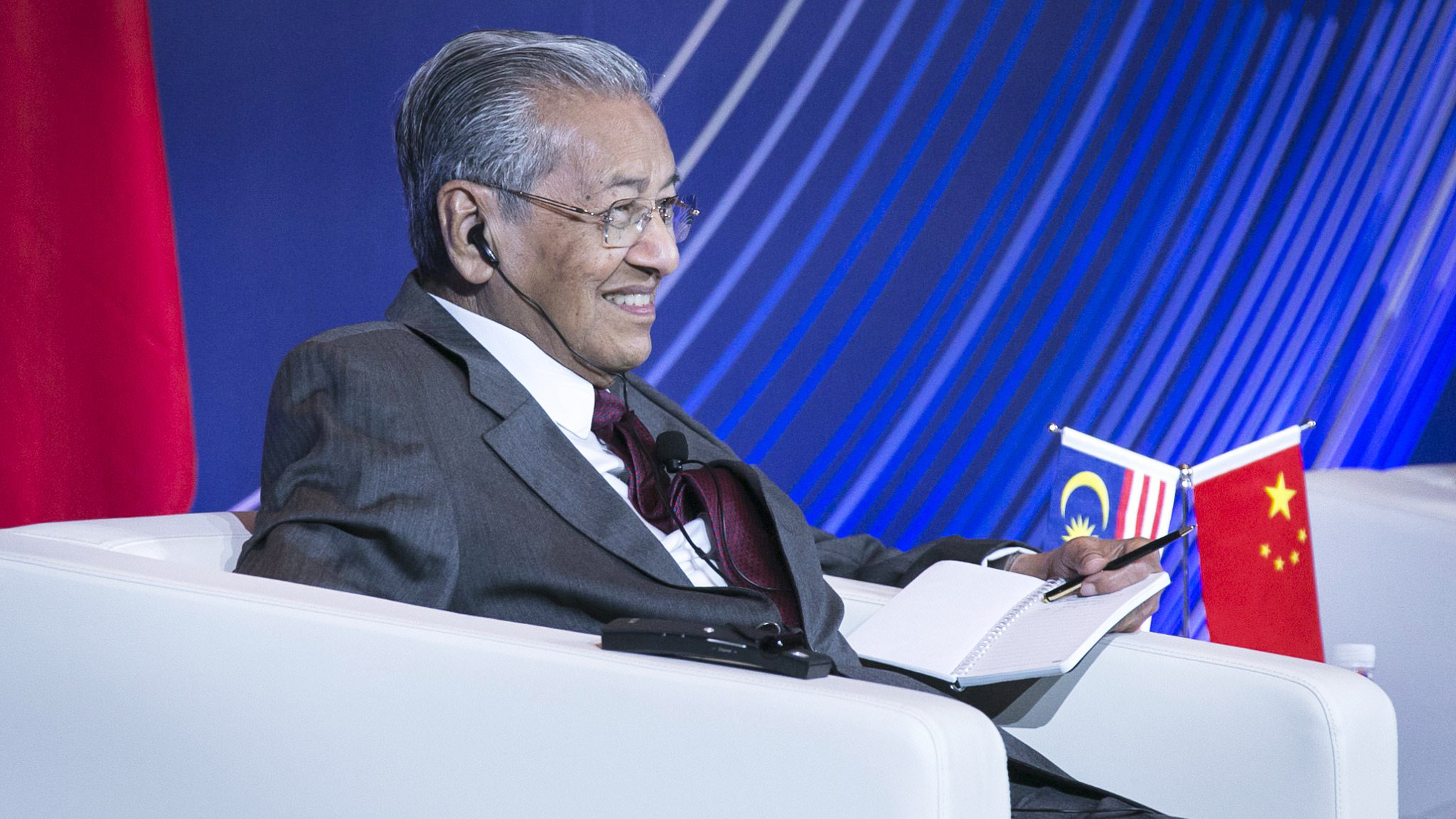
Editor's note: This article is based on an interview with Song Qingrun, an associate professor at the China Institutes of Contemporary International Relations, and Qu Qiang, assistant director of the International Monetary Institute at Renmin University of China. The article reflects the authors' opinions, and not necessarily the views of CGTN.
The Malaysian Prime Minister Mahathir Mohamad came to China 33 years ago with an economic and trade group of 200 people and a large sum of money saying that he came to appreciate the beauty and import agricultural products. But now, he hopes to take capital and technology back to Malaysia.
After prudent selection, Mahathir chose Alibaba Group Holding Limited, a Chinese multinational e-commerce, retail, internet, AI and technology conglomerate, as his first stop in China, and Ma Yun, the co-founder and executive chairman of Alibaba Group, welcomed the Malaysian Prime Minister.
After visiting Alibaba's exhibition hall in the park, the two wasted no time in discussing the three major technologies that Alibaba is currently focusing on: blockchain, artificial intelligence and the Internet of Things (IOT).
According to the World Bank and International Monetary Fund, Malaysia’s productivity has witnessed a significant growth over the past 25 years, but it is not high enough when compared with some international and regional reference values.
Therefore, as the traditional economic growth engine slows down, Malaysia’s need to increase its productivity is relatively urgent.
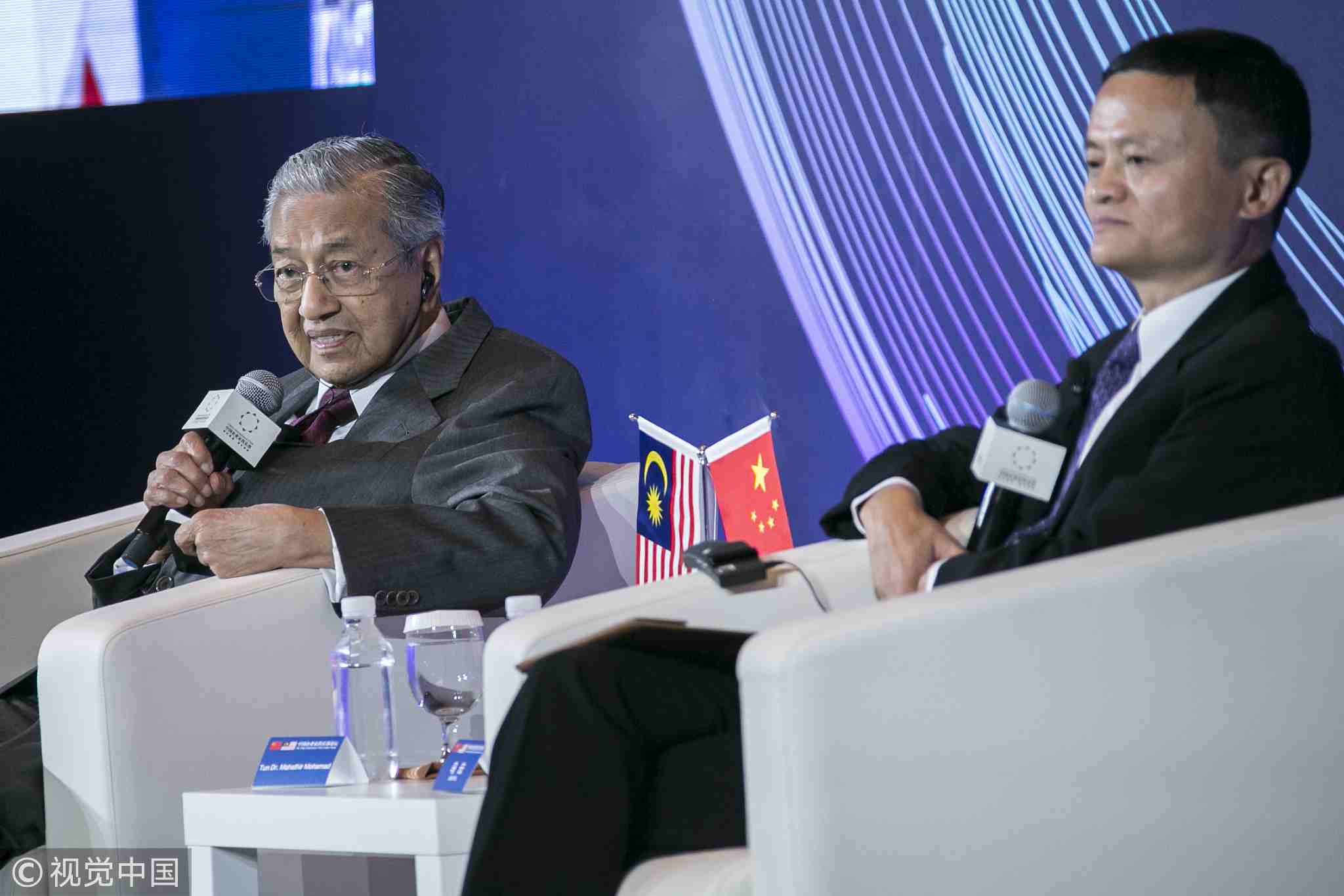
Malaysian Prime Minister Mahathir Mohamad with Ma Yun, the co-founder and executive chairman of Alibaba Group at Hangzhou, Zhejiang Province. /VCG Photo
Malaysian Prime Minister Mahathir Mohamad with Ma Yun, the co-founder and executive chairman of Alibaba Group at Hangzhou, Zhejiang Province. /VCG Photo
After Mahathir was re-elected as Prime Minister, the new government proposed the "New Malaysia" plan. Minister of Foreign Affairs Saifuddin Abdullah said in an interview earlier that the name of the plan was proposed by Malaysian netizens "because they are eager to change, and they need more freedom, better work, and higher income."
According to the WeChat official account of Xiakedao, Malaysia needs new opportunities and new impetus as it seeks development and progress. This is also why Mahathir said during the election campaign that the Belt and Road Initiative is a major opportunity for regional countries to achieve common development and prosperity. Malaysia supports the Initiative.
As a Chinese multinational company, Alibaba has also released many positive externalities of foreign direct investment (FDI) in Malaysia.
Previously, Ali's first overseas pilot of the eWTP (electronic world trade platform) was the Digital Free Trade Zone (DFTZ), which was jointly established with the Malaysian Digital Economy Development Agency. The project is expected to create 60,000 jobs in Malaysia.
Chinese Premier Li Keqiang later met Malaysian Prime Minister Mahathir Mohamad in Beijing. The two sides witnessed the signing of bilateral cooperation documents in the fields of economy, trade, agriculture, finance, science and technology after the meeting.
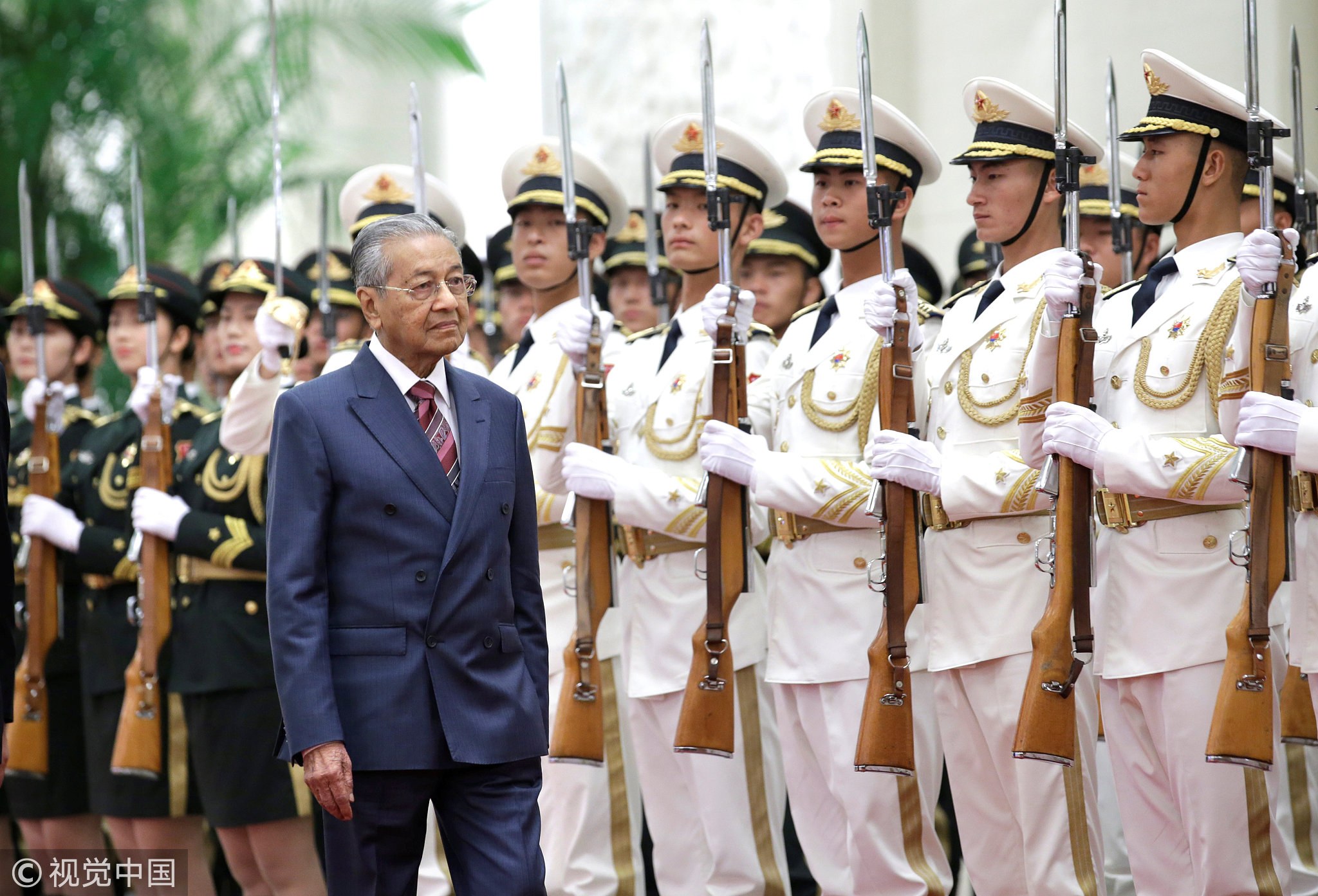
Malaysian Prime Minister Mahathir Mohamad attends a welcome ceremony hosted by China's Premier Li Keqiang at the Great Hall of the People in Beijing on August 20, 2018. /VCG Photo
Malaysian Prime Minister Mahathir Mohamad attends a welcome ceremony hosted by China's Premier Li Keqiang at the Great Hall of the People in Beijing on August 20, 2018. /VCG Photo
Song Qingrun, an associate professor at the China Institutes of Contemporary International Relations, holds the view that the agreements bring a win-win situation and show the strengthening of the strategic partnership between the two countries.
"I think the contracts will boost some economic fields for the two countries. For example, for Malaysia, an e-company like Alibaba will invest more in Malaysia, it will boost Malaysia's new e-commerce development and also the Chinese company will get more profiles." Since 2009, China has been Malaysia's largest trading partner.
However, earlier, there were some concerns about "Mahathir's unfriendly attitude toward China,” including his decision to suspend Chinese investment projects.
In fact, the main reason for the decision is the Malaysian government's scarcity of fund reserves, thus they need to reduce expenditures. Another reason is to draw a line with former prime minister Najib.
"I think we can step back a little bit and renegotiate with each other, and some middle ground can be found," said Qu Qiang, the assistant director of the International Monetary Institute at Renmin University of China. "If Malaysia and China can reach a consensus on the government level, there will be a strong signal for the private sectors as long as they want to invest in Malaysia."
Song also thinks the projects that were suspended by Mahathir will not be canceled. They can be optimized and two countries will maintain friendly ties in the long term.
01:35
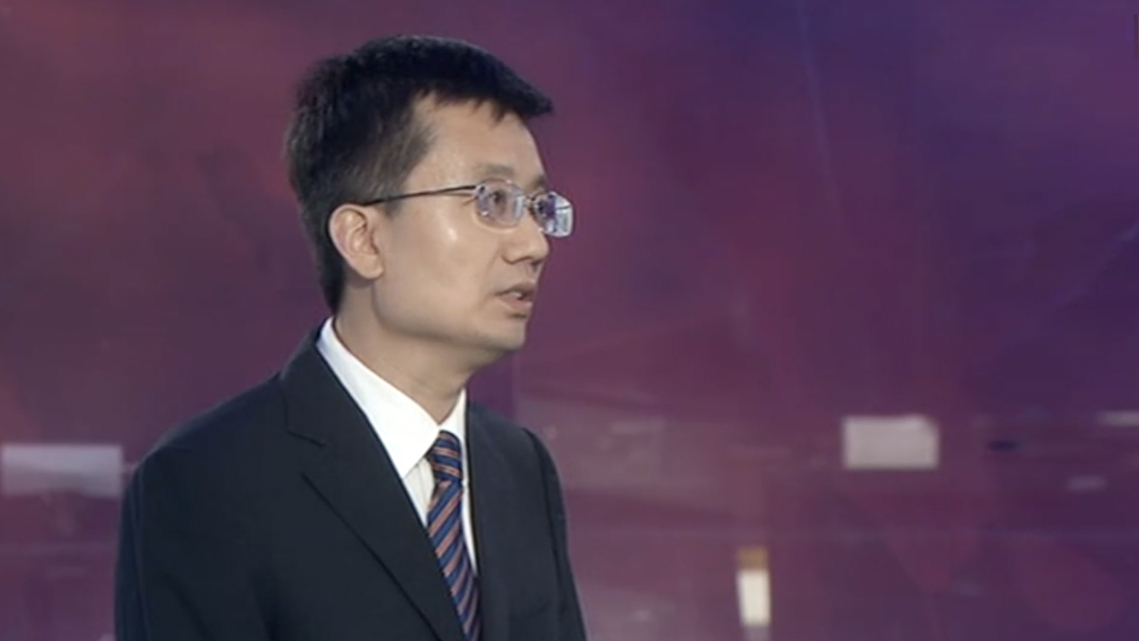
"Compared to the previous government, the current one wants to conduct more and more economic programs with China. It's natural that the two countries have differences, not only within the relations between China and Malaysia, but also in China with other countries. It's more important that they can find new ways to conduct new cooperation", said Song.
History has proved that cooperation has always been the main theme of China-Malaysia relations, and economic and trade ties are the ballast stone of the relations. Mahathir’s visit has further strengthened the scientific and technological cooperation between the two countries.
A few days ago, Minister of Foreign Affairs Saifuddin Abdullah said that China and Malaysia should jointly deal with the current trade war, and both China and Malaysia firmly support openness and globalization. Malaysia deeply understands that the capital, technology and huge market that China owns cannot be ignored.