
Opinions
15:10, 21-Aug-2018
Opinion: China, a defender of free trade
Updated
14:13, 24-Aug-2018
 ["china","other"]
Share







Copied
Editor's note: Roberto Dumas Damas is a Brazilian economist. The article, which first appeared in People's Daily on August 20, reflects the author’s opinions, and not necessarily the views of CGTN.
China has released strong signals supporting economic globalization and liberalization and facilitation of trade and investment.
The reform and opening-up policy adopted by China in 1978 has unleashed great potential for economic growth and brought about tremendous changes. China set up special economic zones and opened up coastal cities as critical windows to leverage labor advantage, and attract international capital and technologies.
Through the reform and opening-up, market and efficiency gained ever more significance in both rural and urban areas, contributing to stably increasing productivity, ever rising per capita income and dramatic reduction of poverty. China has continued to draw in foreign investment, acquire advanced technologies from abroad, leverage its comparative advantages and participate in the global division of labor.
Over the past four decades of reform and opening-up, China has multiplied its GDP, become the world’s second-largest economy and come under the spotlight on the international stage.
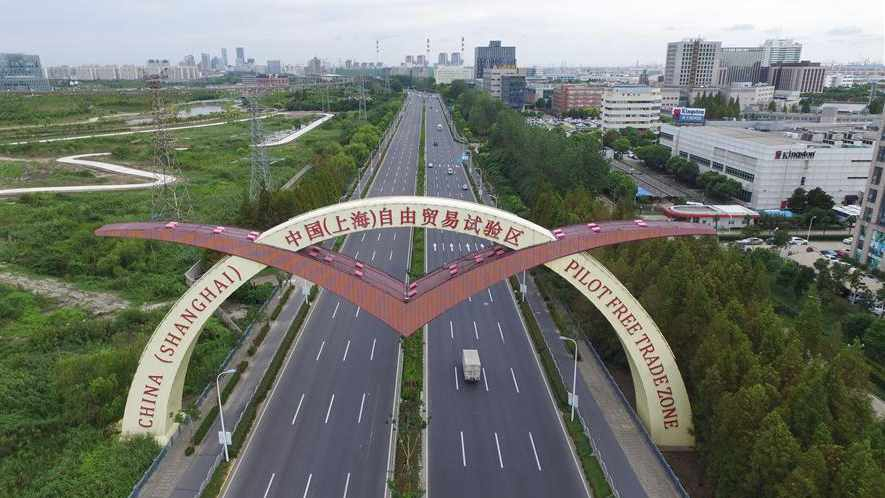
A view of China (Shanghai) Pilot Free Trade Zone in Shanghai, on September 21, 2016. /Xinhua News Agency
A view of China (Shanghai) Pilot Free Trade Zone in Shanghai, on September 21, 2016. /Xinhua News Agency
It is worth mentioning that the Chinese economy has been running at full throttle throughout this period, even during the financial crisis in 2008 when China effectively countered its negative impact, wowing scholars, entrepreneurs and politicians all over the world and triggering discussions on the “Chinese miracle” and the “Beijing consensus.”
On the current international landscape, countries need more, not less, connectivity and openness. On the one hand, we are seeing that China is becoming a defender of free trade, strengthening its connection with the rest of the world through foreign investment and trade exchanges, facilitating the formation of a more balanced global supply chain and helping other economies to increase productivity.
On the other hand, we are seeing that the US government is looking increasingly inward and adopting outmoded protectionist trade policies, going against the trend of economic globalization.
In recent years, China has released strong signals supporting economic globalization, and liberalization and facilitation of trade and investment. On January 17, 2017, President Xi Jinping said in his keynote speech at the annual conference of the World Economic Forum in Davos that China will steadfastly promote free trade and investment in the world.
His words won widespread accolades from the international community, not just because they are right, but also because they have depicted a promising blueprint of a community of shared future for all mankind.
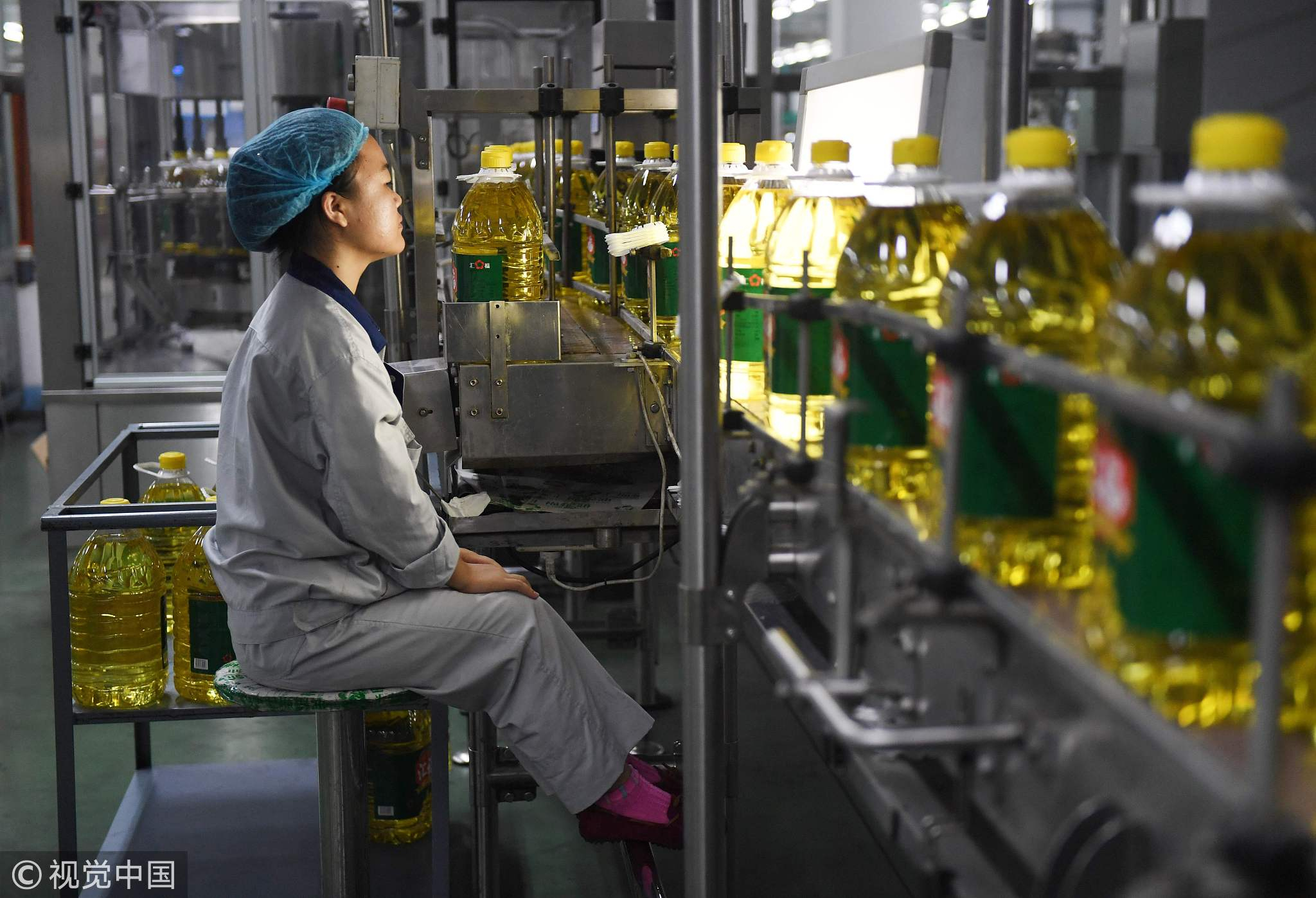
A worker monitoring a soybean oil production line at the Hopeful Grain and Oil Group factory in Sanhe, China on July 19. /VCG Photo
A worker monitoring a soybean oil production line at the Hopeful Grain and Oil Group factory in Sanhe, China on July 19. /VCG Photo
The Belt and Road Initiative proposed by China in 2013 is a testament to its commitment to economic globalization. Nowadays, the Belt and Road Initiative is getting positive responses and support from ever more countries. China’s investment in infrastructure in countries, including in Latin America, provides a strong guarantee for these countries to achieve growth that is sustainable and structural, not cyclical.
When it comes to China and Brazil, the economic complementarity between them is self-evident. Through international trade brought about by openness, Brazil is able to buy manufactured goods from China at prices far lower than domestically produced ones, thus offering cheaper products to consumers and delivering a shot in the arm for the Brazilian economy.
Brazil also satisfies China’s demand for primary goods such as iron ore and soybeans. In recent years, Chinese companies have been investing in sectors such as energy, construction, automobiles, banking, and infrastructure in Brazil, boosting local economic growth. Many of these projects have also become platforms that facilitate cooperation among Latin American countries.