
Opinions
18:42, 19-Aug-2018
Opinion: What has contributed to lira crisis besides US sanctions?
Updated
18:39, 22-Aug-2018
 ["china"]
Share







Copied
Editor's note: Dr. Harun Ozturkler is an associate professor working in the Faculty of Economics and Administrative Sciences of the Department of Econometrics in Kirikkale University in Turkey. The article reflects the author’s opinion, and not necessarily the views of CGTN.
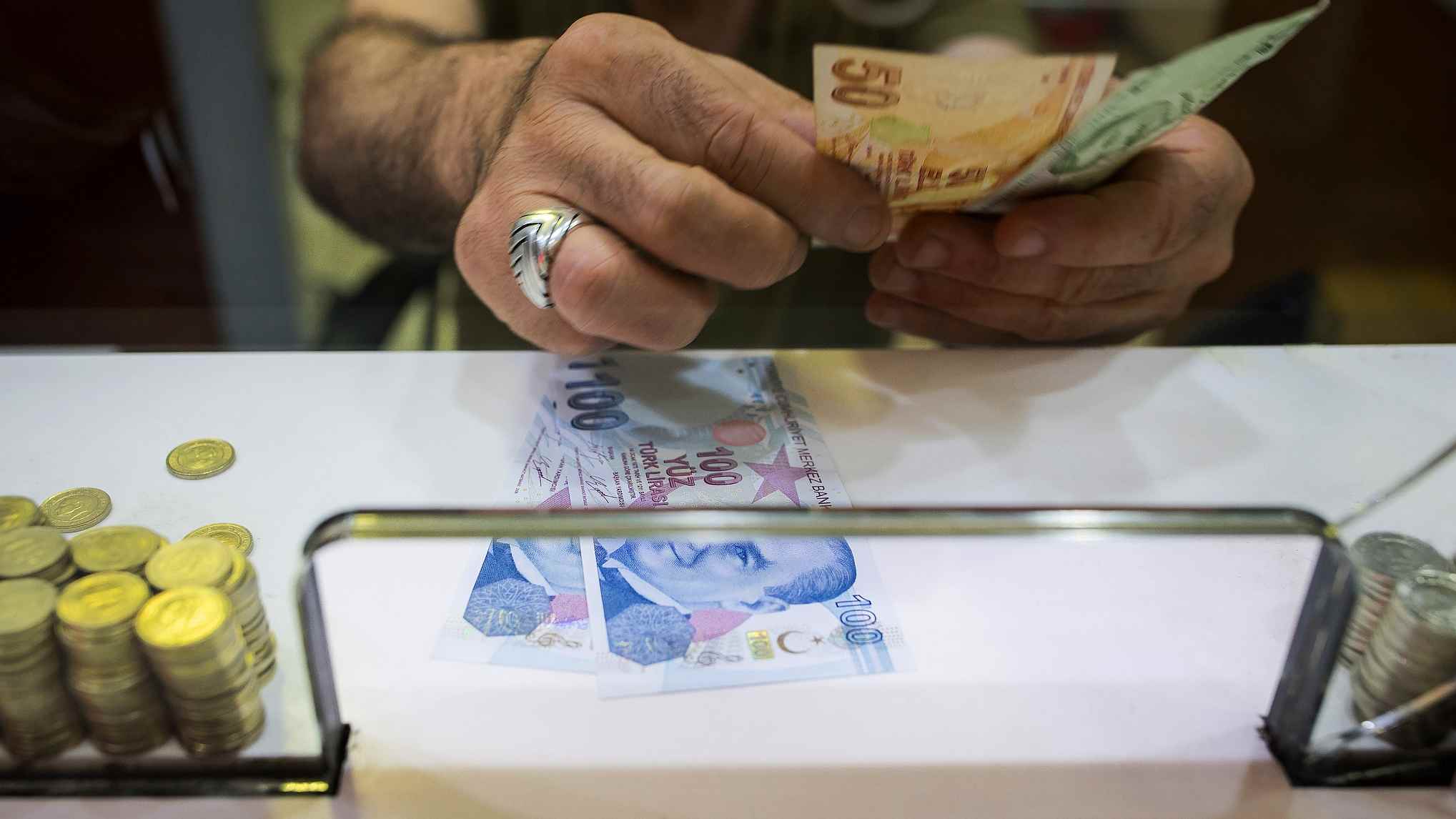
In the last couple of months, the exchange rate between the Turkish lira and the US dollar almost doubled.
The reasons for this tremendous loss in the value of the lira were large foreign exchange deficit due to high current account deficit, a very big foreign debt stock (specifically private debt stock), high and rising inflation rate, the Turkish Central Bank's late and inadequate policy reaction to the rising inflation and the developments in the currency markets, radical and unjustified changes in the politico-institutional structures in the country, and finally the nontraditional and unjustified assignments in the government and the bureaucracy.
Therefore, so long as there are going to be radical U-turns in the aforementioned root factors, the lira will continue to face deep fluctuations.
On the question of if the lira turmoil can lead to similar effects in the international currency markets and world economy, similar to what happened with the Asian and Russian crises from 1997-1998, the answer is a simple “No.”
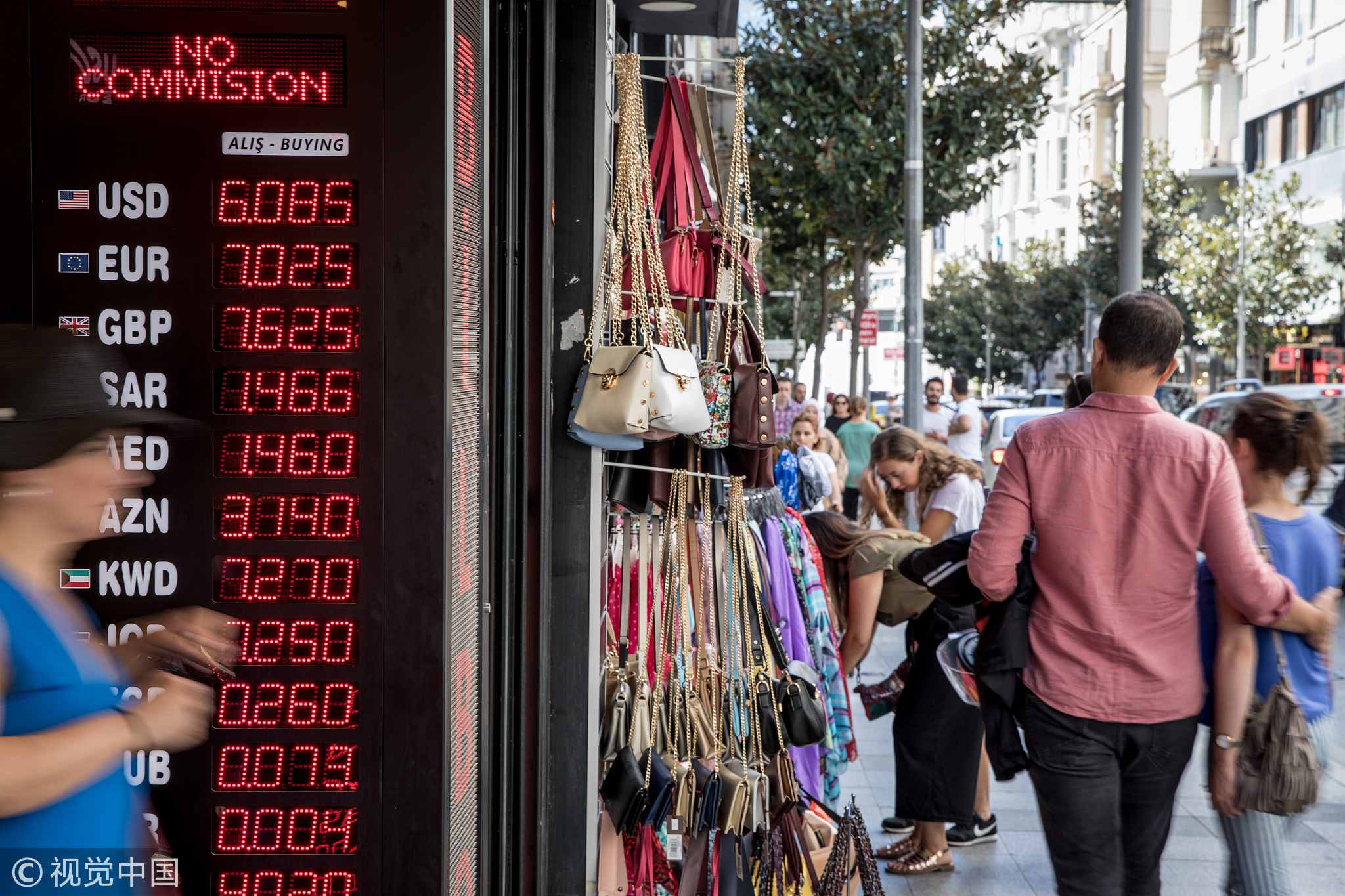
People walk past a currency exchange shop in Istanbul, Turkey, August 14, 2018. / VCG Photo
People walk past a currency exchange shop in Istanbul, Turkey, August 14, 2018. / VCG Photo
We can come up with several justifications for this answer. The foremost is the size of the Turkish economy.
In 2017, the Turkish gross domestic product was about 850 billion US dollars (with the current exchange rate it is going to be far less in 2018), while the global GDP was at about 80 trillion dollars.
That is, the Turkish GDP was about 1 percent of the world GDP. By the same token, the daily volume of the currency trade in the Turkish financial markets is about 1 percent of that of world financial markets.
Furthermore, during the Asian crisis, the interconnectedness of the region’s economies, one of which is China with a GDP of about 15 percent of global GDP, snowballed into something larger than the initial national currency crises stemming from the struggling Asian countries.
In the Russian case, the global effect was not only the result of a failing currency but also an economy with one of the largest energy reserves and an economy with a huge demand for European Union goods and services.
In the Turkish case, there are different channels at work. First of all, Turkey does half of its international trade with the European Union. On the other hand, Turkey has a large deficit with two members of the union: Germany and the UK.

Customers look at gold jewelry through store window in the Grand Bazaar in Istanbul, Turkey, August 10, 2018. / VCG Photo
Customers look at gold jewelry through store window in the Grand Bazaar in Istanbul, Turkey, August 10, 2018. / VCG Photo
Secondly, the United States is one of Turkey's largest four trading partners, and Turkey has a nearly balanced trade relationship with the US. Furthermore, the Turkish economy is structurally dependent on the European Union and US economies.
For every 100 dollars exported, Turkey needs about 70 dollars imported. That is, most Turkish exports are made up of re-exports. The structural detail of the Turkish foreign trade makes it even more vulnerable.
About 20 percent of the Turkish manufacturing goods import is high technology products, while just about 2 percent of manufacturing exports consists of high technology products. That means the Turkish economy cannot function properly without imported intermediate products and investment goods.
As a result, high exchange rates will make these imports highly costly, and in some cases impossible. In turn, high import costs will be transferred to high domestic inflation, which will further undermine the value of the lira.
In short, the lira currency crisis is due to problems in Turkey's political and economic organizational structures. However, because of the small size of the Turkish economy and financial markets, the lira turmoil will not have a significant impact on the world economy and financial system.