
Opinions
22:52, 07-Jun-2018
Opinion: 5 dilemmas for G7 and its future
 ["china"]
Share







Copied
Editor's note: Bao Jianyun is a professor at Renmin University of China. The article reflects the author’s opinion, and not necessarily the views of CGTN.
The G7, a group made up of developed countries established in the 1970s, is one of the most important inter-state organizations for Western countries.
It plays an indispensable role in coordinating the internal political and economic relations among Western countries and maintaining the vested interests of developed economies, and the G7 has also become an important tool to interfere especially in global political and economic affairs of non-Western countries.
Since the outbreak of the international financial crisis in 2008, the G7’s overall economic strength and political influence have continued to decline, such as its ability to influence global affairs and to coordinate internal affairs.
Since the Trump administration took office in the United States, internal disagreements in the G7 have been further expanded, resulting in its declining influence in the drastic changes of international system.
At present, the G7 faces the following five dilemmas:
The first is reduced capacity. When the G7 was in its initial stage, the combined GDP of member countries accounted for about 80 percent of global GDP, representing a strong global influence.
However, currently, the GDP in the G7 member countries accounts for less than 50 percent of the world's total. Thus, its ability to intervene in global economic affairs has sharply weakened.

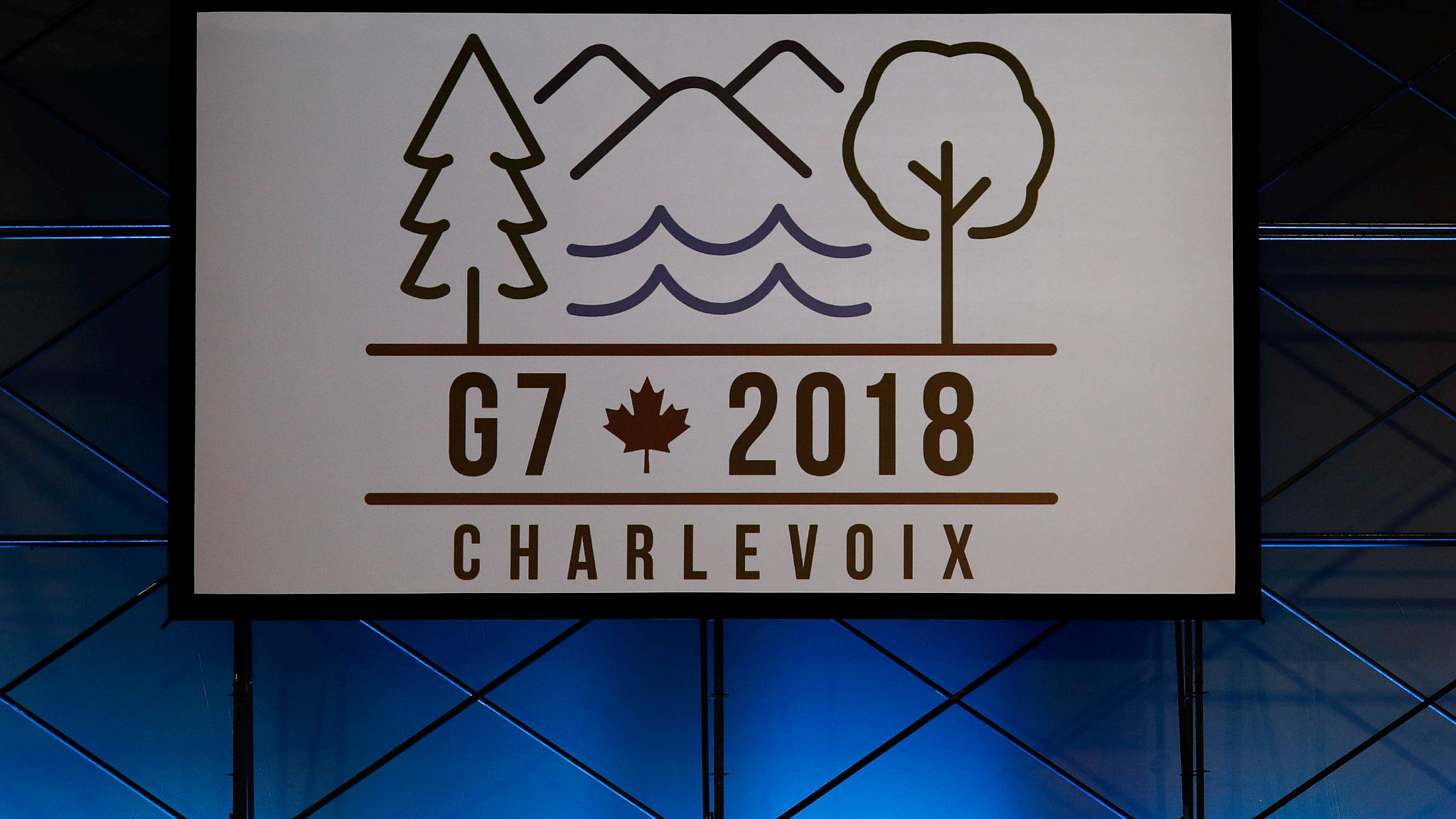
June 6, 2018: A Charlevoix G7 logo at the main press center, ahead of G7 Summit in Quebec, Canada./VCG Photo
June 6, 2018: A Charlevoix G7 logo at the main press center, ahead of G7 Summit in Quebec, Canada./VCG Photo
The second is internal conflict. Since taking office, Trump has launched a trade war not only against emerging countries represented by China, but also against the G7 member countries, thus further expanding conflict within the G7 members.
The third is big-power-manipulation dilemmas. As the largest member of the G7, the United States always regards the G7 as a tool for safeguarding the US interests and realizing the US national strategy.
The US has a strong influence on the G7, and the G7 has always been unable to escape the plight of being manipulated by the big power.
The most typical example is that the G7 members, under the manipulation or influence of the US, improperly intervened in China’s South China Sea’s sovereignty in the past few years, not only impairing China’s sovereign interests, but also damaging the G7’s relations with China.
The fourth is ideological abduction. Since the founding of the G7, it has attempted to export Western ideology and values to the world and ideologically intervened non-Western countries, which has made the G7 an output tool for Western ideology and values.
The fifth is global governance. The G7, as a regional international organization that coordinates economic relations among Western countries, has actively played the role of a global governor.
However, the G7 is a regional national organization of limited numbers of Western countries, which cannot escape the interests of minority member countries.

June 6, 2018: The Charlevoix G7 logo at the main press center ahead of the G7 Summit in Quebec, Canada./ VCG Photo
June 6, 2018: The Charlevoix G7 logo at the main press center ahead of the G7 Summit in Quebec, Canada./ VCG Photo
This is not only detrimental to the improvement of the global governance mechanism, but also becomes a destructive force that undermines global stability in certain periods.
Actually, the G7 must properly resolve these dilemmas and coordinate its relations with China and other emerging powers to promote G7's organizational transformation and internal governance changes.
To achieve this, the first step is to eliminate the zero-sum game thinking centered on the interests of Western countries, and to increase the openness and transparency of the G7.
Secondly, it needs to weaken the ideological tone, and to be inclusive of non-Western ideas, which can increase the organization's inclusiveness.
Thirdly, it is necessary to correctly recognize the decreased global impact of the G7.
If the G7 does not undergo transformation and governance changes, its future is not optimistic.