
Middle East
14:40, 29-May-2019
West's foreign fighters – whose problem?
Updated
12:36, 30-May-2019
 ["other","Iraq"]
Share







Copied
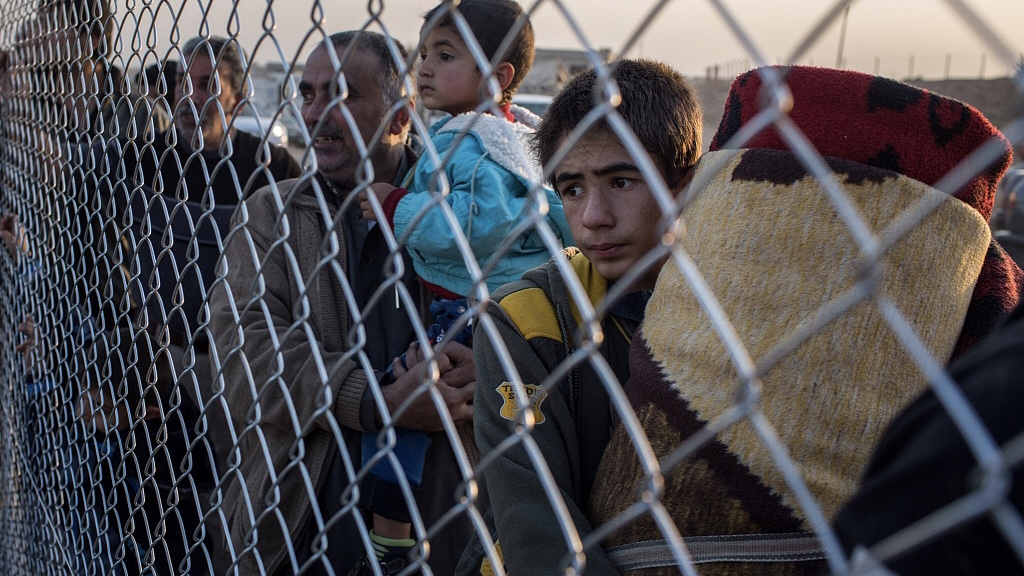
On Wednesday, two more French citizens were sentenced to death by a Baghdad court, after they were found guilty of joining the Islamic State of Iraq and the Levant (ISIL). Their execution is expected within three days. This ruling brings the total number to six of former French ISIL members who are sentenced to death by the Iraqi court.
The French foreign minister responded to the judgment in a statement on Monday after the first case of death ruling on three French women, stressed France's opposition to the death penalty while respecting the sovereignty of Iraq, saying that ISIL members "had to answer for their crimes."
Starting in April, Iraq has begun trial proceedings for Iraq's suspected members of ISIL caught fleeing jihadist territory in eastern Syria including territory bordering Iraq. There are reportedly 900 to 1,000 suspects involved in this ongoing trial, which were handed over to Iraqi authorities by Syrian Democratic Forces (SDF).
In early April, the Iraqi government has offered to put hundreds of suspected foreign fighters on trial in Baghdad in exchange for millions of dollars. It proposed a rate of two million U.S. dollars per suspect per year, calculated based on the estimated operational costs in Guantanamo Bay, a U.S.-run prison. But no evidence indicating that any kind of fundings would be provided from Washington to Baghdad in this case.
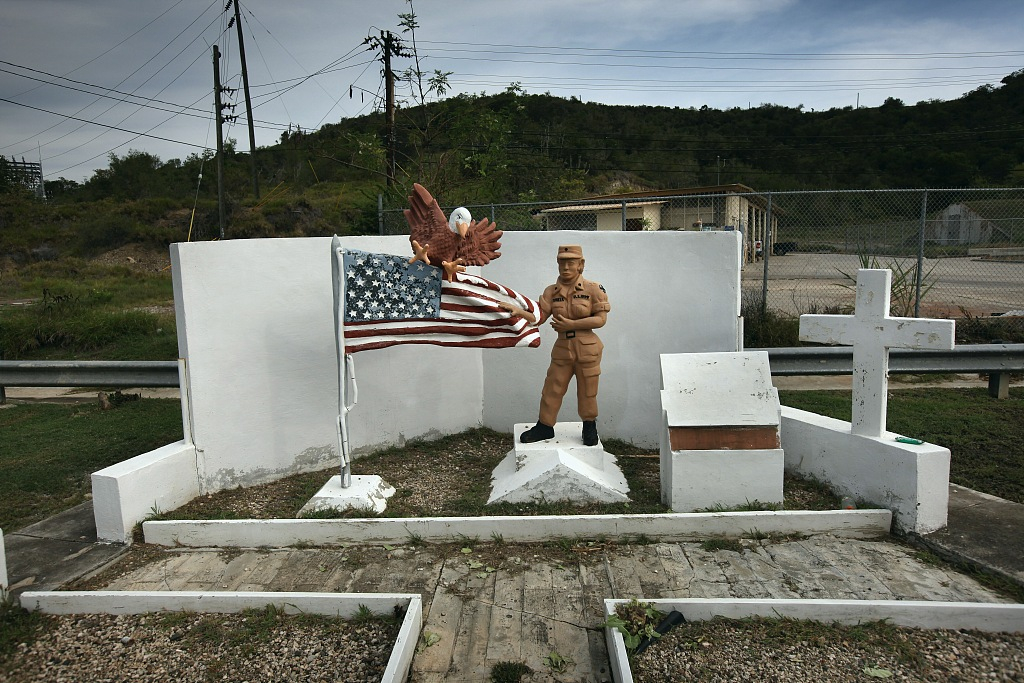
A nameless memorial stands at the U.S. Naval Station in Guantanamo Bay, Cuba, September 14, 2010. /VCG Photo
A nameless memorial stands at the U.S. Naval Station in Guantanamo Bay, Cuba, September 14, 2010. /VCG Photo
Without much help from the international community, trying these 900 detained suspects casts a heavy burden on Iraq. Human rights groups have repeatedly criticized the trials, which allegedly rely on circumstantial evidence or confessions obtained under torture. This is only "the very first tragedy of the problem," said Dr. Randam Slim, the senior fellow and director of Conflict Resolution Program and Track II Dialogues in Middle East Institute.
Long before President Trump declared the total victory against ISIL early this year, the how-de-do moment has been brought up to the table about the arrangement of the so-called "foreign fighters". According to the New York Times, the SDF is estimated to hold about 12,000 foreign women and children in camps, and some 1,000 foreign fighters in the prisons in Syria alone. And the European countries are reluctant to repatriate them back to their homeland.
In 2017, the Wall Street Journal reported that the French special forces in Iraq have for months enlisted Iraqi soldiers to hunt and kill French nationals who have joined the senior ranks of ISIL. Slim strongly condemned the decision process of the European countries "because they don't want to face the situation."
This whole scenario creates a group of international pariahs, include not only the former ISIL fighters but also a generation of left-behind children, who were born disfranchised and marginalized by society.
French Defense Minister Florence Party said on Wednesday that "the government would soon repatriate more orphaned or vulnerable children of French ISIL fighters from camps." But the claiming process for "their grandparents, aunts, and uncles in foreign countries can be very complicated and lengthy," Slim told CGTN from her experience talking to social workers in Iraq and Syria. "These children were born innocent on the Iraqi and Syrian soil. After turning into school age, without a valid ID card, what can they do and where can they go?"
Another roadway in the developing crisis is that by not dealing with the foreign fighters who are currently under Kurdish control in Syria, they will end up in the hands of President Bashar al-Assad.
"It is highly possible that we are going to see repeated situation happened in 2003 and 2004 after 9/11," warned Slim. "Assad will take control over thousands of jihadists and use them against his opponents, maybe in Lebanon or Saudi Arabia when the situation shifts against him in the future."
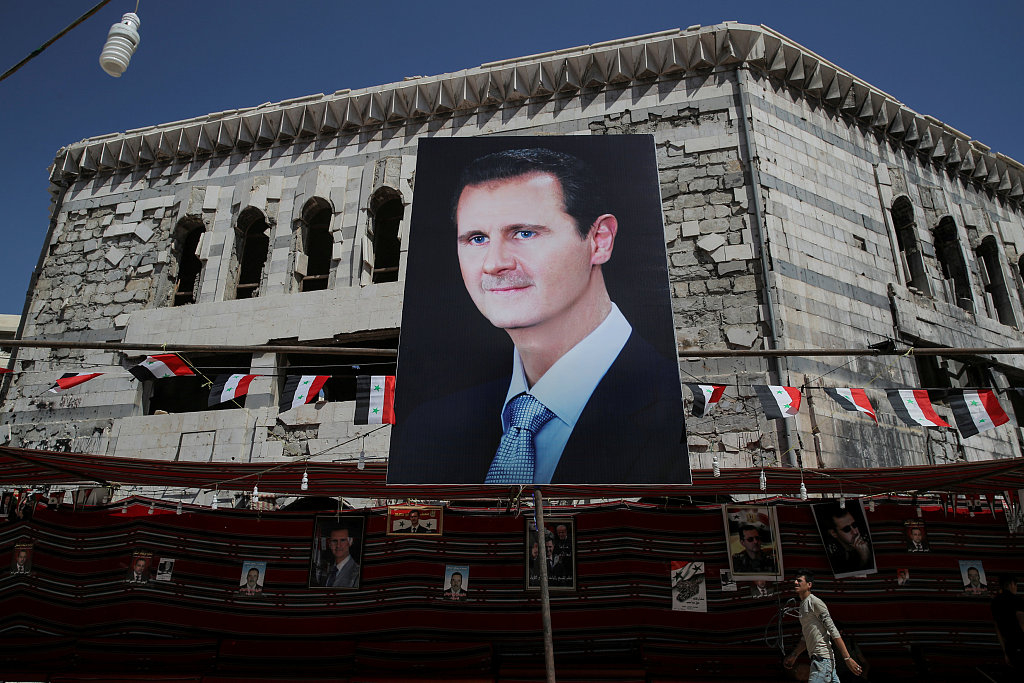
A portrait of Syrian President Bashar al-Assad is seen out of a building in Douma, outside Damascus, Syria, September 17, 2018. /VCG Photo
A portrait of Syrian President Bashar al-Assad is seen out of a building in Douma, outside Damascus, Syria, September 17, 2018. /VCG Photo
So, is there a better way out of the crisis?
"My own view is that it's a mistake for British authority not to repatriate Shamima Begum," said Dr. Michael Kenney, an associate professor of international affairs at the University of Pittsburgh. Shamima Begum is a teenager whose citizenship was revoked by the British government because of joining ISIL.
Based on years of field works done by Kenney for his new Book "Islamic States in Britain," he raised the point that "it's important to note that a number of foreign Fighters who left Britain and went over to Iraq and Syria are already back [...] None of those people, as far as I know, have carried out a terrorist attack or try to get engaged in political violence in Britain."
"We need an international tribunal to publicly try them, to hold them accountable in public not in secrecy," said Slim. But she didn't offer any feasible funding source or a leading power to organize and monitor the process.
She ended the interview with a rather pessimistic conclusion, "The situation has a first-order effect, second-order effect, third-order effect, short term, medium-to-long term effects, and nobody is paying attention to it."