
Business
22:50, 29-Jul-2018
Who is to blame for the US trade deficit with China?
Updated
22:09, 01-Aug-2018
 ["china"]
Share







Copied
02:04
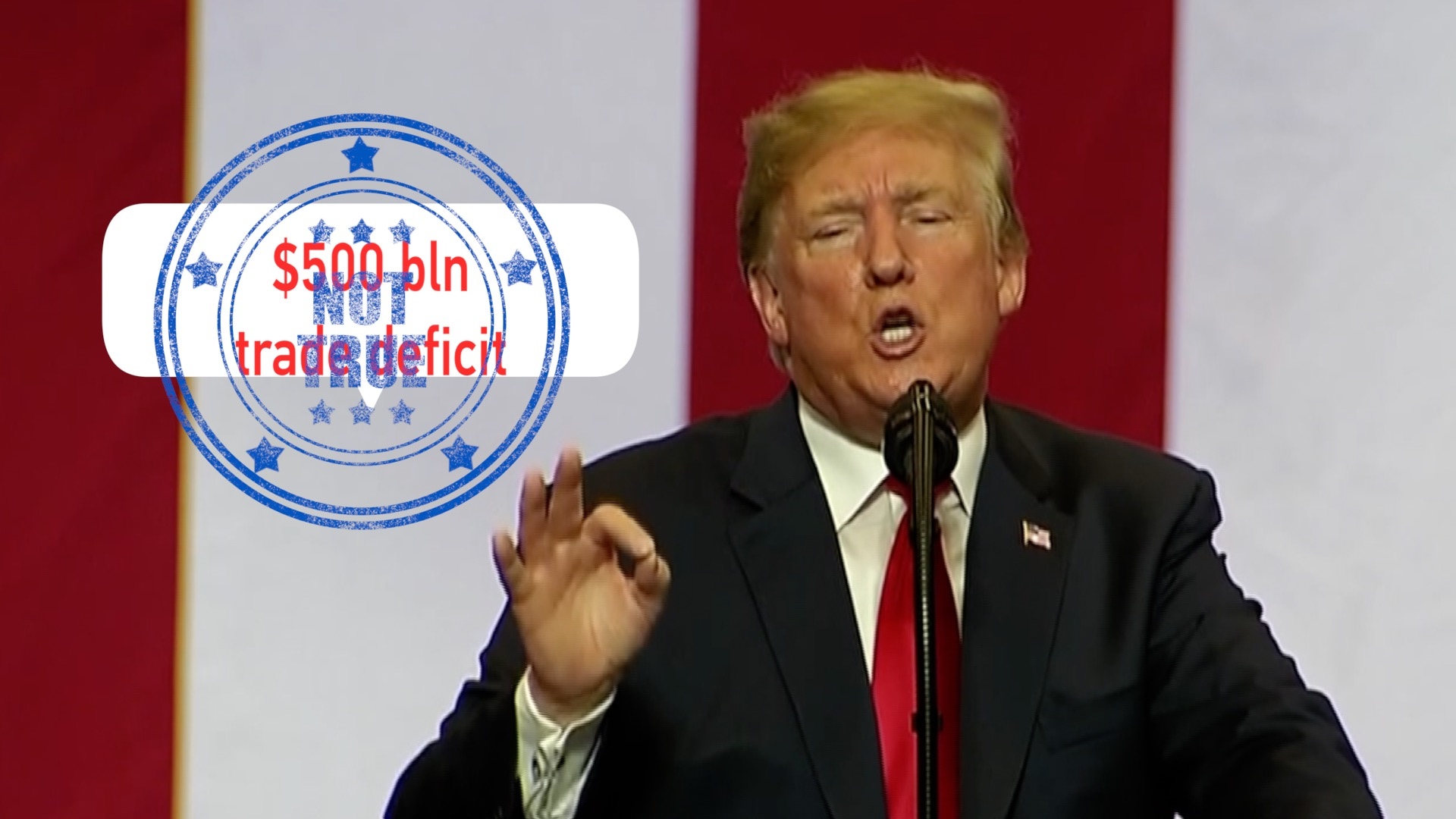
An annual trade deficit of 500 billion US dollars. That is one excuse for the Trump administration to launch a trade war against China.
The president claims that the US is suffering from a trade imbalance, but is China to blame? Or the US should blame itself?
Is Trump correct about the number?
According to data from the US Department of Commerce, the country had a merchandise trade deficit of 375 billion US dollars with China in 2017. The 500 billion US dollars that Trump has chanted, is fully one-third larger than the official figure. And it conveniently overlooks the US service trade surplus with China.
The service sector is a vital component for the US economy, which accounts for 90 million US jobs and 80 percent of US economic activity. Chinese statistics show the US had a service trade surplus with China of 54.1 billion US dollars in 2017 and has benefited from Chinese tourists and students, as well as exporting copyrights and patents to China.
Where does the trade gap come from?
Economist Stephen Roach from Yale University said, a fundamental problem is that the US doesn’t save enough.
According to the Federal Reserve Bank of St. Louis, in the fourth quarter of 2017, the net US domestic saving rate was just 1.4 percent of national income, down from 5.7 percent just 30 years ago.
"When you don't save but you want a growth, you must import surplus savings from abroad, and to do that, you run a big balance of payments deficit, and trade deficits with many countries to attract foreign capital,” said Roach.
In 2017, the US had merchandise deficits with 102 nations, including China, Mexico, Japan, Germany, Vietnam, Ireland and Italy.
The international specialization of comparative advantage also explains the gap.
China has the comparative advantage of cheaper labor cost, as with other developing countries, while the US is at the high end of the global supply chain, boasting its capital and technology. US manufacturers send materials to China for low-cost assembly, but when they are assembled and shipped back, they are considered imports.
Based on the value added of what is actually produced in China, the 47 percent share of the US deficit ascribed to China would be reduced to around 28 percent.
Want a deficit quick fix?
Though experts generally agree that trade imbalances are not a good metric for economic health as they are influenced by many factors, the US could still make a difference with deficits by lifting its restrictions on high-tech products exported to China. Or, face its own structural problems.
Script writer/Video editor: Xu Xiaotong
Graphic designer: Gao Hongmei
Voice-over: John Goodrich