
12:33, 17-Aug-2017
Helping Syria's Wounded: New high-tech prosthetic centers open in Turkey
 []
[]
Share







Copied
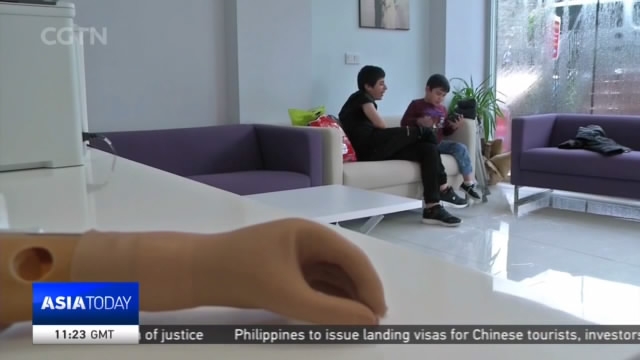
Turkey's first High-Tech Orthotic Prosthetic Centers have opened in Istanbul and two southern Turkish provinces. These are to help Syrian war victims left permanently disabled due to bombings and fighting. The project is run by Turkey's Humanitarian Relief Foundation and The International Doctors' Association. It aims to provide a thousand patients with prosthetic limbs within two years, using cutting-edge 3D printer technology. CGTN's Natalie Carney visited centres in Istanbul and Sanliurfa.
More than 22 percent of Syrian refugees are reported to be disabled, higher than the 18-20 percent estimated for most other conflict areas. Mahmoud, Muhammad and Ayman are only three of them. Mahmoud is six. He lost his right leg in an airstrike on his village back in Syria, but soon he'll be able to walk without crutches again.
MAHMOUD PROSTHETIC PATIENT (I will be able to) run and play football. 32-years-old Ayman from Aleppo use to be a pastry chef. He too lost his arm and part of his hand in an air strike and still has shrapnel lodged in his face.
AYMAN PROSTHETIC PATIENT CI want to use this limb because people look at you differently when you have something missing, but now they won't notice. Today Ayman is being fitted for a new prostatic arm. He has been waiting a long time for this day. Aymen's arm is scanned. A computer program then creates a 3D image of his limb and the prosthetic needed.
DR. YASAR TATAR PROJECT COORDINATOR Look, my colleague is giving it shape. We apply our knowledge of the prosthesis -- like shrinking it, enlarging it, adding additional material. After it's complete, you press the print button. Within 2-6 hours, the printer gives the prosthesis that you want. While this facility still uses the conventional way of producing new body parts, they also apply the cutting edge technology of 3D printers. This removes costs and speeds up the production time considerable. In most cases, patients can have their new limb within hours for free! Patients don't even have to come to the clinic.
DR. YASAR TATAR PROJECT COORDINATOR It was possible to make prosthetics by conventional methods, but the numbers grew too high. There was also the disadvantage of mobilizing and applying the prosthetics to large numbers of people from here in the center. Especially in the war zone, in the camps, it is not possible for people to get out all the time. So we decided to use the 3D printer. Our staff there collects the data by scanning the patients, then they send it to our center. Our engineer colleagues prepare the prosthesis and send it to the camps or border. The project, owned by IHH Humanitarian Relief Foundation is well coordinated by the international doctors' association and funded by the Kuwait Zakat House.
NATALIE CARNEY SANLIURFA IHH are opening up three rehabilitation clinics across the country, like this one here in the southern city of Urfa. They are not the first to offer free prosthetics to injured Syrians, but doctors say the continual violence in Syria is fuelling this growing demand.
DR. YASAR TATAR PROJECT COORDINATOR At the end of this month, more than 20 patients will have prosthetics. It is a high number, and that is just for the Istanbul center. When Reyhanli and Urfa are active, 40-50 patients will be fitted with prosthetics each month. While their focus is to meet the requirements of Syrian war victims, those who have been disabled outside of war and do not have the ability to pay for the procedure will also get free prosthetic limbs and a new chance at life. Natalie Carney, CGTN, Turkey.