Editor's note: The article was first published on China Plus on August 13. The article reflects the author's opinion, and not necessarily the views of CGTN.
At a time when the Turkish lira went on a monumental slide downward against the US dollar, US President Donald Trump authorized a doubling of tariffs on Turkish steel and aluminum on Friday, hiking import costs for Turkish steel by 50 percent, and 20 percent on aluminum.
This follows a move by the US Treasury Department to freeze the assets of Turkish Justice Minister Abdulhamit Gul and Interior Minister Suleyman Soylu in the United States in connection with the detention of US pastor Andrew Brunson.
Brunson is accused of aiding in the plot to overthrow Turkey's President in the failed coup in 2016. These moves now beg the question: If the United States can be so ruthless towards a NATO ally, Turkey, what about other countries? Is the United States a trustworthy and responsible member of the international community?
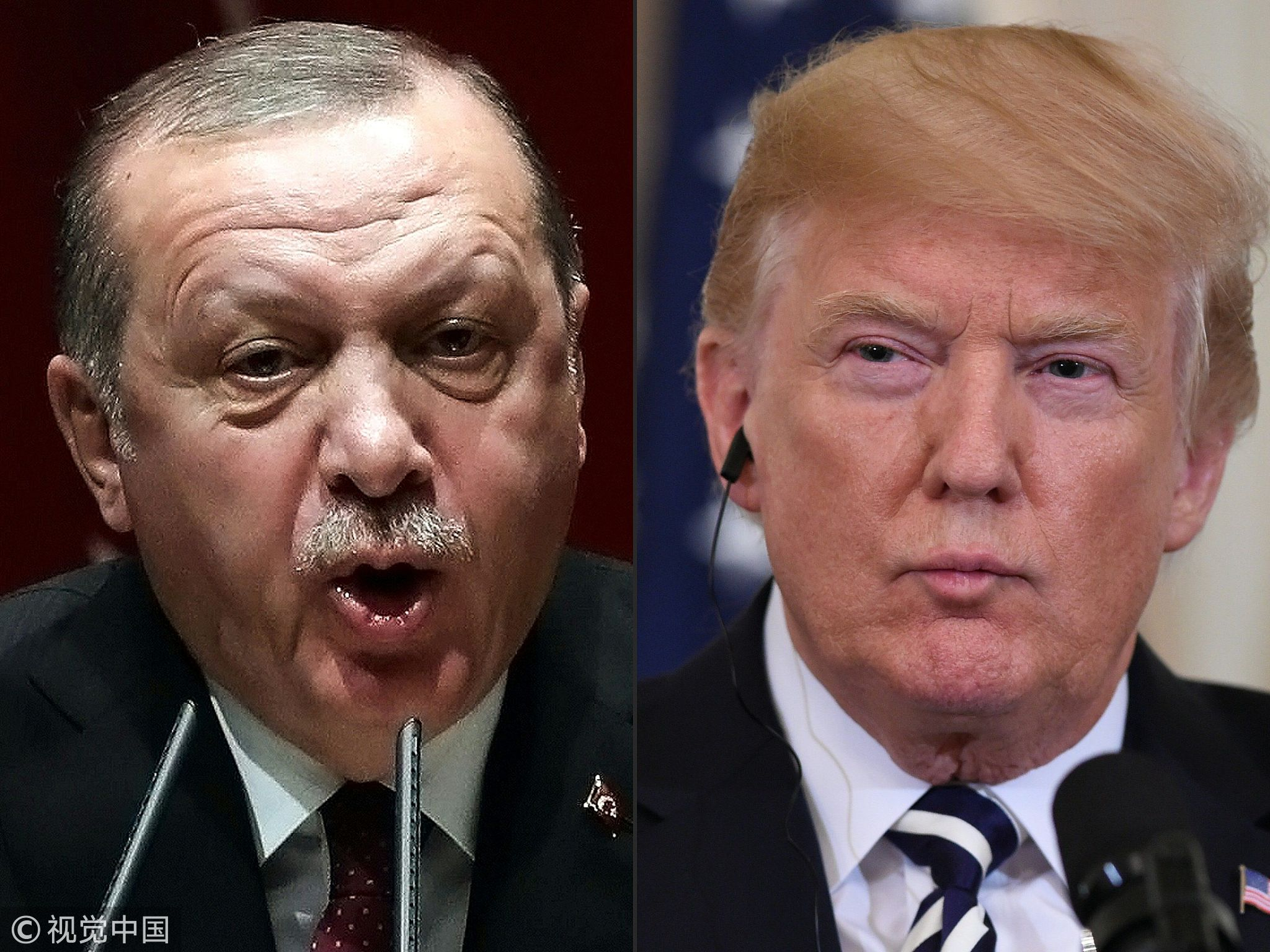
This combination of file pictures created on August 11, 2018, shows (L) President of Turkey and Leader of the Justice and Development Party (AKP), Recep Tayyip Erdogan delivering a speech during an AK party's group meeting at the AK Party's headquarters in Ankara, on January 26, 2018. /VCG Photo.
This combination of file pictures created on August 11, 2018, shows (L) President of Turkey and Leader of the Justice and Development Party (AKP), Recep Tayyip Erdogan delivering a speech during an AK party's group meeting at the AK Party's headquarters in Ankara, on January 26, 2018. /VCG Photo.
This is not the first time such a question has surfaced. Following last year's G7 summit in Italy, the disappointment expressed by German Chancellor Angela Merkel was palpable. "The times in which we can completely depend on others are, to a certain extent, over," said Merkel. "I've experienced that in the last few days. We Europeans truly have to take our fate into our own hands."
While some might pin this unreliability on the policies of current President Donald Trump, history has shown that the US has a track record of being a fair-weather ally. The Kurdish minority in northern Iraq is all too aware of this.
As early as the 1970s, the Kurds began an insurgency against the Baghdad regime, earning promises at the time for assistance from the United States. But the US ultimately abandoned the Kurds, leaving thousands dead and tens-of-thousands more as refugees in other countries.
Former US Secretary of State Henry Kissinger, who is known for his indifference, has been quoted as saying at the time that "foreign policy should not be confused with missionary work." So what is the US foreign policy? "America First" may be the clearest and most straightforward answer.
"America First" is a philosophy which allows the current leader of the United States to push the leaders of other countries out of his way as he steps to the front of the pack to have his photo taken. It's also a policy which he believes gives the United States the right to abandon its responsibilities on the international stage.
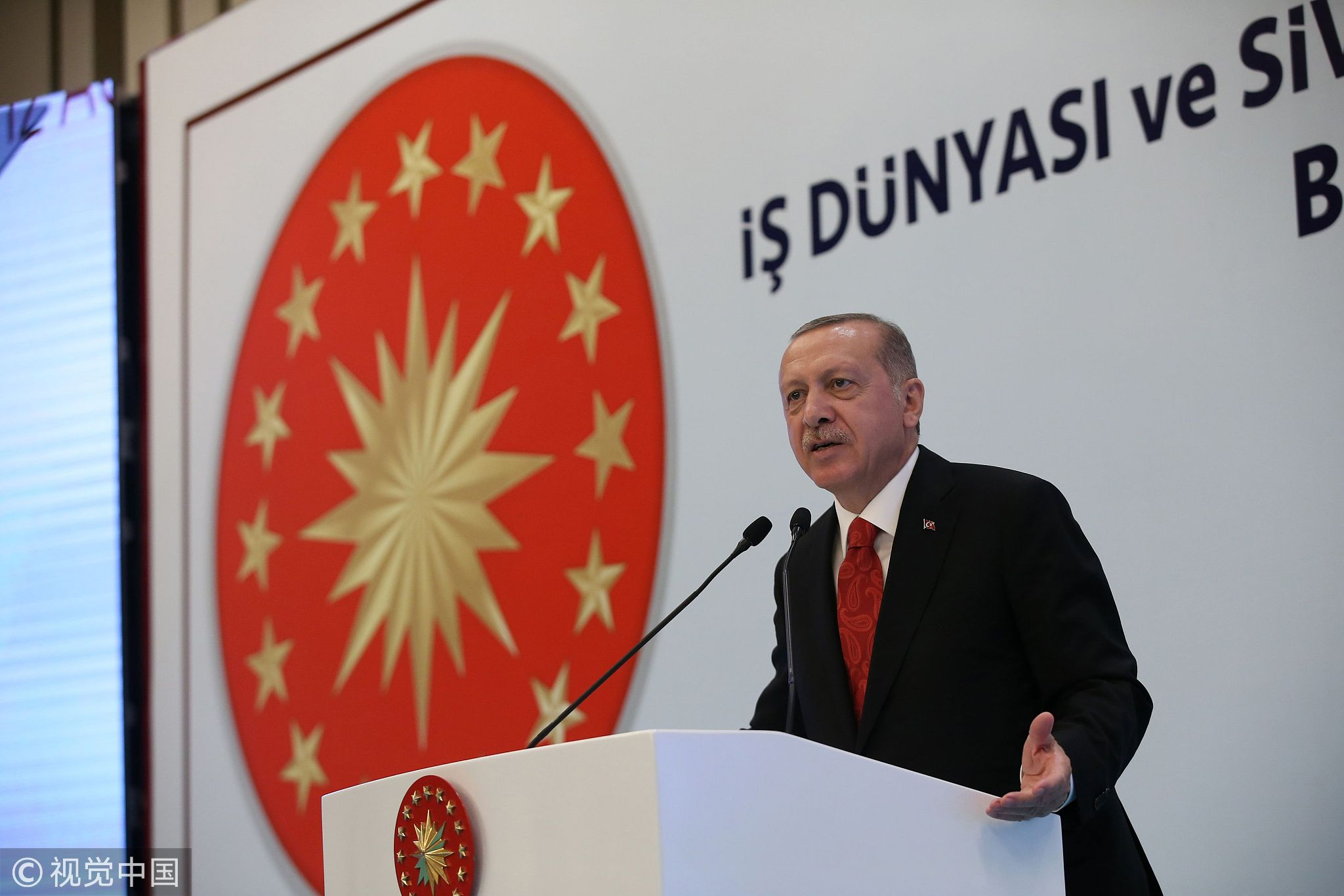
This handout picture taken and released on August 12, 2018, by the Turkish Presidential Press Office shows Turkish President Recep Tayyip Erdogan addressing businessmen in the Black Sea city of Trabzon. /VCG Photo.
This handout picture taken and released on August 12, 2018, by the Turkish Presidential Press Office shows Turkish President Recep Tayyip Erdogan addressing businessmen in the Black Sea city of Trabzon. /VCG Photo.
The Trans-Pacific Partnership, negotiated by 12 countries over the course of many years, became mothballed on just the fourth day of Donald Trump's presidency after Trump announced his plans to withdraw the United States from the pact.
In order to control climate change, the Paris Climate Change Agreement, which has been painstakingly negotiated by major players around the world, has also been abandoned by the US government. Despite being one of the world's largest emitters of carbon dioxide, Trump has surmised that the Paris Agreement would hamper the development of the US economy.
In July 2015, the United States, along with the other permanent members of the UN Security Council, namely Russia, China, the United Kingdom, France, along with Germany, sat down with Iran to try to curtail the Islamic Republic's nuclear program. Following painstaking talks, the P5+1 eventually worked out an agreement to limit Iran's ability to create a nuclear weapon.
Trump, a critic of anything connected to his predecessor Barack Obama, decided to act on his campaign rhetoric - against the wishes of many of his policy advisors - and withdraw the United States from the Iran nuclear deal.
The United States has also withdrawn from international organizations such as UNESCO and the UN Human Rights Council. Can a country that would abandon its international commitments and refuse to assume international responsibility at any time be worthy of respect and trust?
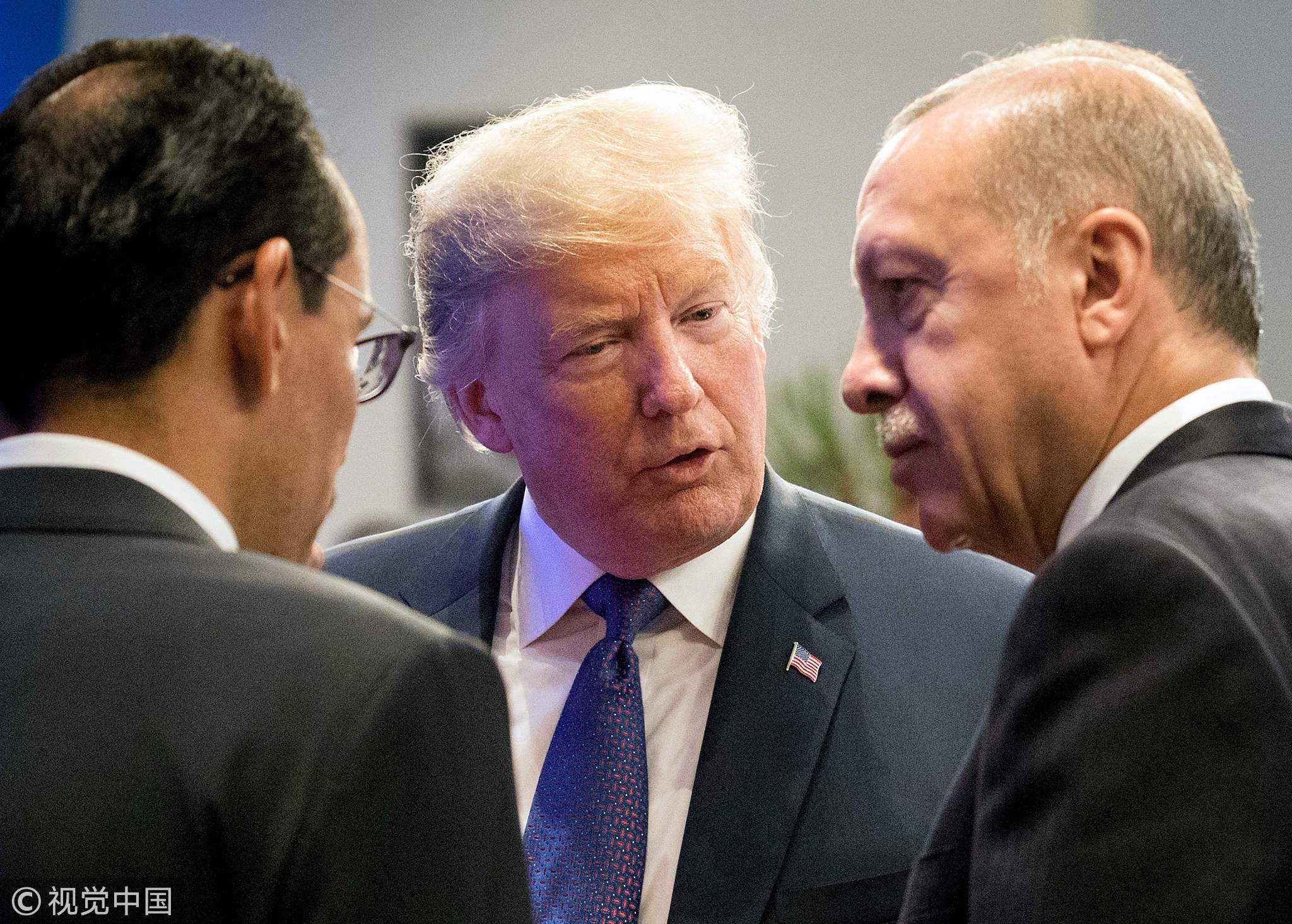
In this file photo taken on July 10, 2018, US President Donald Trump (2ndR) speaks with Turkey's President Recep Tayyip Erdogan (R) during a working dinner in Brussels, during the North Atlantic Treaty Organization summit. /VCG Photo.
In this file photo taken on July 10, 2018, US President Donald Trump (2ndR) speaks with Turkey's President Recep Tayyip Erdogan (R) during a working dinner in Brussels, during the North Atlantic Treaty Organization summit. /VCG Photo.
The same question can be asked even regarding bilateral agreements. In May of this year, shortly after the United States reached a tentative deal with Beijing to avoid a trade war, Washington backtracked, declaring in bad faith that it would levy additional tariffs on Chinese goods.
There are many deep-seated reasons for the current conflict between Turkey and the United States. Despite being NATO allies, the US has refused to extradite the man Ankara accuses of masterminding the failed coup in 2016. The United States also actively supports the Kurds in Syria, which the Turkish government accuses of being terrorists.
When Turkey arrested American pastor Andrew Brunson on charges of assisting terrorist organizations and refused to release him, the United States decided to apply economic pressure on Turkey with high tariffs and the freezing of assets in the U.S. belonging to high-ranking Turkish officials.
Turkey is not the only US trading partner being subjected to the United States' dubious economic policies and actions. Allies and key trading partners including the European Union, Canada, Mexico, Russia, China, and India have all been hit by punitive tariffs from the US, based on Trump's interpretation of how to advance the US economy.
If the US chooses to ignore the multilateral trading system and move toward unilateralism on trade issues, how can it expect to be trusted by others?
As the only superpower in the world today, the US wants absolute security for itself. However, this political doctrine means the US is threatening to unravel the current global security structure. The Trump administration's proposed defense budget for 2019 has been set at 717 billion US dollars, which is more than the combined total of the dozen countries behind it on the list of defense spending.
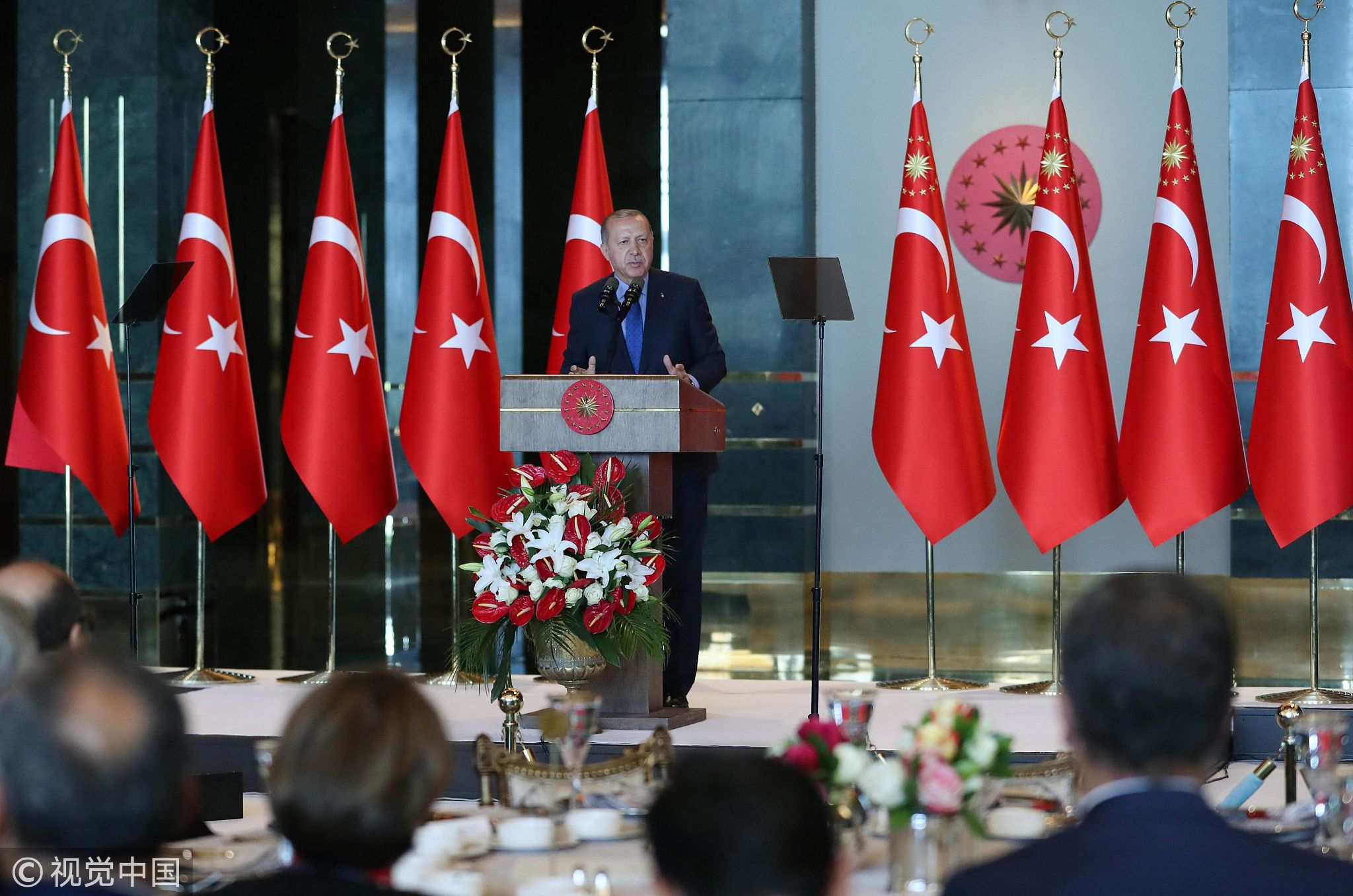
This handout photo was taken and released on August 13, 2018, by the Turkish Presidential Press Service shows Turkish President Recep Tayyip Erdogan addressing a luncheon for participants of the 10th Ambassadors' Conference at the Presidential Complex in Ankara. /VCG Photo.
This handout photo was taken and released on August 13, 2018, by the Turkish Presidential Press Service shows Turkish President Recep Tayyip Erdogan addressing a luncheon for participants of the 10th Ambassadors' Conference at the Presidential Complex in Ankara. /VCG Photo.
Moreover, US Vice President Mike Pence has also asked Congress to earmark an additional 8 billion dollars to establish a so-called Space Force by 2020, which could be the first step to militarize outer space, despite global treaties which ban exactly that.
The opening of this "Pandora's Box" may prompt other countries to act accordingly for their own security, creating security turbulence which the world had shaken itself out of after the end of the Cold War.
The saying that "To be an enemy of America can be dangerous, but to be a friend is fatal," is well-known in diplomatic circles in the Middle East. The US invaded Iraq on fabricated evidence in 2003. In 2011, faced with the insurgency of the "Arab Springs" movement, many US allies turned to Washington for political support.
However, Washington refused to publically support many of the United States' long-time friends, such as Egypt's Hosni Mubarak. The fallout from this political miscalculation is still being felt in the region.
The United States' dedicated enemy, hardline extremists, were able to capitalize on the political instability in the region to launch numerous insurgencies. The tens-of-thousands dead in Syria is a prime example of the short-sightedness of long-time US foreign policy missteps.
Turkey is facing its own challenges but does have other choices beyond the hardline policies being foisted upon it by Washington. President Recep Tayyip Erdogan has said publicly that Turkey will be looking to form alternative economic alliances with Iran, Russia, China, and some European countries.
According to a new poll commissioned by public service TV provider ZDF and conducted by the Mannheim Research Group, 82 percent of Germans believe the US is not a reliable partner for Berlin when it comes to political cooperation. Obviously, not just Germans think so.

 ["china"]