
Business
16:05, 26-Jun-2018
US cheesemakers fear to lose foreign markets due to tariffs
Updated
15:05, 29-Jun-2018
 ["north america"]
Share







Copied
US cheesemakers are growing anxious for fear that they would be shut out of foreign markets as other countries raising tariffs on the US products to retaliate US President Donald Trump’s aggressive trade tariffs.
“If export markets get shut off, I could see us getting to the point where we’re dumping our milk in the fields,” Jeff Schwager, the president of Sartori Company in Wisconsin, was cited by The New York Times.
Sartori faces 15 percent tariffs imposed by Mexico on its exports, which will increase to 25 percent on July 5. The price increase gives a blow to the company, as its customers have enough reason to sign contracts with its European competitors, such as Feta, Muenster and Fontina.
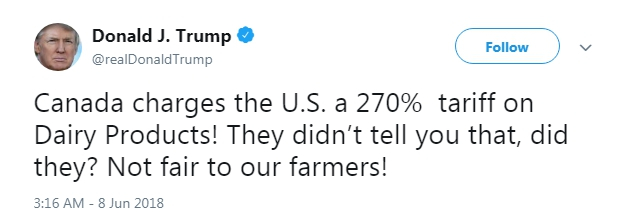
The dairy industry is confronted with substantial tariffs on its exports, as Mexico, Canada and other countries retaliate against Trump’s steel and aluminum tariffs. Mexico is the US largest export destination for cheese, and receives over a quarter of all exported cheese leaving the US.
The US dairy farmers and cheesemakers fear to lose access to foreign markets if Trump withdraws the US from the North American Free Trade Agreement. They generally supported the Trans-Pacific Partnership, but Trump withdrew the US from it in his first days in office.
For US cheesemakers like Sartori, Trump’s protectionist approach has further tilted the global playing field against them, adding more difficulties for them to survive in an increasingly competitive global market, according to The New York Times.
It is believed that the retaliatory tariffs by the EU and Mexico are aimed at Wisconsin, a key state for Trump’s narrow win in 2016 election, as well as home to Representative Paul D. Ryan, the House speaker.
The US motorcycle maker Harley-Davidson, another company based in Wisconsin, also felt the impact of tariffs. It decided on Monday to move some production overseas for European customers to avoid retaliatory tariffs that could cost it up to 100 million US dollars per year.