Editor's note: This article is translated from an editorial piece originally published in the WeChat official account of Bullpiano.
After four days of long drawn-out talks, the latest round of China-U.S. trade talks wrapped up in Washington, DC in the early hours of February 25 Beijing time.
The tight schedule made every minute count. It is reported that on the final day, to save time, delegates on both sides grabbed just a quick lunch before heading back to the negotiation table.
A news release from Xinhua News Agency followed. Here are some main points.
The agreements reached by leaders of both countries in Argentina have been further implemented. The two parties held talks over the text of a trade deal and made substantial progress on specific issues regarding technology transfer, intellectual property rights protection, non-tariff barriers, services, agriculture, and exchange rate, among others. Building on this, the two sides will figure out next steps as instructed by their heads of state.
U.S. President Donald Trump sent two tweets early on about the productivity of the negotiations. He also said that he would be delaying the U.S. increase in tariffs on Chinese exports scheduled to start on March 1, and that marked “a very good weekend for U.S. and China.”
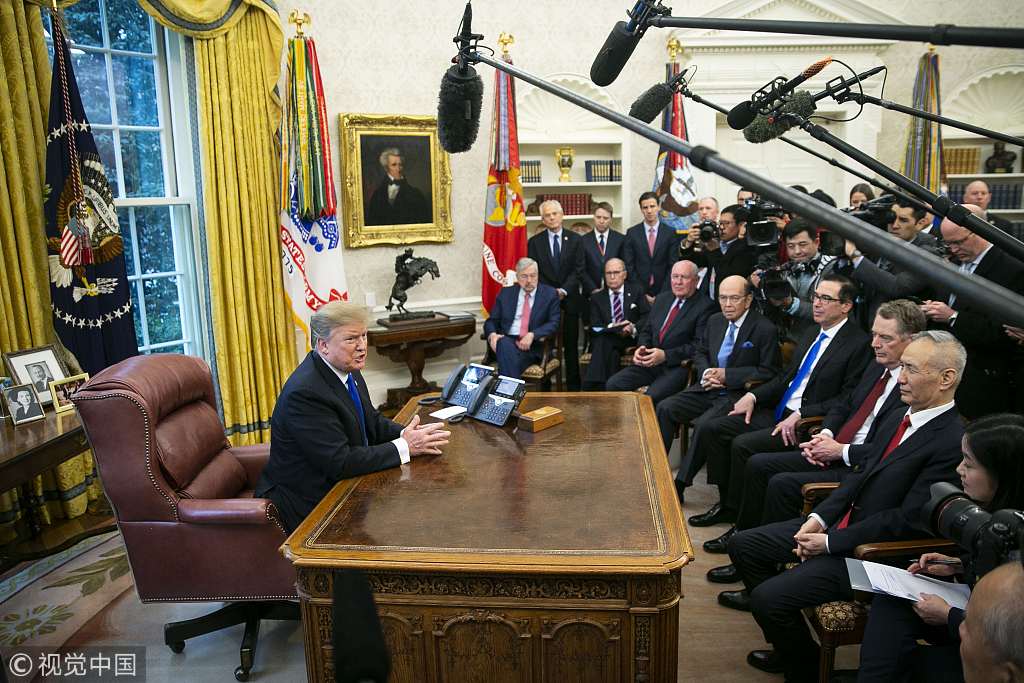
U.S. President Donald Trump (L) speaks during a trade meeting with Liu He, China's vice premier and director of the central leading group of the Chinese Communist Party (R) in the Oval Office of the White House in Washington, DC, U.S., Februrary 22, 2019. /VCG Photo
U.S. President Donald Trump (L) speaks during a trade meeting with Liu He, China's vice premier and director of the central leading group of the Chinese Communist Party (R) in the Oval Office of the White House in Washington, DC, U.S., Februrary 22, 2019. /VCG Photo
The two tweets, short as they were, contained a huge amount of information. Although the message seems bit extravagant, the latest round of talks did send three strong and significant signals.
One: Negotiations have come to the final stage where a deal would be drafted
It is noted in Xinhua's news release that “further implementing major agreements reached in Argentina, the two parties held talks over the text of a trade deal…” The two key expressions are “further implementing” and “the text of a trade deal.”
Compared with the expression “(the two sides) earnestly implemented…” made after the previous round of talks that ended on February 15, “further implementing” indicates a higher degree of determination. More importantly, “talks over the text of a trade deal” is unique to the latest talks.
It is therefore almost certain that the talks are now drawing to an end, that the two sides have already been discussing the text of a final deal, and that we are expecting a deal instead of a memorandum.
As explained previously, a deal and a memorandum would not make much difference for China in terms of either the text or the negotiations.
If things go well, the protracted and unprecedented China-U.S. trade war, after one year of ups and downs, would finally come to a conclusion. But of course, nothing is for sure until the last minute.
Two: Major breakthroughs have been made in various areas
The bilateral talks could finally come to an end mainly because breakthroughs had been made on some tricky issues.
On Twitter, Trump used the word “productive” to describe the latest negotiations.
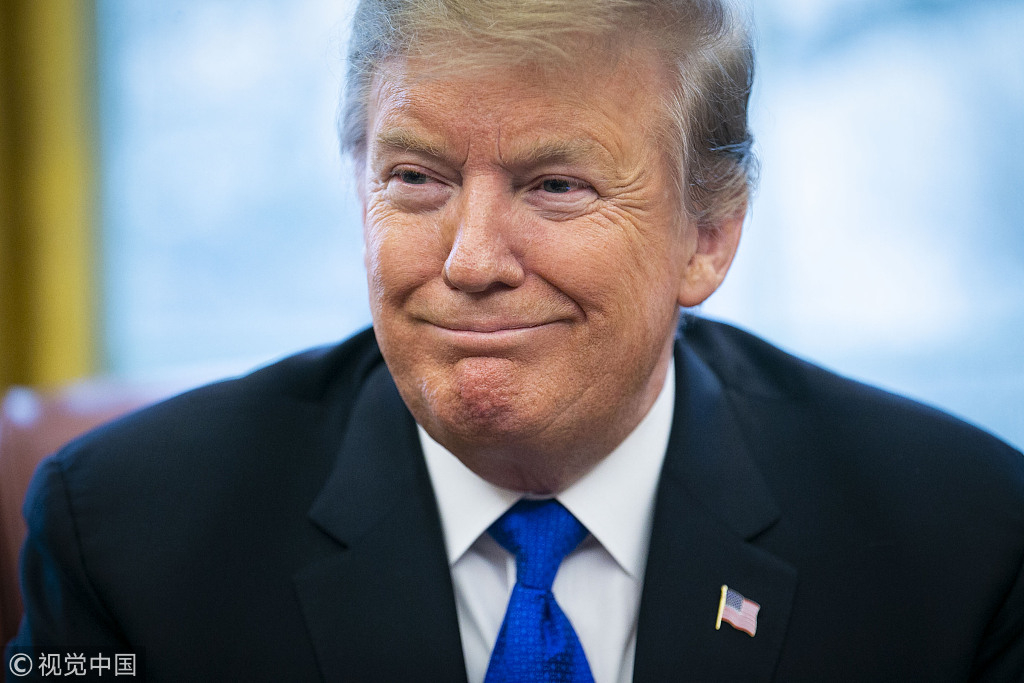
U.S. President Donald Trump at the trade meeting with Liu He, China's vice premier and director of the central leading group of the Chinese Communist Party, not pictured, in the Oval Office of the White House in Washington, DC, U.S., February 22, 2019. /VCG Photo
U.S. President Donald Trump at the trade meeting with Liu He, China's vice premier and director of the central leading group of the Chinese Communist Party, not pictured, in the Oval Office of the White House in Washington, DC, U.S., February 22, 2019. /VCG Photo
Xinhua's news release noted that “(the two sides) made substantial progress on specific issues regarding technology transfer, intellectual property rights protection, non-tariff barriers, services, agriculture, exchange rate, among others.” Here, “specific issues” and “substantial progress” are two key terms.
Compared with the expression “in-depth exchanges of views” made after the sixth round of talks, “substantial progress” and, in particular, “specific issues” are indicative of significant breakthroughs and more detailed approaches.
Specifically, Xinhua's new release mentioned areas including “technology transfer, intellectual property rights protection, non-tariff barriers, services, agriculture, exchange rate, among others”. The expression “among others” left much room for maneuver for both countries.
Major breakthroughs would pave the way for a final deal. However, should any unforeseen issues arise, all progress previously made would vanish into thin air and U.S. soybeans would once again bear the brunt.
Three: The historical moment is just around the corner
The closing sentence of Xinhua's news release: “Building on this, the two sides will figure out next steps as instructed by the head of state” seems pretty straightforward, but has much more to it beneath the surface.
For one thing, we can conclude that the talks are drawing to an end since it is not clear whether there will be new talks. Certainly, we cannot completely exclude the possibility that there would be another round or two.
For another, “figure out next steps as instructed by the head of state” means that due to the extraordinary significance of currents talks, how to address some of the trickiest issues would be up to the head of state.
On Twitter, Trump said excitingly that “… we will be planning a Summit for President Xi and myself, at Mar-a-Lago, to conclude an agreement.” He subsequently announced that major news would be released in the next one or two weeks if everything went well.
While meeting with Chinese Vice Premier Liu He in the White House on February 23, Trump explicitly pointed out that he was very much looking forward to meeting Chinese President Xi Jinping in the near future to jointly witness a historical moment in bilateral trade and economic relations.
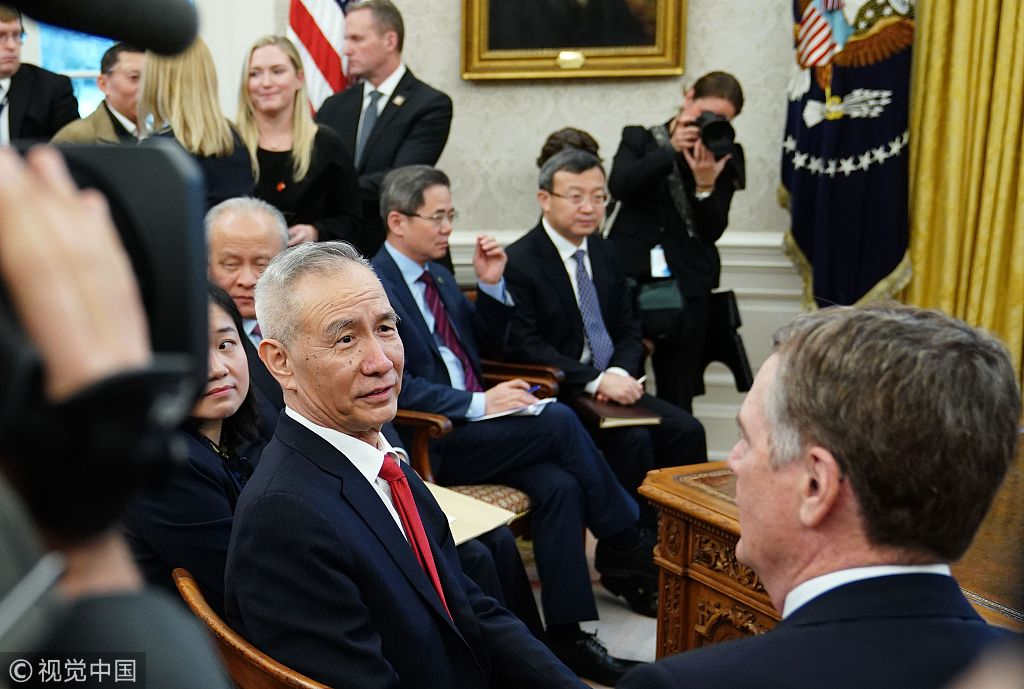
China's Vice Premier Liu He (L) speaks with U.S. Trade Representative Robert Lighthizer (R) in the Oval Office of the White House in Washington, DC, February 22, 2019. /VCG Photo
China's Vice Premier Liu He (L) speaks with U.S. Trade Representative Robert Lighthizer (R) in the Oval Office of the White House in Washington, DC, February 22, 2019. /VCG Photo
The latest round of talks was indeed epoch-making. In the last one year, high-level trade talks alone were held seven times, not to mention those at lower levels. After frequent exchanges of bitter words, a deal is finally around the corner.
To some extent, negotiation is about making a compromise. We must understand that both sides have compromised in one way or another and avoided a lose-lose situation. This is not easy. It reflects the wisdom of negotiators of both countries.
This boils down to how we perceive interests. We must be aware of China's core and long-term interests. Trade serves as ballast in U.S.-China relations. Therefore, stable trade ties guarantee stable bilateral relations.
(If you want to contribute and have specific expertise, please contact us at opinions@cgtn.com.)

 ["china"]