01:54
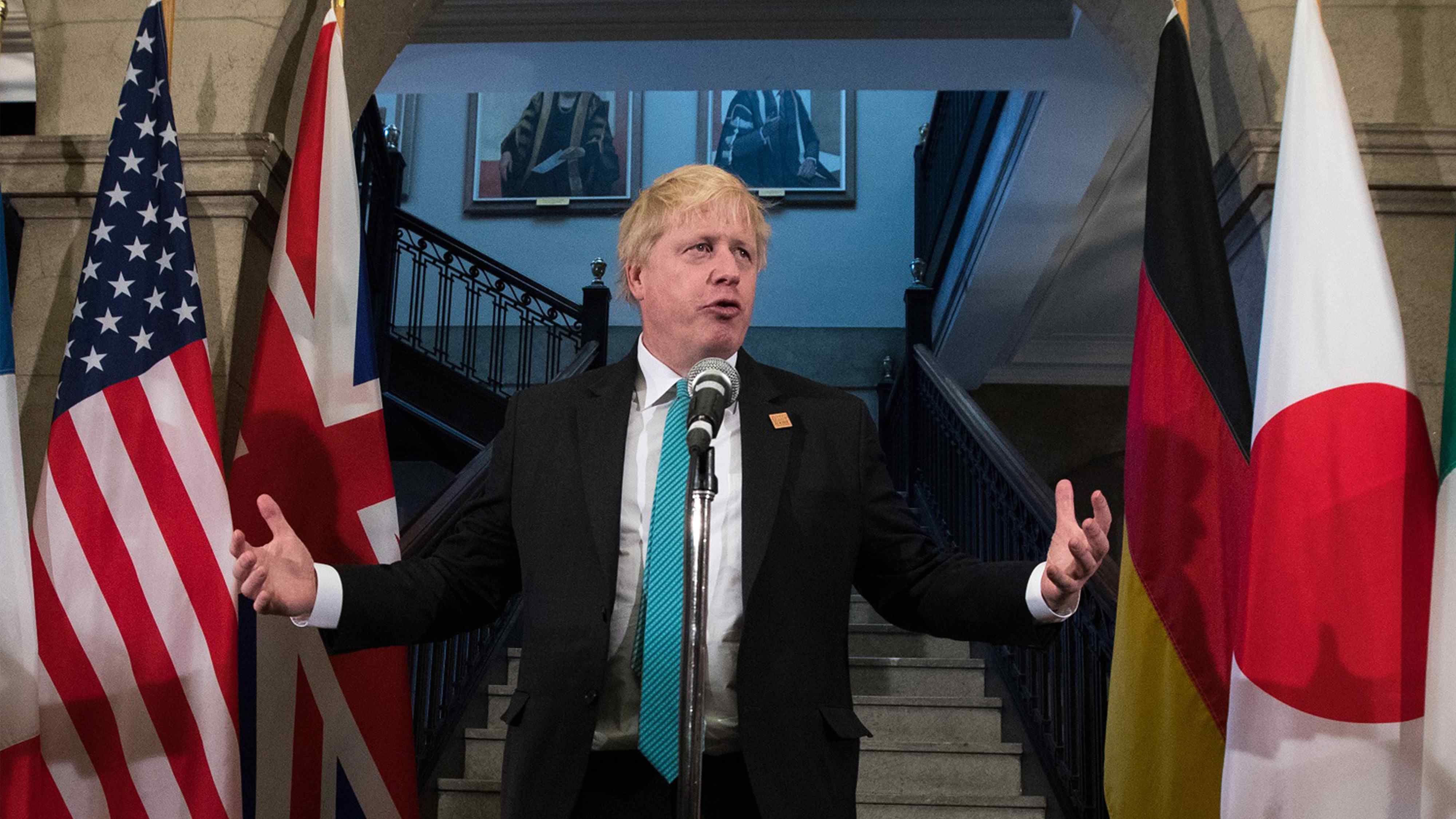
Iran and Russia dominated a meeting of the G7 in Toronto, despite their absence from the event.
The ministers, meeting in Toronto for two days, discussed tensions with Moscow, Iran and the Democratic People's Republic of Korea (DPRK), while also addressing political problems in Venezuela and Myanmar.
“There was G7 unity on opposing Russia’s malign behavior,” the senior State Department official, speaking on condition of anonymity, told reporters at the end of the first day of meetings in Toronto.
“There was also openness among G7 members to dialogue with Russia while we hold them accountable for their malign activities and their efforts to destabilize nations,” the official added.
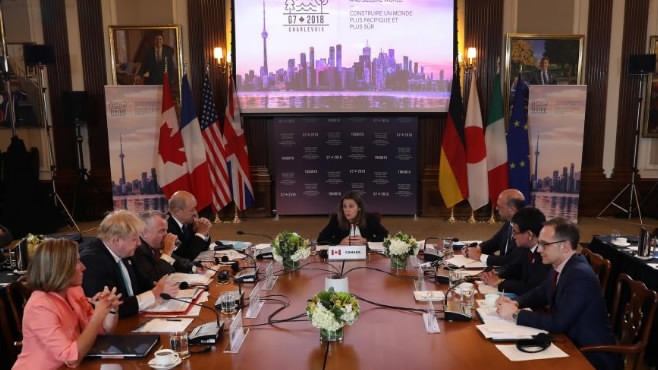
Canada's Minister of Foreign Affairs Chrystia Freeland is joined by France's Minister of Europe and Foreign Affairs Jean-Yves Le Drian, Acting US Secretary of State John J. Sullivan, Britain's Foreign Secretary Boris Johnson, High Representative for the European Union's Foreign Affairs Federica Mogherini, Italy's Minister of Foreign Affairs Angelino Alfano, Japan's Minister of Foreign Affairs Taro Kono and Minister of Foreign Affairs for Germany Heiko Maas at opening remarks on the first day of foreign ministers meetings from G7 countries in Toronto, Ontario, Canada, April 22, 2018. /Reuters Photo
Canada's Minister of Foreign Affairs Chrystia Freeland is joined by France's Minister of Europe and Foreign Affairs Jean-Yves Le Drian, Acting US Secretary of State John J. Sullivan, Britain's Foreign Secretary Boris Johnson, High Representative for the European Union's Foreign Affairs Federica Mogherini, Italy's Minister of Foreign Affairs Angelino Alfano, Japan's Minister of Foreign Affairs Taro Kono and Minister of Foreign Affairs for Germany Heiko Maas at opening remarks on the first day of foreign ministers meetings from G7 countries in Toronto, Ontario, Canada, April 22, 2018. /Reuters Photo
Foreign ministers from the Group of Seven industrialized nations were united in opposing Russia’s destabilizing behavior while agreeing to leave the door open for dialogue with Moscow, a senior US official said on April 22.
German Foreign Minister Heiko Maas called on Moscow to help resolve the crisis in Syria, where Russia and Iran are backing Syrian President Bashar al-Assad.
“We know that the Syrian conflict, for example, can’t be solved without Russia. But it must then come up with constructive offers in return,” he told reporters on Sunday.
The G7 meeting is the first high-level gathering of the allies since the United States, France and Britain launched 105 missiles targeting chemical weapons facilities in Syria in retaliation for a suspected poison gas attack on April 7.
The Western countries blame Assad for the attack that killed dozens of people. The Syrian government and its Russian ally deny involvement or using poison gas on April 7.
The State Department official said there was broad support among the ministers for the UN-led “Geneva Process” that outlines a political transition in Syria in which Assad would step aside.
“The political process that comes out of any war has ups and downs. The Geneva Process is the present focus of making political progress,” the official added.
The United States said its priorities also included Iran’s “malign” regional activities and ending DPRK’s nuclear program.
The foreign ministers’ talks, ended late on Monday, will help prepare for a G7 leaders’ summit in Canada in early June. The G7 comprises the United States, Britain, Canada, Germany, France, Italy and Japan.
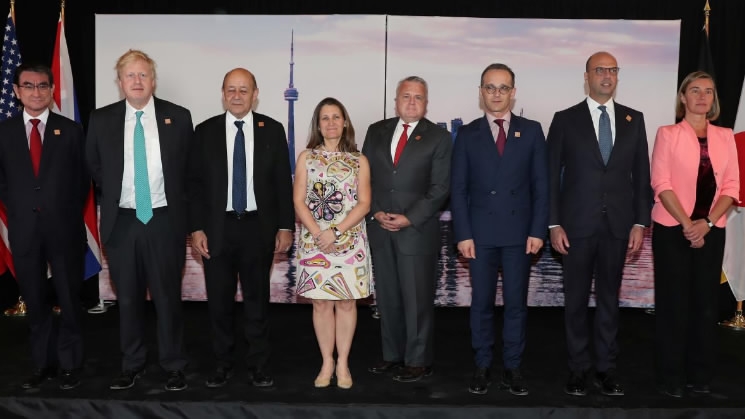
Canada's Minister of Foreign Affairs Chrystia Freeland is joined by France's Minister of Europe and Foreign Affairs Jean-Yves Le Drian, US Acting Secretary of State John J. Sullivan, Britain's Foreign Secretary Boris Johnson, High Representative for the European Union's Foreign Affairs Federica Mogherini, Italy's Minister of Foreign Affairs Angelino Alfano, Japan's Minister of Foreign Affairs Taro Kono and Minister of Foreign Affairs for Germany Heiko Maas prior to a reception at the Royal Ontario Museum on the first day of the foreign ministers' meetings from G7 countries in Toronto, Ontario, Canada, April 22, 2018. /Reuters Photo
Canada's Minister of Foreign Affairs Chrystia Freeland is joined by France's Minister of Europe and Foreign Affairs Jean-Yves Le Drian, US Acting Secretary of State John J. Sullivan, Britain's Foreign Secretary Boris Johnson, High Representative for the European Union's Foreign Affairs Federica Mogherini, Italy's Minister of Foreign Affairs Angelino Alfano, Japan's Minister of Foreign Affairs Taro Kono and Minister of Foreign Affairs for Germany Heiko Maas prior to a reception at the Royal Ontario Museum on the first day of the foreign ministers' meetings from G7 countries in Toronto, Ontario, Canada, April 22, 2018. /Reuters Photo
The G7 last week condemned what it said was a Russian nerve agent attack in Britain. A senior official from one G7 nation said ministers were deeply worried about what the group saw as a pattern of Russia misbehavior going back years.
Russia denies any involvement in the nerve attack on British soil in March.
US President Donald Trump gave an ultimatum on Jan. 12 to the European powers, saying they must agree to “fix the terrible flaws” of the deal or he would refuse to extend the US sanctions relief on Iran that it calls for US sanctions will resume unless Trump again waives them on May 12.
Iran says its nuclear program is only for peaceful purposes. It has said it will stick to the accord as long as the other signatories respect it but will “shred” the deal if Washington pulls out.
Iranian President Hassan Rouhani said on April 21 that Iran’s atomic agency was ready with “expected and unexpected” reactions if the United States pulls out of the 2015 agreement.
“One of the things we are concerned about now is the (deal) and where that is headed,” British Foreign Secretary Boris Johnson said on the sidelines of the G7 meeting.
The ministers had “good discussions” on DPRK’s nuclear programs as Trump and DPRK's leader Kim Jong Un prepare to meet in late May or early June. Pyongyang said on April 21 that
it would suspend nuclear and missile tests and scrap its nuclear test site.
[Cover Photo: British Foreign Secretary Boris Johnson holds media availability during the G7 Foreign Minister meeting in Toronto, Ontario, April 23, 2018 /Reuters]
Source(s): Reuters

 ["china"]